

internal C¼C bonds in the copolymer produced by copolymerization of ethylene and
cyclopentene over the Phillips catalyst also suggested the transformation of Cr¼C
into Cr–C species as polymerization active sites during the polymerization stage, as
confirmed experimentally [95]. Espelid and Børve suggested that the adjacent
hydroxyl group might be responsible for the formation of a Cossee-type active
site. However, this proposal is questioned due to the fact that Phillips catalyst
calcined at higher temperature with much less surface residual hydroxyl groups
usually shows higher activity than that calcined at lower temperature. The
metallacyclic mechanism through a chromacyclopentane species was supported by
strong experimental evidence concerning the intermediacy of large metallacycles in
polyethylene chain growth, resulting in the selective trimerization of ethylene to
1-hexene [161]. It could be concluded that the metallacycle mechanism is most
probably responsible for the initiation of ethylene polymerization, especially for the
formation of the first polymer chain on each active site on the Phillips catalyst.
In the above-mentioned theoretical studies of the initiation mechanism for
Phillips catalysts, the spin state of the chromium center, which might play a very
important role in the formation of the first chromium–carbon chain, was not
considered. As discussed in Sect. 6.2, although formation of the chromacyclopentane species as the key intermediate of the metallacyclic mechanism is
prohibited by the much higher energy barrier on a single quintet surface, a transition
of the reaction to the adjacent triplet surface through an MECP could lower the
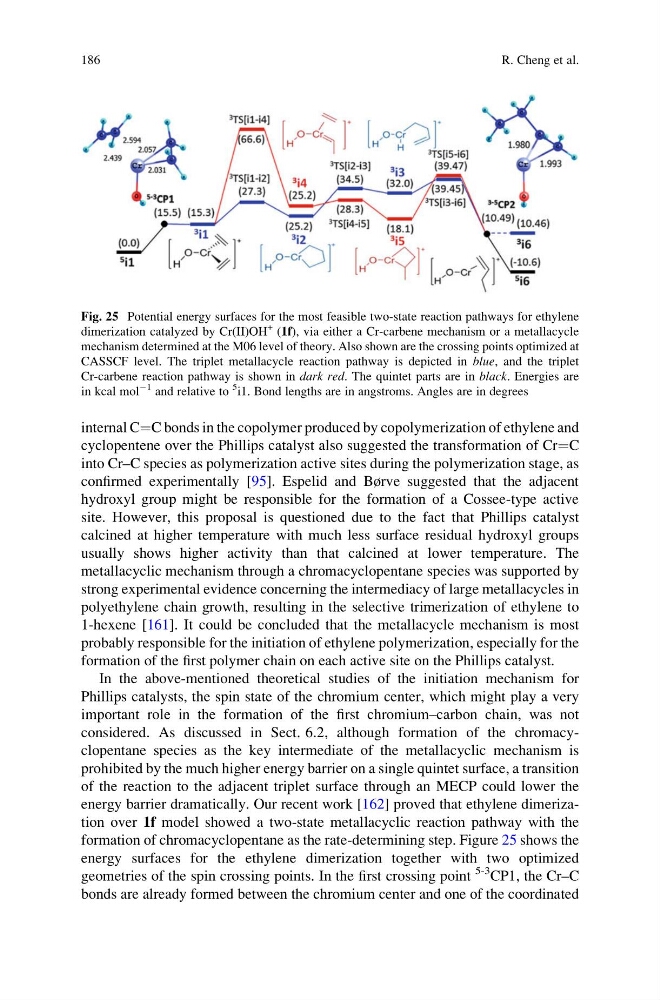
energy barrier dramatically. Our recent work [162] proved that ethylene dimerization over 1f model showed a two-state metallacyclic reaction pathway with the
formation of chromacyclopentane as the rate-determining step. Figure 25 shows the
energy surfaces for the ethylene dimerization together with two optimized
geometries of the spin crossing points. In the first crossing point
5-3 CP1, the Cr–C
bonds are already formed between the chromium center and one of the coordinated
Fig. 25 Potential energy surfaces for the most feasible two-state reaction pathways for ethylene
dimerization catalyzed by Cr(II)OH
+ (1f), via either a Cr-carbene mechanism or a metallacycle
mechanism determined at the M06 level of theory. Also shown are the crossing points optimized at
CASSCF level. The triplet metallacycle reaction pathway is depicted in blue, and the triplet
Cr-carbene reaction pathway is shown in dark red. The quintet parts are in black. Energies are
in kcal mol
À1 and relative to
5
i1. Bond lengths are in angstroms. Angles are in degrees
186
R. Cheng et al.
cyclopentene over the Phillips catalyst also suggested the transformation of Cr¼C
into Cr–C species as polymerization active sites during the polymerization stage, as
confirmed experimentally [95]. Espelid and Børve suggested that the adjacent
hydroxyl group might be responsible for the formation of a Cossee-type active
site. However, this proposal is questioned due to the fact that Phillips catalyst
calcined at higher temperature with much less surface residual hydroxyl groups
usually shows higher activity than that calcined at lower temperature. The
metallacyclic mechanism through a chromacyclopentane species was supported by
strong experimental evidence concerning the intermediacy of large metallacycles in
polyethylene chain growth, resulting in the selective trimerization of ethylene to
1-hexene [161]. It could be concluded that the metallacycle mechanism is most
probably responsible for the initiation of ethylene polymerization, especially for the
formation of the first polymer chain on each active site on the Phillips catalyst.
In the above-mentioned theoretical studies of the initiation mechanism for
Phillips catalysts, the spin state of the chromium center, which might play a very
important role in the formation of the first chromium–carbon chain, was not
considered. As discussed in Sect. 6.2, although formation of the chromacyclopentane species as the key intermediate of the metallacyclic mechanism is
prohibited by the much higher energy barrier on a single quintet surface, a transition
of the reaction to the adjacent triplet surface through an MECP could lower the
energy barrier dramatically. Our recent work [162] proved that ethylene dimerization over 1f model showed a two-state metallacyclic reaction pathway with the
formation of chromacyclopentane as the rate-determining step. Figure 25 shows the
energy surfaces for the ethylene dimerization together with two optimized
geometries of the spin crossing points. In the first crossing point
5-3 CP1, the Cr–C
bonds are already formed between the chromium center and one of the coordinated
Fig. 25 Potential energy surfaces for the most feasible two-state reaction pathways for ethylene
dimerization catalyzed by Cr(II)OH
+ (1f), via either a Cr-carbene mechanism or a metallacycle
mechanism determined at the M06 level of theory. Also shown are the crossing points optimized at
CASSCF level. The triplet metallacycle reaction pathway is depicted in blue, and the triplet
Cr-carbene reaction pathway is shown in dark red. The quintet parts are in black. Energies are
in kcal mol
À1 and relative to
5
i1. Bond lengths are in angstroms. Angles are in degrees
186
R. Cheng et al.