

6.3 Polymerization Mechanisms and the First Cr–C Bond
Formation
Phillips catalysts initiating ethylene polymerization without using any organometallic cocatalyst brings us a long standing question: how is the first polyethylene
chain initiated on the naked chromium site? That is to say, the initiation mechanism
of ethylene polymerization in terms of the formation of the first polymer chain over
the active site on a Phillips catalyst is the key problem awaiting elucidation. In the
literature, three typical mechanisms, as previously shown in Scheme 2, have been
proposed for ethylene polymerization over a Phillips catalyst: (1) the formation of an
acyclic Cr–C or Cr–H bond followed by chain propagation through the classic
Cossee–Arlman mechanism; (2) the formation of Cr¼C (Cr-carbene) bond followed
by chain propagation through the Green–Rooney mechanism; and (3) the formation
of metallacycle in which both ends of the alkyl group are attached to the chromium
site, followed by chain propagation through the metallacycle mechanism.
Espelid and Børve [120] first studied different routes of initiation and chain
propagation mechanisms for ethylene polymerization over the Phillips catalyst
using the cluster models 3g–10g, and the six-membered chromasiloxane ring 4g
was regarded as one of the most plausible active Cr species. The potential catalytic
activities of monomeric and dimeric chromium species on the silica surface were
also evaluated [146, 147]. Starting from a Cr-cyclopropane, Espelid and Børve
compared three different initiation mechanisms including the formation of the
acyclic ethenylhydridochromium species, the ethylidenechromium species, and
the cyclic chromacyclopentane species [120]. The calculations showed that initiation through a direct Cr–carbene formation could be safely excluded, while a
metallacycle pathway exhibited a much lower energy barrier. Meanwhile, Schmid
and Ziegler [153] found that a cationic Cr–C species could be generated by protonation of the Cr¼C (Cr-carbene), which showed a lower energy barrier for chain
propagation compared with that through Cr-carbene propagation. The absence of
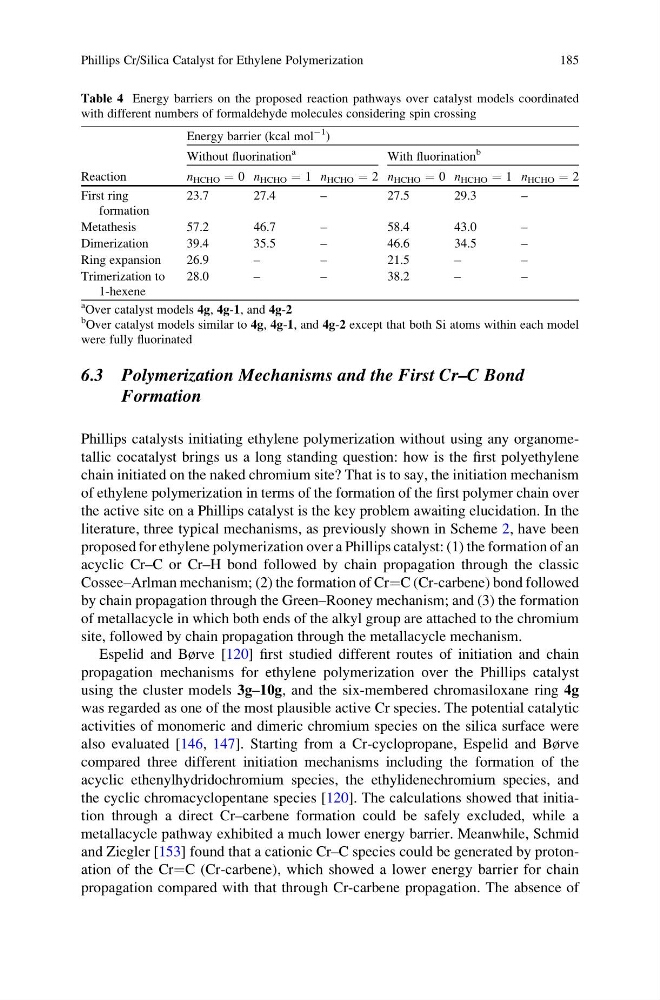
Table 4 Energy barriers on the proposed reaction pathways over catalyst models coordinated
with different numbers of formaldehyde molecules considering spin crossing
Reaction
Energy barrier (kcal mol
À1
)
Without fluorination
a
With fluorination
b
n HCHO ¼ 0 n HCHO ¼ 1 n HCHO ¼ 2 n HCHO ¼ 0 n HCHO ¼ 1 n HCHO ¼ 2
First ring
formation
23.7
27.4
–
27.5
29.3
–
Metathesis
57.2
46.7
–
58.4
43.0
–
Dimerization
39.4
35.5
–
46.6
34.5
–
Ring expansion
26.9
–
–
21.5
–
–
Trimerization to
1-hexene
28.0
–
–
38.2
–
–
a
Over catalyst models 4g, 4g-1, and 4g-2
b
Over catalyst models similar to 4g, 4g-1, and 4g-2 except that both Si atoms within each model
were fully fluorinated
Phillips Cr/Silica Catalyst for Ethylene Polymerization
185
Formation
Phillips catalysts initiating ethylene polymerization without using any organometallic cocatalyst brings us a long standing question: how is the first polyethylene
chain initiated on the naked chromium site? That is to say, the initiation mechanism
of ethylene polymerization in terms of the formation of the first polymer chain over
the active site on a Phillips catalyst is the key problem awaiting elucidation. In the
literature, three typical mechanisms, as previously shown in Scheme 2, have been
proposed for ethylene polymerization over a Phillips catalyst: (1) the formation of an
acyclic Cr–C or Cr–H bond followed by chain propagation through the classic
Cossee–Arlman mechanism; (2) the formation of Cr¼C (Cr-carbene) bond followed
by chain propagation through the Green–Rooney mechanism; and (3) the formation
of metallacycle in which both ends of the alkyl group are attached to the chromium
site, followed by chain propagation through the metallacycle mechanism.
Espelid and Børve [120] first studied different routes of initiation and chain
propagation mechanisms for ethylene polymerization over the Phillips catalyst
using the cluster models 3g–10g, and the six-membered chromasiloxane ring 4g
was regarded as one of the most plausible active Cr species. The potential catalytic
activities of monomeric and dimeric chromium species on the silica surface were
also evaluated [146, 147]. Starting from a Cr-cyclopropane, Espelid and Børve
compared three different initiation mechanisms including the formation of the
acyclic ethenylhydridochromium species, the ethylidenechromium species, and
the cyclic chromacyclopentane species [120]. The calculations showed that initiation through a direct Cr–carbene formation could be safely excluded, while a
metallacycle pathway exhibited a much lower energy barrier. Meanwhile, Schmid
and Ziegler [153] found that a cationic Cr–C species could be generated by protonation of the Cr¼C (Cr-carbene), which showed a lower energy barrier for chain
propagation compared with that through Cr-carbene propagation. The absence of
Table 4 Energy barriers on the proposed reaction pathways over catalyst models coordinated
with different numbers of formaldehyde molecules considering spin crossing
Reaction
Energy barrier (kcal mol
À1
)
Without fluorination
a
With fluorination
b
n HCHO ¼ 0 n HCHO ¼ 1 n HCHO ¼ 2 n HCHO ¼ 0 n HCHO ¼ 1 n HCHO ¼ 2
First ring
formation
23.7
27.4
–
27.5
29.3
–
Metathesis
57.2
46.7
–
58.4
43.0
–
Dimerization
39.4
35.5
–
46.6
34.5
–
Ring expansion
26.9
–
–
21.5
–
–
Trimerization to
1-hexene
28.0
–
–
38.2
–
–
a
Over catalyst models 4g, 4g-1, and 4g-2
b
Over catalyst models similar to 4g, 4g-1, and 4g-2 except that both Si atoms within each model
were fully fluorinated
Phillips Cr/Silica Catalyst for Ethylene Polymerization
185