

ethylene molecules, with two Cr–C bonds of 2.057 and 2.031 A ˚ . After the first spinflipping to the triplet surface, the metallacycle reaction pathway was found to be
more favorable than the Cr-carbene reaction pathway. 1-Butene was formed from
the chromacyclopentane by a two-step reductive elimination pathway through a
chromium(IV) hydride intermediate. Therefore, the initiation reaction of the ethylene polymerization could not proceed on a single quintet surface, but a spin-flipping
to an adjacent triplet surface facilitated the formation of the first Cr–C bond at the
crossing point of the two adjacent potential energy surfaces.
6.4 Polymerization Mechanisms for the Ti-Modified Phillips
Catalyst
As an important industrial catalyst, the Ti-modified Phillips catalyst is widely used
in ethylene polymerization. Recently, the mechanism of ethylene polymerization
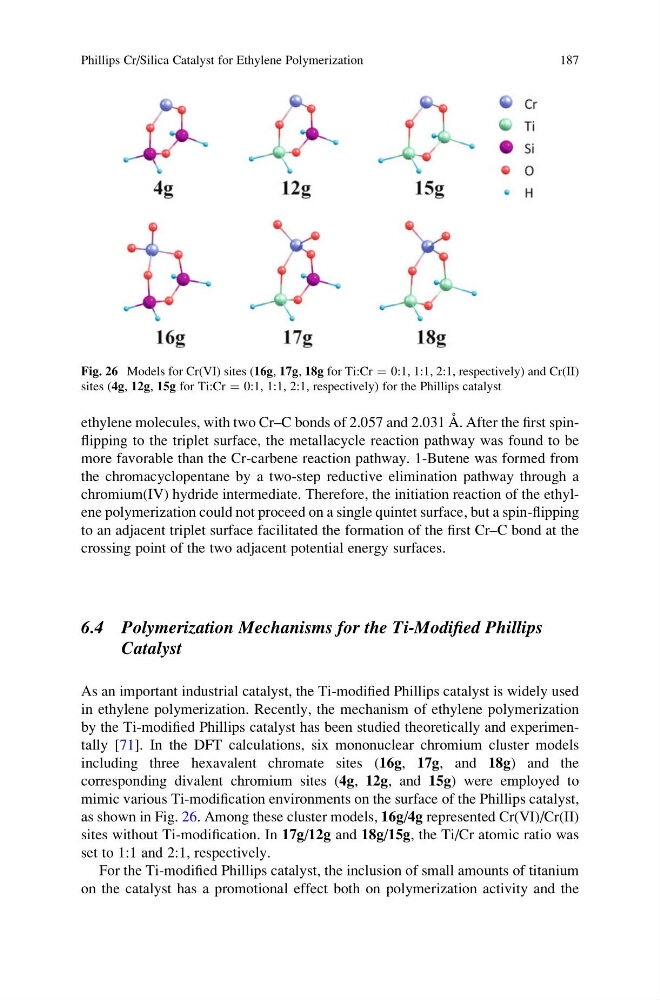
by the Ti-modified Phillips catalyst has been studied theoretically and experimentally [71]. In the DFT calculations, six mononuclear chromium cluster models
including three hexavalent chromate sites (16g, 17g, and 18g) and the
corresponding divalent chromium sites (4g, 12g, and 15g) were employed to
mimic various Ti-modification environments on the surface of the Phillips catalyst,
as shown in Fig. 26. Among these cluster models, 16g/4g represented Cr(VI)/Cr(II)
sites without Ti-modification. In 17g/12g and 18g/15g, the Ti/Cr atomic ratio was
set to 1:1 and 2:1, respectively.
For the Ti-modified Phillips catalyst, the inclusion of small amounts of titanium
on the catalyst has a promotional effect both on polymerization activity and the
Fig. 26 Models for Cr(VI) sites (16g, 17g, 18g for Ti:Cr ¼ 0:1, 1:1, 2:1, respectively) and Cr(II)
sites (4g, 12g, 15g for Ti:Cr ¼ 0:1, 1:1, 2:1, respectively) for the Phillips catalyst
Phillips Cr/Silica Catalyst for Ethylene Polymerization
187
more favorable than the Cr-carbene reaction pathway. 1-Butene was formed from
the chromacyclopentane by a two-step reductive elimination pathway through a
chromium(IV) hydride intermediate. Therefore, the initiation reaction of the ethylene polymerization could not proceed on a single quintet surface, but a spin-flipping
to an adjacent triplet surface facilitated the formation of the first Cr–C bond at the
crossing point of the two adjacent potential energy surfaces.
6.4 Polymerization Mechanisms for the Ti-Modified Phillips
Catalyst
As an important industrial catalyst, the Ti-modified Phillips catalyst is widely used
in ethylene polymerization. Recently, the mechanism of ethylene polymerization
by the Ti-modified Phillips catalyst has been studied theoretically and experimentally [71]. In the DFT calculations, six mononuclear chromium cluster models
including three hexavalent chromate sites (16g, 17g, and 18g) and the
corresponding divalent chromium sites (4g, 12g, and 15g) were employed to
mimic various Ti-modification environments on the surface of the Phillips catalyst,
as shown in Fig. 26. Among these cluster models, 16g/4g represented Cr(VI)/Cr(II)
sites without Ti-modification. In 17g/12g and 18g/15g, the Ti/Cr atomic ratio was
set to 1:1 and 2:1, respectively.
For the Ti-modified Phillips catalyst, the inclusion of small amounts of titanium
on the catalyst has a promotional effect both on polymerization activity and the
Fig. 26 Models for Cr(VI) sites (16g, 17g, 18g for Ti:Cr ¼ 0:1, 1:1, 2:1, respectively) and Cr(II)
sites (4g, 12g, 15g for Ti:Cr ¼ 0:1, 1:1, 2:1, respectively) for the Phillips catalyst
Phillips Cr/Silica Catalyst for Ethylene Polymerization
187