

this equilibrium is located completely at the right-hand side. These constants
were determined by means of
13 C NMR spectroscopy and quantitative line shape
analysis [15].
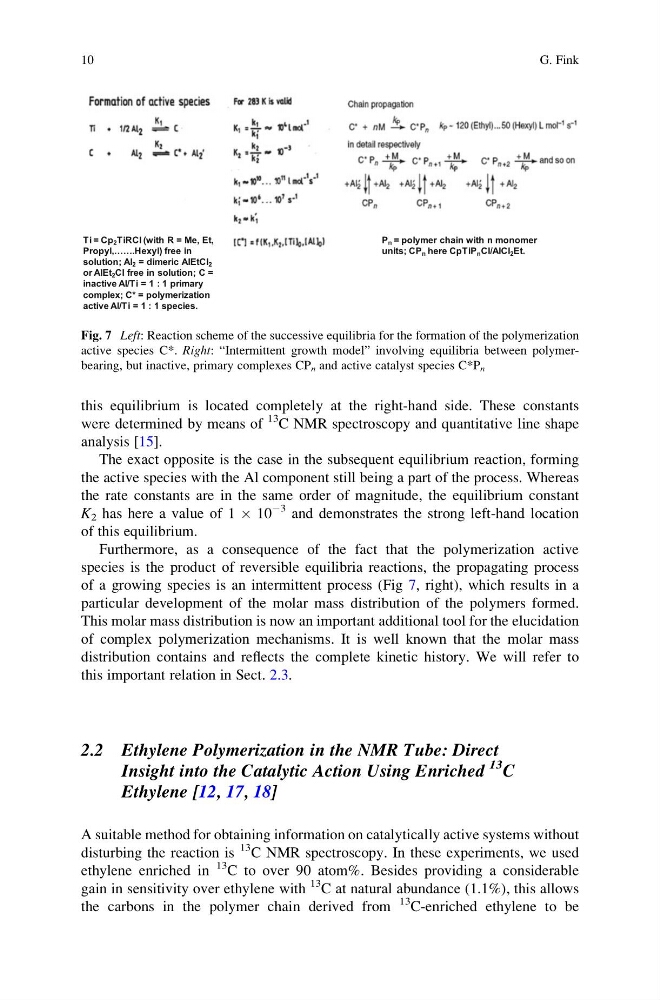
The exact opposite is the case in the subsequent equilibrium reaction, forming
the active species with the Al component still being a part of the process. Whereas
the rate constants are in the same order of magnitude, the equilibrium constant
K 2 has here a value of 1 Â 10
À3 and demonstrates the strong left-hand location
of this equilibrium.
Furthermore, as a consequence of the fact that the polymerization active
species is the product of reversible equilibria reactions, the propagating process
of a growing species is an intermittent process (Fig 7, right), which results in a
particular development of the molar mass distribution of the polymers formed.
This molar mass distribution is now an important additional tool for the elucidation
of complex polymerization mechanisms. It is well known that the molar mass
distribution contains and reflects the complete kinetic history. We will refer to
this important relation in Sect. 2.3.
2.2 Ethylene Polymerization in the NMR Tube: Direct
Insight into the Catalytic Action Using Enriched
13
C
Ethylene [12, 17, 18]
A suitable method for obtaining information on catalytically active systems without
disturbing the reaction is
13 C NMR spectroscopy. In these experiments, we used
ethylene enriched in
13 C to over 90 atom%. Besides providing a considerable
gain in sensitivity over ethylene with
13 C at natural abundance (1.1%), this allows
the carbons in the polymer chain derived from
13 C-enriched ethylene to be
Ti = Cp 2 TiRCl (with R = Me, Et,
Propyl,…….Hexyl) free in
solution; Al 2 = dimeric AlEtCl 2
or AlEt 2 Cl free in solution; C =
inactive Al/Ti = 1 : 1 primary
complex; C* = polymerization
active Al/Ti = 1 : 1 species.
P n = polymer chain with n monomer
units; CP n here CpTiP n Cl/AlCl 2 Et.
Fig. 7 Left: Reaction scheme of the successive equilibria for the formation of the polymerization
active species C*. Right: “Intermittent growth model” involving equilibria between polymerbearing, but inactive, primary complexes CP n and active catalyst species C*P n
10
G. Fink
were determined by means of
13 C NMR spectroscopy and quantitative line shape
analysis [15].
The exact opposite is the case in the subsequent equilibrium reaction, forming
the active species with the Al component still being a part of the process. Whereas
the rate constants are in the same order of magnitude, the equilibrium constant
K 2 has here a value of 1 Â 10
À3 and demonstrates the strong left-hand location
of this equilibrium.
Furthermore, as a consequence of the fact that the polymerization active
species is the product of reversible equilibria reactions, the propagating process
of a growing species is an intermittent process (Fig 7, right), which results in a
particular development of the molar mass distribution of the polymers formed.
This molar mass distribution is now an important additional tool for the elucidation
of complex polymerization mechanisms. It is well known that the molar mass
distribution contains and reflects the complete kinetic history. We will refer to
this important relation in Sect. 2.3.
2.2 Ethylene Polymerization in the NMR Tube: Direct
Insight into the Catalytic Action Using Enriched
13
C
Ethylene [12, 17, 18]
A suitable method for obtaining information on catalytically active systems without
disturbing the reaction is
13 C NMR spectroscopy. In these experiments, we used
ethylene enriched in
13 C to over 90 atom%. Besides providing a considerable
gain in sensitivity over ethylene with
13 C at natural abundance (1.1%), this allows
the carbons in the polymer chain derived from
13 C-enriched ethylene to be
Ti = Cp 2 TiRCl (with R = Me, Et,
Propyl,…….Hexyl) free in
solution; Al 2 = dimeric AlEtCl 2
or AlEt 2 Cl free in solution; C =
inactive Al/Ti = 1 : 1 primary
complex; C* = polymerization
active Al/Ti = 1 : 1 species.
P n = polymer chain with n monomer
units; CP n here CpTiP n Cl/AlCl 2 Et.
Fig. 7 Left: Reaction scheme of the successive equilibria for the formation of the polymerization
active species C*. Right: “Intermittent growth model” involving equilibria between polymerbearing, but inactive, primary complexes CP n and active catalyst species C*P n
10
G. Fink