

with a MWD of 2–4 for its PE products [128]. Theopold and coworkers [121,
129–131] reported a series of cationic alkyl Cr(III) catalysts for ethylene polymerization and claimed that these catalysts bearing β-diiminates ligand could mimic the
hard coordination environment of the silica surface and thus could be taken as
models of the Phillips catalyst (model 8f shows one example). However, these
catalysts showed ethylene living polymerization behavior, which was far from the
character of the Phillips catalyst. It is still a great challenge to find ideal homogeneous model catalyst systems to mimic the polymerization behaviors of the industrial Phillips catalyst.
Recently, a novel homogeneous triphenylsiloxy complex of chromium(II) model
catalyst [(Ph 3 SiO)Cr · (THF)] 2 (μ-OSiPh 3 ) 2 (model 9f) was successfully
synthesized and structurally characterized. Its ethylene polymerization performance
was systematically investigated in a comparison with that of BC (model 3f)
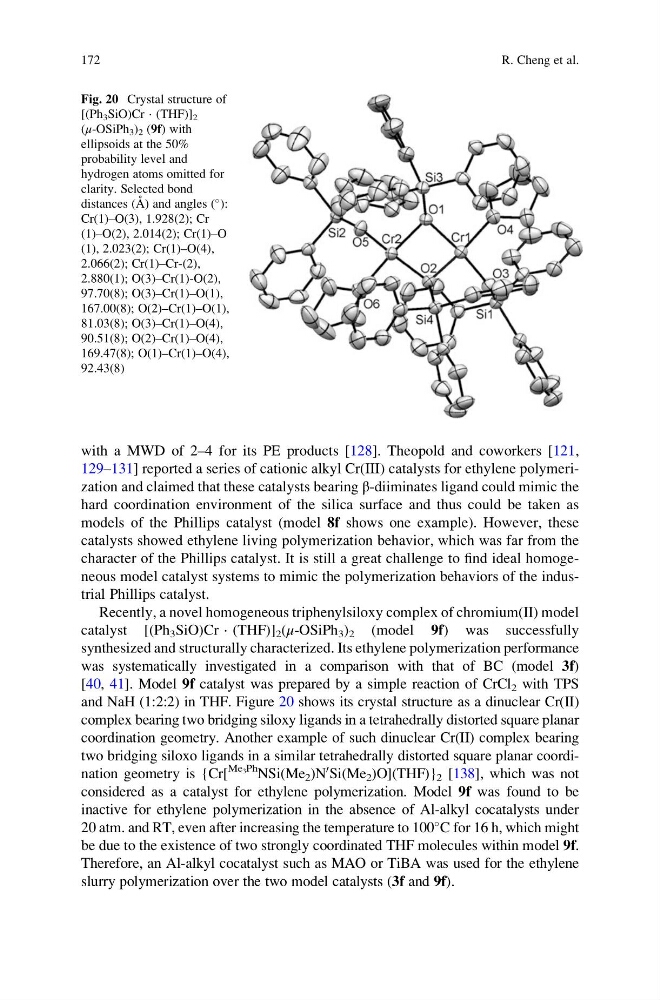
[40, 41]. Model 9f catalyst was prepared by a simple reaction of CrCl 2 with TPS
and NaH (1:2:2) in THF. Figure 20 shows its crystal structure as a dinuclear Cr(II)
complex bearing two bridging siloxy ligands in a tetrahedrally distorted square planar
coordination geometry. Another example of such dinuclear Cr(II) complex bearing
two bridging siloxo ligands in a similar tetrahedrally distorted square planar coordination geometry is {Cr[
Me 3 Ph
NSi(Me 2 )N
0 Si(Me 2 )O](THF)} 2 [138], which was not
considered as a catalyst for ethylene polymerization. Model 9f was found to be
inactive for ethylene polymerization in the absence of Al-alkyl cocatalysts under
20 atm. and RT, even after increasing the temperature to 100
C for 16 h, which might
be due to the existence of two strongly coordinated THF molecules within model 9f.
Therefore, an Al-alkyl cocatalyst such as MAO or TiBA was used for the ethylene
slurry polymerization over the two model catalysts (3f and 9f).
Fig. 20 Crystal structure of
[(Ph 3 SiO)Cr · (THF)] 2
(μ-OSiPh 3 ) 2 (9f) with
ellipsoids at the 50%
probability level and
hydrogen atoms omitted for
clarity. Selected bond
distances (A ˚ ) and angles (
):
Cr(1)–O(3), 1.928(2); Cr
(1)–O(2), 2.014(2); Cr(1)–O
(1), 2.023(2); Cr(1)–O(4),
2.066(2); Cr(1)–Cr-(2),
2.880(1); O(3)–Cr(1)-O(2),
97.70(8); O(3)–Cr(1)–O(1),
167.00(8); O(2)–Cr(1)–O(1),
81.03(8); O(3)–Cr(1)–O(4),
90.51(8); O(2)–Cr(1)–O(4),
169.47(8); O(1)–Cr(1)–O(4),
92.43(8)
172
R. Cheng et al.
129–131] reported a series of cationic alkyl Cr(III) catalysts for ethylene polymerization and claimed that these catalysts bearing β-diiminates ligand could mimic the
hard coordination environment of the silica surface and thus could be taken as
models of the Phillips catalyst (model 8f shows one example). However, these
catalysts showed ethylene living polymerization behavior, which was far from the
character of the Phillips catalyst. It is still a great challenge to find ideal homogeneous model catalyst systems to mimic the polymerization behaviors of the industrial Phillips catalyst.
Recently, a novel homogeneous triphenylsiloxy complex of chromium(II) model
catalyst [(Ph 3 SiO)Cr · (THF)] 2 (μ-OSiPh 3 ) 2 (model 9f) was successfully
synthesized and structurally characterized. Its ethylene polymerization performance
was systematically investigated in a comparison with that of BC (model 3f)
[40, 41]. Model 9f catalyst was prepared by a simple reaction of CrCl 2 with TPS
and NaH (1:2:2) in THF. Figure 20 shows its crystal structure as a dinuclear Cr(II)
complex bearing two bridging siloxy ligands in a tetrahedrally distorted square planar
coordination geometry. Another example of such dinuclear Cr(II) complex bearing
two bridging siloxo ligands in a similar tetrahedrally distorted square planar coordination geometry is {Cr[
Me 3 Ph
NSi(Me 2 )N
0 Si(Me 2 )O](THF)} 2 [138], which was not
considered as a catalyst for ethylene polymerization. Model 9f was found to be
inactive for ethylene polymerization in the absence of Al-alkyl cocatalysts under
20 atm. and RT, even after increasing the temperature to 100
C for 16 h, which might
be due to the existence of two strongly coordinated THF molecules within model 9f.
Therefore, an Al-alkyl cocatalyst such as MAO or TiBA was used for the ethylene
slurry polymerization over the two model catalysts (3f and 9f).
Fig. 20 Crystal structure of
[(Ph 3 SiO)Cr · (THF)] 2
(μ-OSiPh 3 ) 2 (9f) with
ellipsoids at the 50%
probability level and
hydrogen atoms omitted for
clarity. Selected bond
distances (A ˚ ) and angles (
):
Cr(1)–O(3), 1.928(2); Cr
(1)–O(2), 2.014(2); Cr(1)–O
(1), 2.023(2); Cr(1)–O(4),
2.066(2); Cr(1)–Cr-(2),
2.880(1); O(3)–Cr(1)-O(2),
97.70(8); O(3)–Cr(1)–O(1),
167.00(8); O(2)–Cr(1)–O(1),
81.03(8); O(3)–Cr(1)–O(4),
90.51(8); O(2)–Cr(1)–O(4),
169.47(8); O(1)–Cr(1)–O(4),
92.43(8)
172
R. Cheng et al.