

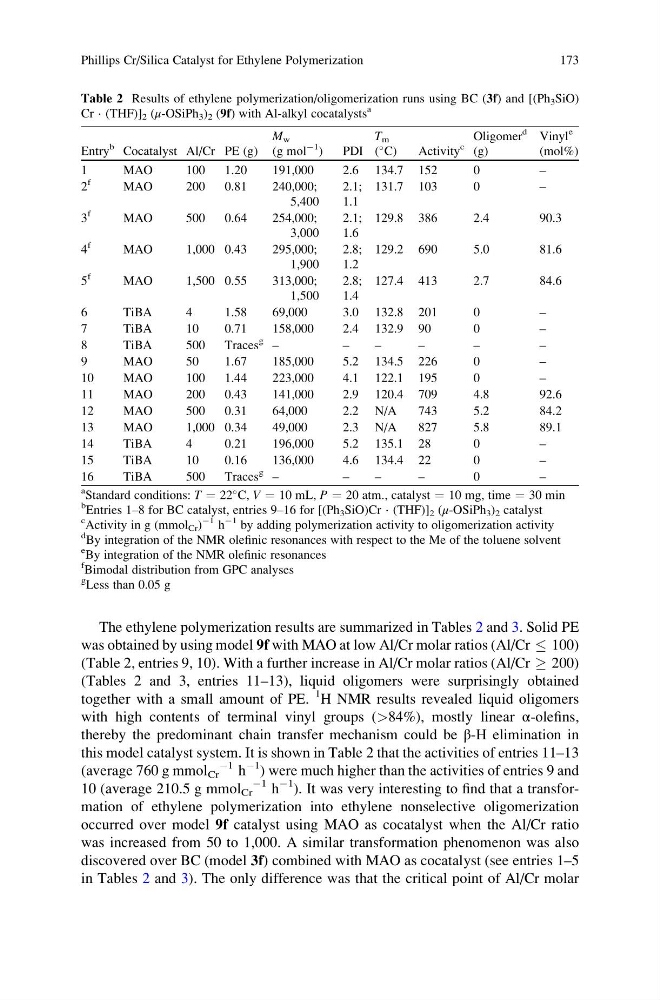
The ethylene polymerization results are summarized in Tables 2 and 3. Solid PE
was obtained by using model 9f with MAO at low Al/Cr molar ratios (Al/Cr 100)
(Table 2, entries 9, 10). With a further increase in Al/Cr molar ratios (Al/Cr ! 200)
(Tables 2 and 3, entries 11–13), liquid oligomers were surprisingly obtained
together with a small amount of PE.
1 H NMR results revealed liquid oligomers
with high contents of terminal vinyl groups (>84%), mostly linear α-olefins,
thereby the predominant chain transfer mechanism could be β-H elimination in
this model catalyst system. It is shown in Table 2 that the activities of entries 11–13
(average 760 g mmol Cr
À1 h
À1 ) were much higher than the activities of entries 9 and
10 (average 210.5 g mmol Cr
À1 h
À1 ). It was very interesting to find that a transformation of ethylene polymerization into ethylene nonselective oligomerization
occurred over model 9f catalyst using MAO as cocatalyst when the Al/Cr ratio
was increased from 50 to 1,000. A similar transformation phenomenon was also
discovered over BC (model 3f) combined with MAO as cocatalyst (see entries 1–5
in Tables 2 and 3). The only difference was that the critical point of Al/Cr molar
Table 2 Results of ethylene polymerization/oligomerization runs using BC (3f) and [(Ph 3 SiO)
Cr · (THF)] 2 (μ-OSiPh 3 ) 2 (9f) with Al-alkyl cocatalysts
a
Entry
b Cocatalyst Al/Cr PE (g)
M w
(g mol
À1
)
PDI
T m
(
C)
Activity
c
Oligomer
d
(g)
Vinyl
e
(mol%)
1
MAO
100
1.20
191,000
2.6 134.7 152
0
–
2
f
MAO
200
0.81
240,000;
5,400
2.1;
1.1
131.7 103
0
–
3
f
MAO
500
0.64
254,000;
3,000
2.1;
1.6
129.8 386
2.4
90.3
4
f
MAO
1,000 0.43
295,000;
1,900
2.8;
1.2
129.2 690
5.0
81.6
5
f
MAO
1,500 0.55
313,000;
1,500
2.8;
1.4
127.4 413
2.7
84.6
6
TiBA
4
1.58
69,000
3.0 132.8 201
0
–
7
TiBA
10
0.71
158,000
2.4 132.9 90
0
–
8
TiBA
500
Traces
g –
–
–
–
–
–
9
MAO
50
1.67
185,000
5.2 134.5 226
0
–
10
MAO
100
1.44
223,000
4.1 122.1 195
0
–
11
MAO
200
0.43
141,000
2.9 120.4 709
4.8
92.6
12
MAO
500
0.31
64,000
2.2 N/A
743
5.2
84.2
13
MAO
1,000 0.34
49,000
2.3 N/A
827
5.8
89.1
14
TiBA
4
0.21
196,000
5.2 135.1 28
0
–
15
TiBA
10
0.16
136,000
4.6 134.4 22
0
–
16
TiBA
500
Traces
g –
–
–
–
0
–
a
Standard conditions: T ¼ 22
C, V ¼ 10 mL, P ¼ 20 atm., catalyst ¼ 10 mg, time ¼ 30 min
b
Entries 1–8 for BC catalyst, entries 9–16 for [(Ph 3 SiO)Cr · (THF)] 2 (μ-OSiPh 3 ) 2 catalyst
c
Activity in g (mmol Cr )
À1 h
À1 by adding polymerization activity to oligomerization activity
d
By integration of the NMR olefinic resonances with respect to the Me of the toluene solvent
e
By integration of the NMR olefinic resonances
f
Bimodal distribution from GPC analyses
g
Less than 0.05 g
Phillips Cr/Silica Catalyst for Ethylene Polymerization
173
was obtained by using model 9f with MAO at low Al/Cr molar ratios (Al/Cr 100)
(Table 2, entries 9, 10). With a further increase in Al/Cr molar ratios (Al/Cr ! 200)
(Tables 2 and 3, entries 11–13), liquid oligomers were surprisingly obtained
together with a small amount of PE.
1 H NMR results revealed liquid oligomers
with high contents of terminal vinyl groups (>84%), mostly linear α-olefins,
thereby the predominant chain transfer mechanism could be β-H elimination in
this model catalyst system. It is shown in Table 2 that the activities of entries 11–13
(average 760 g mmol Cr
À1 h
À1 ) were much higher than the activities of entries 9 and
10 (average 210.5 g mmol Cr
À1 h
À1 ). It was very interesting to find that a transformation of ethylene polymerization into ethylene nonselective oligomerization
occurred over model 9f catalyst using MAO as cocatalyst when the Al/Cr ratio
was increased from 50 to 1,000. A similar transformation phenomenon was also
discovered over BC (model 3f) combined with MAO as cocatalyst (see entries 1–5
in Tables 2 and 3). The only difference was that the critical point of Al/Cr molar
Table 2 Results of ethylene polymerization/oligomerization runs using BC (3f) and [(Ph 3 SiO)
Cr · (THF)] 2 (μ-OSiPh 3 ) 2 (9f) with Al-alkyl cocatalysts
a
Entry
b Cocatalyst Al/Cr PE (g)
M w
(g mol
À1
)
PDI
T m
(
C)
Activity
c
Oligomer
d
(g)
Vinyl
e
(mol%)
1
MAO
100
1.20
191,000
2.6 134.7 152
0
–
2
f
MAO
200
0.81
240,000;
5,400
2.1;
1.1
131.7 103
0
–
3
f
MAO
500
0.64
254,000;
3,000
2.1;
1.6
129.8 386
2.4
90.3
4
f
MAO
1,000 0.43
295,000;
1,900
2.8;
1.2
129.2 690
5.0
81.6
5
f
MAO
1,500 0.55
313,000;
1,500
2.8;
1.4
127.4 413
2.7
84.6
6
TiBA
4
1.58
69,000
3.0 132.8 201
0
–
7
TiBA
10
0.71
158,000
2.4 132.9 90
0
–
8
TiBA
500
Traces
g –
–
–
–
–
–
9
MAO
50
1.67
185,000
5.2 134.5 226
0
–
10
MAO
100
1.44
223,000
4.1 122.1 195
0
–
11
MAO
200
0.43
141,000
2.9 120.4 709
4.8
92.6
12
MAO
500
0.31
64,000
2.2 N/A
743
5.2
84.2
13
MAO
1,000 0.34
49,000
2.3 N/A
827
5.8
89.1
14
TiBA
4
0.21
196,000
5.2 135.1 28
0
–
15
TiBA
10
0.16
136,000
4.6 134.4 22
0
–
16
TiBA
500
Traces
g –
–
–
–
0
–
a
Standard conditions: T ¼ 22
C, V ¼ 10 mL, P ¼ 20 atm., catalyst ¼ 10 mg, time ¼ 30 min
b
Entries 1–8 for BC catalyst, entries 9–16 for [(Ph 3 SiO)Cr · (THF)] 2 (μ-OSiPh 3 ) 2 catalyst
c
Activity in g (mmol Cr )
À1 h
À1 by adding polymerization activity to oligomerization activity
d
By integration of the NMR olefinic resonances with respect to the Me of the toluene solvent
e
By integration of the NMR olefinic resonances
f
Bimodal distribution from GPC analyses
g
Less than 0.05 g
Phillips Cr/Silica Catalyst for Ethylene Polymerization
173