

and ethylene pressures (!350 atm) in cyclohexane solution without adding any
cocatalyst. In our opinion, BC could be taken as a homogeneous model for the
Phillips catalyst and should be more extensively studied. A POSS-supported Cr
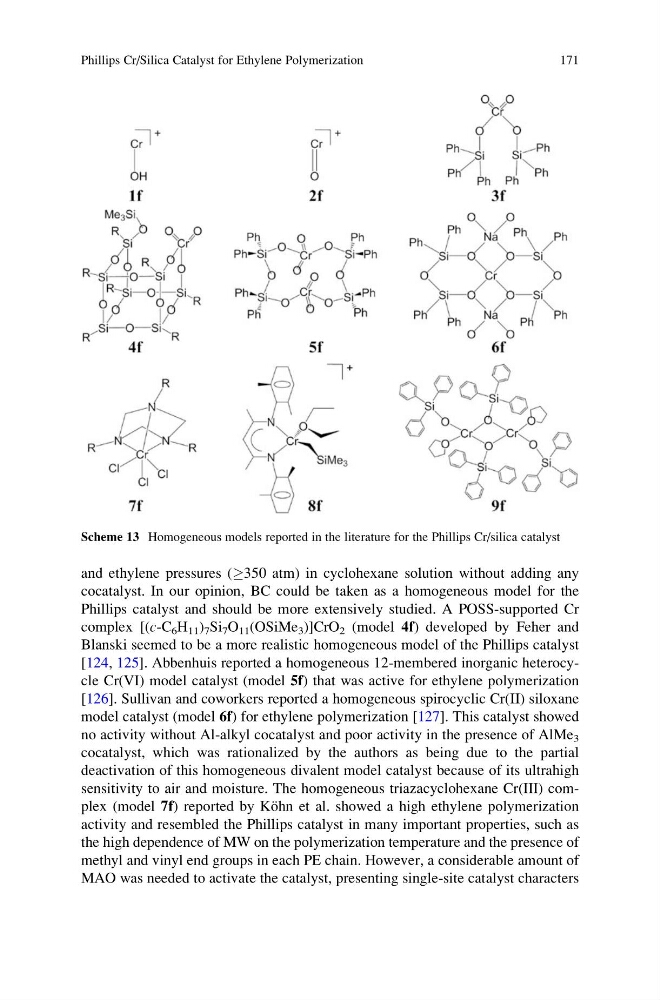
complex [(c-C 6 H 11 ) 7 Si 7 O 11 (OSiMe 3 )]CrO 2 (model 4f) developed by Feher and
Blanski seemed to be a more realistic homogeneous model of the Phillips catalyst
[124, 125]. Abbenhuis reported a homogeneous 12-membered inorganic heterocycle Cr(VI) model catalyst (model 5f) that was active for ethylene polymerization
[126]. Sullivan and coworkers reported a homogeneous spirocyclic Cr(II) siloxane
model catalyst (model 6f) for ethylene polymerization [127]. This catalyst showed
no activity without Al-alkyl cocatalyst and poor activity in the presence of AlMe 3
cocatalyst, which was rationalized by the authors as being due to the partial
deactivation of this homogeneous divalent model catalyst because of its ultrahigh
sensitivity to air and moisture. The homogeneous triazacyclohexane Cr(III) complex (model 7f) reported by Ko ¨hn et al. showed a high ethylene polymerization
activity and resembled the Phillips catalyst in many important properties, such as
the high dependence of MW on the polymerization temperature and the presence of
methyl and vinyl end groups in each PE chain. However, a considerable amount of
MAO was needed to activate the catalyst, presenting single-site catalyst characters
Scheme 13 Homogeneous models reported in the literature for the Phillips Cr/silica catalyst
Phillips Cr/Silica Catalyst for Ethylene Polymerization
171
cocatalyst. In our opinion, BC could be taken as a homogeneous model for the
Phillips catalyst and should be more extensively studied. A POSS-supported Cr
complex [(c-C 6 H 11 ) 7 Si 7 O 11 (OSiMe 3 )]CrO 2 (model 4f) developed by Feher and
Blanski seemed to be a more realistic homogeneous model of the Phillips catalyst
[124, 125]. Abbenhuis reported a homogeneous 12-membered inorganic heterocycle Cr(VI) model catalyst (model 5f) that was active for ethylene polymerization
[126]. Sullivan and coworkers reported a homogeneous spirocyclic Cr(II) siloxane
model catalyst (model 6f) for ethylene polymerization [127]. This catalyst showed
no activity without Al-alkyl cocatalyst and poor activity in the presence of AlMe 3
cocatalyst, which was rationalized by the authors as being due to the partial
deactivation of this homogeneous divalent model catalyst because of its ultrahigh
sensitivity to air and moisture. The homogeneous triazacyclohexane Cr(III) complex (model 7f) reported by Ko ¨hn et al. showed a high ethylene polymerization
activity and resembled the Phillips catalyst in many important properties, such as
the high dependence of MW on the polymerization temperature and the presence of
methyl and vinyl end groups in each PE chain. However, a considerable amount of
MAO was needed to activate the catalyst, presenting single-site catalyst characters
Scheme 13 Homogeneous models reported in the literature for the Phillips Cr/silica catalyst
Phillips Cr/Silica Catalyst for Ethylene Polymerization
171