

amorphous silica support as well as the fact that more than 99% of the active sites
exist within the micro- and mesopores in the inner surface of the silica support.
During the last few decades, various homogeneous model catalysts have been
developed in order to simplify such complexity of the traditional Phillips catalyst
originating from the silica support [121]. Some typical homogeneous model catalysts
are listed in Scheme 13, including the Cr(II)OH
+ and Cr(III)O
+ cations (models 1f
and 2f) [122, 123], bistriphenylsilyl chromate (BC) (model 3f) [111], a POSSsupported Cr catalyst (model 4f) [124, 125], siloxane chromate ester (model 5f)
[126], spirocyclic chromium(II) siloxane (model 6f) [127], 1,3,5-triazacyclohexane
complexes of chromium(III) (model 7f) [128], cationic alkyl complexes of chromium
(III) (model 8f) [121, 129–131], and [(Ph 3 SiO)Cr · (THF)] 2 (μ-OSiPh 3 ) 2 (model 9f)
[40, 41]. Some recently reported novel homogeneous Cr-based complexes based on
low-valence chromium species for ethylene polymerization or oligomerization, such
as imido, β-diketiminates and reduced Schiff base [N, O] chelate derivatives, which
are far from the character of the Phillips catalyst, will not be considered here
[132–137].
Hanmura et al. [122, 123] found two simple chromium cations Cr(II)OH
+ and
Cr(III)O
+ (models 1f and 2f) that could dimerize ethylene into 1-butene without
using any organometallic cocatalyst, and proposed that they could be treated as
simple homogenous cluster models for the Phillips catalyst. Baker and Carrick
[111] reported ethylene polymerization over BC (model 3f), a hexavalent chromate
compound bearing two triphenylsilyl ligands, at elevated temperatures (!130
C)
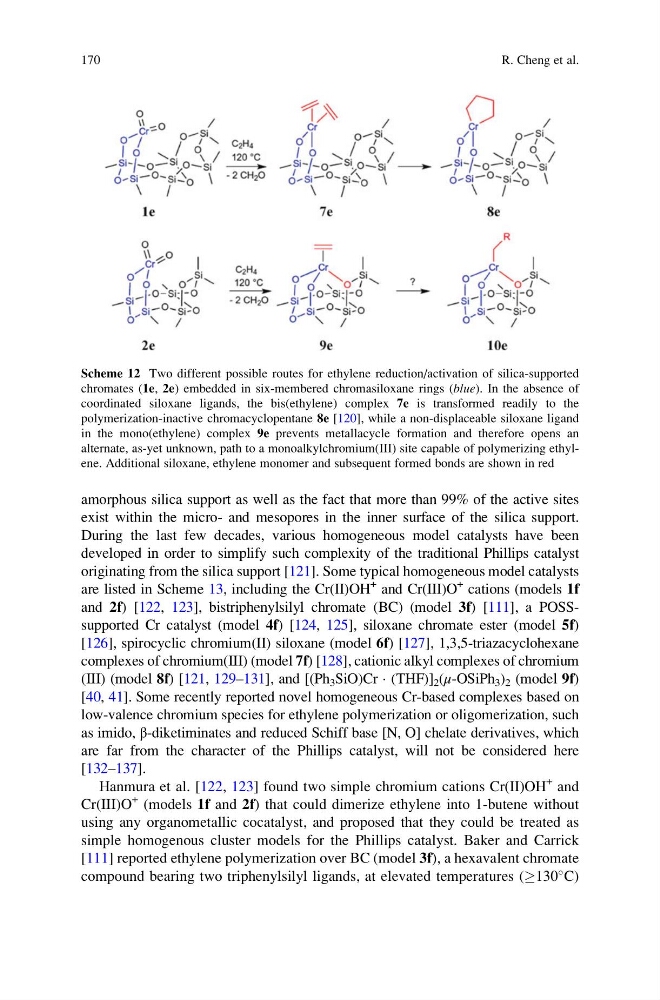
Scheme 12 Two different possible routes for ethylene reduction/activation of silica-supported
chromates (1e, 2e) embedded in six-membered chromasiloxane rings (blue). In the absence of
coordinated siloxane ligands, the bis(ethylene) complex 7e is transformed readily to the
polymerization-inactive chromacyclopentane 8e [120], while a non-displaceable siloxane ligand
in the mono(ethylene) complex 9e prevents metallacycle formation and therefore opens an
alternate, as-yet unknown, path to a monoalkylchromium(III) site capable of polymerizing ethylene. Additional siloxane, ethylene monomer and subsequent formed bonds are shown in red
170
R. Cheng et al.
exist within the micro- and mesopores in the inner surface of the silica support.
During the last few decades, various homogeneous model catalysts have been
developed in order to simplify such complexity of the traditional Phillips catalyst
originating from the silica support [121]. Some typical homogeneous model catalysts
are listed in Scheme 13, including the Cr(II)OH
+ and Cr(III)O
+ cations (models 1f
and 2f) [122, 123], bistriphenylsilyl chromate (BC) (model 3f) [111], a POSSsupported Cr catalyst (model 4f) [124, 125], siloxane chromate ester (model 5f)
[126], spirocyclic chromium(II) siloxane (model 6f) [127], 1,3,5-triazacyclohexane
complexes of chromium(III) (model 7f) [128], cationic alkyl complexes of chromium
(III) (model 8f) [121, 129–131], and [(Ph 3 SiO)Cr · (THF)] 2 (μ-OSiPh 3 ) 2 (model 9f)
[40, 41]. Some recently reported novel homogeneous Cr-based complexes based on
low-valence chromium species for ethylene polymerization or oligomerization, such
as imido, β-diketiminates and reduced Schiff base [N, O] chelate derivatives, which
are far from the character of the Phillips catalyst, will not be considered here
[132–137].
Hanmura et al. [122, 123] found two simple chromium cations Cr(II)OH
+ and
Cr(III)O
+ (models 1f and 2f) that could dimerize ethylene into 1-butene without
using any organometallic cocatalyst, and proposed that they could be treated as
simple homogenous cluster models for the Phillips catalyst. Baker and Carrick
[111] reported ethylene polymerization over BC (model 3f), a hexavalent chromate
compound bearing two triphenylsilyl ligands, at elevated temperatures (!130
C)
Scheme 12 Two different possible routes for ethylene reduction/activation of silica-supported
chromates (1e, 2e) embedded in six-membered chromasiloxane rings (blue). In the absence of
coordinated siloxane ligands, the bis(ethylene) complex 7e is transformed readily to the
polymerization-inactive chromacyclopentane 8e [120], while a non-displaceable siloxane ligand
in the mono(ethylene) complex 9e prevents metallacycle formation and therefore opens an
alternate, as-yet unknown, path to a monoalkylchromium(III) site capable of polymerizing ethylene. Additional siloxane, ethylene monomer and subsequent formed bonds are shown in red
170
R. Cheng et al.