

progress by our group via in-situ techniques in order to figure out the formation of
the first Cr–C bond and the initiation mechanism of ethylene polymerization. A step
forward in the interpretation of the nature of the active sites and polymerization
mechanisms (especially the initiation mechanism of the first polyethylene chain)
requires the combination of heterogeneous model catalyst systems with more
advanced and multiple characterization techniques, especially in-situ/operando
techniques as well as molecular modeling. The rational design and utilization of
new heterogeneous model Phillips catalysts is expected to allow further progress in
better understanding of the real and complex catalyst system.
5 Approaches Using Homogeneous Model Catalysts
In the previous section, investigations on heterogeneous model catalysts with more
uniform and well-defined structure of surface chromium species supported on silica
gel had been demonstrated as a powerful strategy for the basic study of Phillips
catalysts. However, the complexity is still derived from the heterogeneity of the
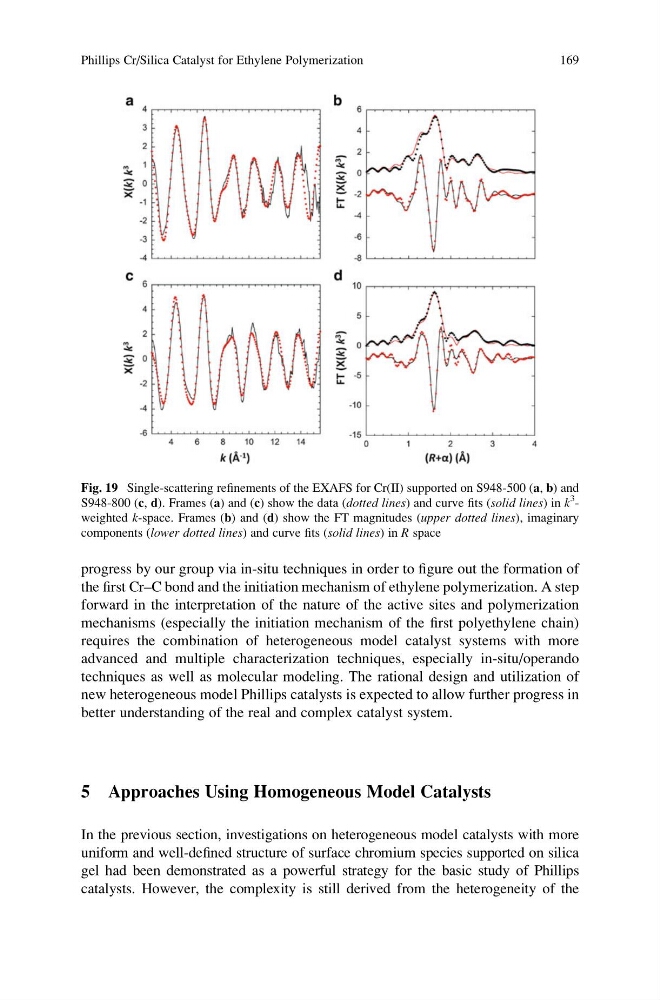
Fig. 19 Single-scattering refinements of the EXAFS for Cr(II) supported on S948-500 (a, b) and
S948-800 (c, d). Frames (a) and (c) show the data (dotted lines) and curve fits (solid lines) in k
3
-
weighted k-space. Frames (b) and (d) show the FT magnitudes (upper dotted lines), imaginary
components (lower dotted lines) and curve fits (solid lines) in R space
Phillips Cr/Silica Catalyst for Ethylene Polymerization
169
the first Cr–C bond and the initiation mechanism of ethylene polymerization. A step
forward in the interpretation of the nature of the active sites and polymerization
mechanisms (especially the initiation mechanism of the first polyethylene chain)
requires the combination of heterogeneous model catalyst systems with more
advanced and multiple characterization techniques, especially in-situ/operando
techniques as well as molecular modeling. The rational design and utilization of
new heterogeneous model Phillips catalysts is expected to allow further progress in
better understanding of the real and complex catalyst system.
5 Approaches Using Homogeneous Model Catalysts
In the previous section, investigations on heterogeneous model catalysts with more
uniform and well-defined structure of surface chromium species supported on silica
gel had been demonstrated as a powerful strategy for the basic study of Phillips
catalysts. However, the complexity is still derived from the heterogeneity of the
Fig. 19 Single-scattering refinements of the EXAFS for Cr(II) supported on S948-500 (a, b) and
S948-800 (c, d). Frames (a) and (c) show the data (dotted lines) and curve fits (solid lines) in k
3
-
weighted k-space. Frames (b) and (d) show the FT magnitudes (upper dotted lines), imaginary
components (lower dotted lines) and curve fits (solid lines) in R space
Phillips Cr/Silica Catalyst for Ethylene Polymerization
169