

could be reduced by ethylene and coordinated with formaldehyde to form Site-C1.
Secondly, DEAE needed a longer time for the conversion of metathesis active sites
into polymerization active sites. More α-olefin will be formed from metathesis
active sites to insert into the polymer chains. Thirdly, different Al-alkoxyl
byproducts of the reaction between TEA/DEAE and chromate species, subsequently
coordinated with the chromium active site, will also affect the incorporation rate of
α-olefin comonomers.
Ethylene homopolymerization or 1-hexene/ethylene copolymerization, using
Phillips catalyst PC600/CO calcined at 600
C treated with activation by CO at
350
C followed by TEA cocatalyst activation during the slurry polymerization
process, was carried out with Al/Cr molar ratios of 7.5, 15.0, and 22.5 [80,
110]. For this catalyst system, it was expected that N 2 could not remove all
adsorbed CO from the Cr(II) due to the similar electron characteristics of CO and
formaldehyde and due to the high coordinative unsaturation of the Cr(II) center.
According to XPS results (Fig. 4), it was found that almost one-third of the
chromate(VI) species still existed after the normal CO pre-reduction procedure.
Under these complex conditions, a hybrid-type polymerization kinetics
(corresponding to type a in Fig. 10a) was still found for both homo- and copolymerization, as shown in Fig. 15. One of the types with instant activation and fast
decay originated from the active site (Site-A in Scheme 8), formed through desorption of formaldehyde (Site-C1) or CO (Site-C2) from the Cr(II) site by TEA or
ethylene monomer. The other type with slow activation and slow decay was from
the Site-B, formed from the reduction of residual chromate(VI) species by TEA.
The formed Al-alkoxyl can strongly coordinate with the Cr(II) site and thus protect
the Cr(II) center from further over-reduction by TEA. The first peaks of the
copolymerization kinetic curves from Site-A became broader in comparison with
those of homopolymerization, suggesting either that the decay of Site-A became
slower in the presence of comonomer or that the transformation of metathesis
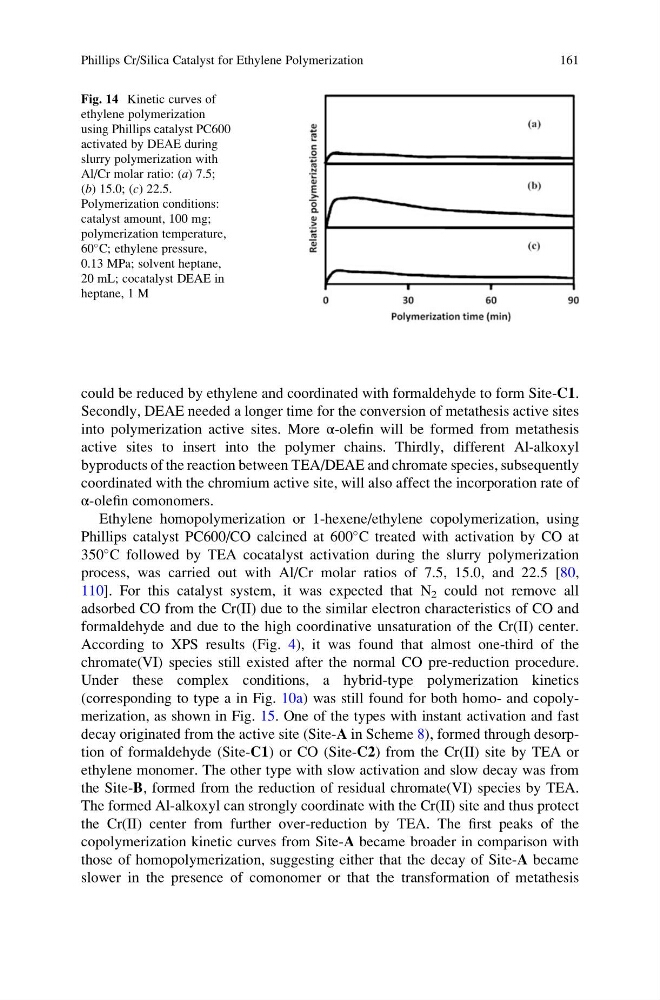
Fig. 14 Kinetic curves of
ethylene polymerization
using Phillips catalyst PC600
activated by DEAE during
slurry polymerization with
Al/Cr molar ratio: (a) 7.5;
(b) 15.0; (c) 22.5.
Polymerization conditions:
catalyst amount, 100 mg;
polymerization temperature,
60
C; ethylene pressure,
0.13 MPa; solvent heptane,
20 mL; cocatalyst DEAE in
heptane, 1 M
Phillips Cr/Silica Catalyst for Ethylene Polymerization
161
Secondly, DEAE needed a longer time for the conversion of metathesis active sites
into polymerization active sites. More α-olefin will be formed from metathesis
active sites to insert into the polymer chains. Thirdly, different Al-alkoxyl
byproducts of the reaction between TEA/DEAE and chromate species, subsequently
coordinated with the chromium active site, will also affect the incorporation rate of
α-olefin comonomers.
Ethylene homopolymerization or 1-hexene/ethylene copolymerization, using
Phillips catalyst PC600/CO calcined at 600
C treated with activation by CO at
350
C followed by TEA cocatalyst activation during the slurry polymerization
process, was carried out with Al/Cr molar ratios of 7.5, 15.0, and 22.5 [80,
110]. For this catalyst system, it was expected that N 2 could not remove all
adsorbed CO from the Cr(II) due to the similar electron characteristics of CO and
formaldehyde and due to the high coordinative unsaturation of the Cr(II) center.
According to XPS results (Fig. 4), it was found that almost one-third of the
chromate(VI) species still existed after the normal CO pre-reduction procedure.
Under these complex conditions, a hybrid-type polymerization kinetics
(corresponding to type a in Fig. 10a) was still found for both homo- and copolymerization, as shown in Fig. 15. One of the types with instant activation and fast
decay originated from the active site (Site-A in Scheme 8), formed through desorption of formaldehyde (Site-C1) or CO (Site-C2) from the Cr(II) site by TEA or
ethylene monomer. The other type with slow activation and slow decay was from
the Site-B, formed from the reduction of residual chromate(VI) species by TEA.
The formed Al-alkoxyl can strongly coordinate with the Cr(II) site and thus protect
the Cr(II) center from further over-reduction by TEA. The first peaks of the
copolymerization kinetic curves from Site-A became broader in comparison with
those of homopolymerization, suggesting either that the decay of Site-A became
slower in the presence of comonomer or that the transformation of metathesis
Fig. 14 Kinetic curves of
ethylene polymerization
using Phillips catalyst PC600
activated by DEAE during
slurry polymerization with
Al/Cr molar ratio: (a) 7.5;
(b) 15.0; (c) 22.5.
Polymerization conditions:
catalyst amount, 100 mg;
polymerization temperature,
60
C; ethylene pressure,
0.13 MPa; solvent heptane,
20 mL; cocatalyst DEAE in
heptane, 1 M
Phillips Cr/Silica Catalyst for Ethylene Polymerization
161