

homopolymers obtained from this catalyst system showing the signals of the
branching carbons of methyl, ethyl, and propyl. With increase in the Al/Cr molar
ratios in the polymerization, the relative amount of SCBs of polymers from the catalyst
system also decreased, because the competition between ethylene monomer and TEA
reduced the chromate Cr(VI) species into Cr(II) sites and accelerated the conversion of
metathesis active site-C1 to polymerization active Site-B with more TEA.
Ethylene homopolymerization using Phillips catalyst PC600 calcined at 600
C
followed by activation with DEAE cocatalyst during the slurry polymerization
process was carried out with Al/Cr molar ratios of 7.5, 15.0, and 22.5 [84]. As
shown in Fig. 14, a typical single-type polymerization kinetics corresponding to
type b in Fig. 10b was observed, which was completely different from the kinetics
with the same catalyst activated by TEA at the same conditions (as shown in
Fig. 13). This type of polymerization kinetics could be ascribed to one type of active
site (Site-B) formed in two ways. One was similar with the PC600 activated by TEA:
some chromate Cr(VI) species were reduced to Cr(II) species by ethylene monomer
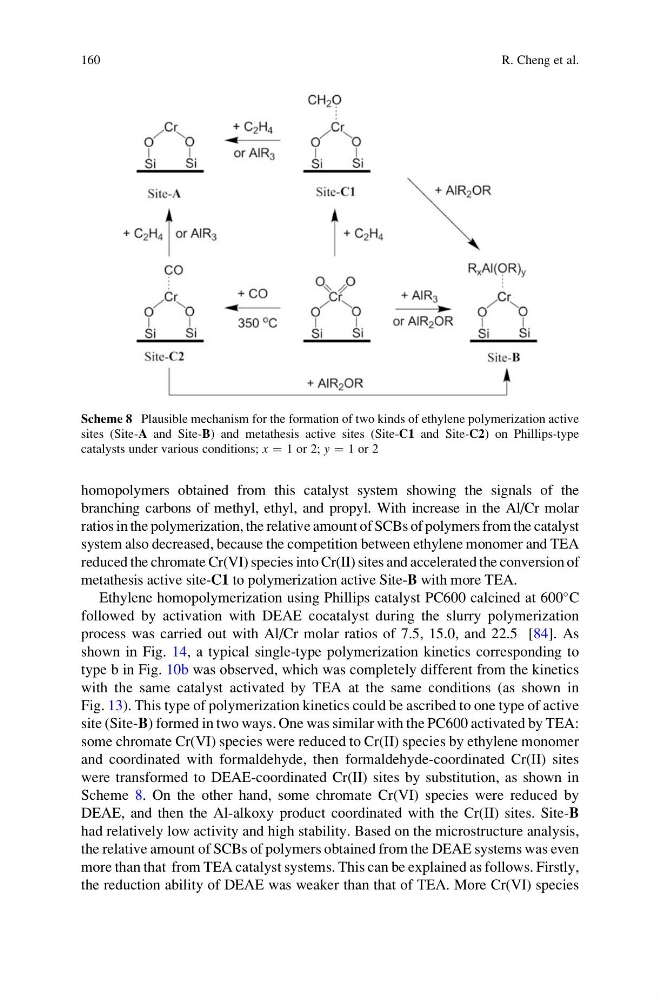
and coordinated with formaldehyde, then formaldehyde-coordinated Cr(II) sites
were transformed to DEAE-coordinated Cr(II) sites by substitution, as shown in
Scheme 8. On the other hand, some chromate Cr(VI) species were reduced by
DEAE, and then the Al-alkoxy product coordinated with the Cr(II) sites. Site-B
had relatively low activity and high stability. Based on the microstructure analysis,
the relative amount of SCBs of polymers obtained from the DEAE systems was even
more than that from TEA catalyst systems. This can be explained as follows. Firstly,
the reduction ability of DEAE was weaker than that of TEA. More Cr(VI) species
Scheme 8 Plausible mechanism for the formation of two kinds of ethylene polymerization active
sites (Site-A and Site-B) and metathesis active sites (Site-C1 and Site-C2) on Phillips-type
catalysts under various conditions; x ¼ 1 or 2; y ¼ 1 or 2
160
R. Cheng et al.
branching carbons of methyl, ethyl, and propyl. With increase in the Al/Cr molar
ratios in the polymerization, the relative amount of SCBs of polymers from the catalyst
system also decreased, because the competition between ethylene monomer and TEA
reduced the chromate Cr(VI) species into Cr(II) sites and accelerated the conversion of
metathesis active site-C1 to polymerization active Site-B with more TEA.
Ethylene homopolymerization using Phillips catalyst PC600 calcined at 600
C
followed by activation with DEAE cocatalyst during the slurry polymerization
process was carried out with Al/Cr molar ratios of 7.5, 15.0, and 22.5 [84]. As
shown in Fig. 14, a typical single-type polymerization kinetics corresponding to
type b in Fig. 10b was observed, which was completely different from the kinetics
with the same catalyst activated by TEA at the same conditions (as shown in
Fig. 13). This type of polymerization kinetics could be ascribed to one type of active
site (Site-B) formed in two ways. One was similar with the PC600 activated by TEA:
some chromate Cr(VI) species were reduced to Cr(II) species by ethylene monomer
and coordinated with formaldehyde, then formaldehyde-coordinated Cr(II) sites
were transformed to DEAE-coordinated Cr(II) sites by substitution, as shown in
Scheme 8. On the other hand, some chromate Cr(VI) species were reduced by
DEAE, and then the Al-alkoxy product coordinated with the Cr(II) sites. Site-B
had relatively low activity and high stability. Based on the microstructure analysis,
the relative amount of SCBs of polymers obtained from the DEAE systems was even
more than that from TEA catalyst systems. This can be explained as follows. Firstly,
the reduction ability of DEAE was weaker than that of TEA. More Cr(VI) species
Scheme 8 Plausible mechanism for the formation of two kinds of ethylene polymerization active
sites (Site-A and Site-B) and metathesis active sites (Site-C1 and Site-C2) on Phillips-type
catalysts under various conditions; x ¼ 1 or 2; y ¼ 1 or 2
160
R. Cheng et al.