

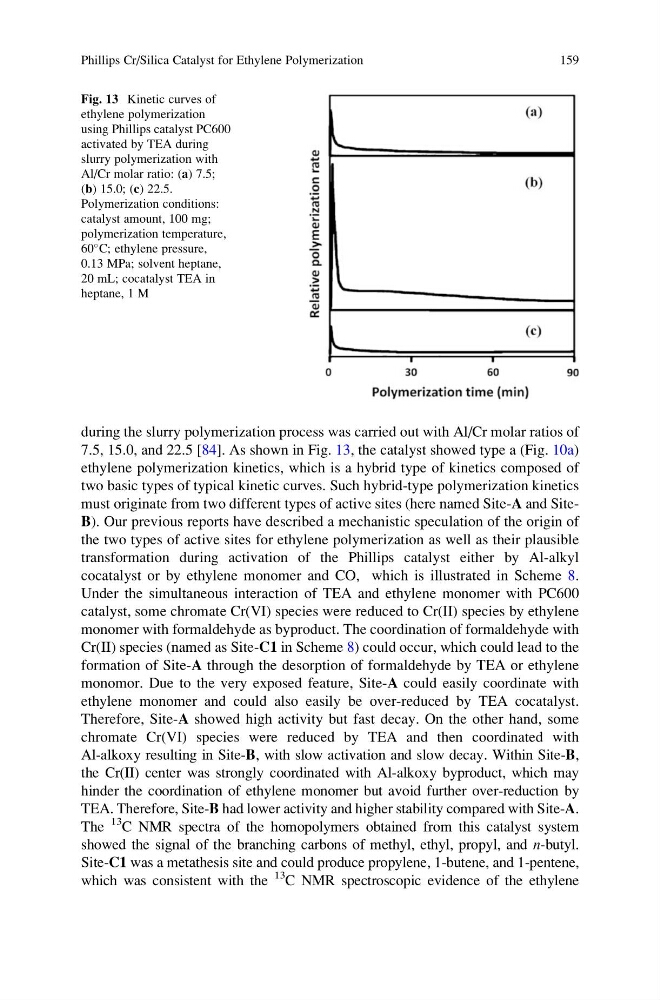
during the slurry polymerization process was carried out with Al/Cr molar ratios of
7.5, 15.0, and 22.5 [84]. As shown in Fig. 13, the catalyst showed type a (Fig. 10a)
ethylene polymerization kinetics, which is a hybrid type of kinetics composed of
two basic types of typical kinetic curves. Such hybrid-type polymerization kinetics
must originate from two different types of active sites (here named Site-A and SiteB). Our previous reports have described a mechanistic speculation of the origin of
the two types of active sites for ethylene polymerization as well as their plausible
transformation during activation of the Phillips catalyst either by Al-alkyl
cocatalyst or by ethylene monomer and CO, which is illustrated in Scheme 8.
Under the simultaneous interaction of TEA and ethylene monomer with PC600
catalyst, some chromate Cr(VI) species were reduced to Cr(II) species by ethylene
monomer with formaldehyde as byproduct. The coordination of formaldehyde with
Cr(II) species (named as Site-C1 in Scheme 8) could occur, which could lead to the
formation of Site-A through the desorption of formaldehyde by TEA or ethylene
monomor. Due to the very exposed feature, Site-A could easily coordinate with
ethylene monomer and could also easily be over-reduced by TEA cocatalyst.
Therefore, Site-A showed high activity but fast decay. On the other hand, some
chromate Cr(VI) species were reduced by TEA and then coordinated with
Al-alkoxy resulting in Site-B, with slow activation and slow decay. Within Site-B,
the Cr(II) center was strongly coordinated with Al-alkoxy byproduct, which may
hinder the coordination of ethylene monomer but avoid further over-reduction by
TEA. Therefore, Site-B had lower activity and higher stability compared with Site-A.
The
13
C NMR spectra of the homopolymers obtained from this catalyst system
showed the signal of the branching carbons of methyl, ethyl, propyl, and n-butyl.
Site-C1 was a metathesis site and could produce propylene, 1-butene, and 1-pentene,
which was consistent with the
13
C NMR spectroscopic evidence of the ethylene
Fig. 13 Kinetic curves of
ethylene polymerization
using Phillips catalyst PC600
activated by TEA during
slurry polymerization with
Al/Cr molar ratio: (a) 7.5;
(b) 15.0; (c) 22.5.
Polymerization conditions:
catalyst amount, 100 mg;
polymerization temperature,
60
C; ethylene pressure,
0.13 MPa; solvent heptane,
20 mL; cocatalyst TEA in
heptane, 1 M
Phillips Cr/Silica Catalyst for Ethylene Polymerization
159
7.5, 15.0, and 22.5 [84]. As shown in Fig. 13, the catalyst showed type a (Fig. 10a)
ethylene polymerization kinetics, which is a hybrid type of kinetics composed of
two basic types of typical kinetic curves. Such hybrid-type polymerization kinetics
must originate from two different types of active sites (here named Site-A and SiteB). Our previous reports have described a mechanistic speculation of the origin of
the two types of active sites for ethylene polymerization as well as their plausible
transformation during activation of the Phillips catalyst either by Al-alkyl
cocatalyst or by ethylene monomer and CO, which is illustrated in Scheme 8.
Under the simultaneous interaction of TEA and ethylene monomer with PC600
catalyst, some chromate Cr(VI) species were reduced to Cr(II) species by ethylene
monomer with formaldehyde as byproduct. The coordination of formaldehyde with
Cr(II) species (named as Site-C1 in Scheme 8) could occur, which could lead to the
formation of Site-A through the desorption of formaldehyde by TEA or ethylene
monomor. Due to the very exposed feature, Site-A could easily coordinate with
ethylene monomer and could also easily be over-reduced by TEA cocatalyst.
Therefore, Site-A showed high activity but fast decay. On the other hand, some
chromate Cr(VI) species were reduced by TEA and then coordinated with
Al-alkoxy resulting in Site-B, with slow activation and slow decay. Within Site-B,
the Cr(II) center was strongly coordinated with Al-alkoxy byproduct, which may
hinder the coordination of ethylene monomer but avoid further over-reduction by
TEA. Therefore, Site-B had lower activity and higher stability compared with Site-A.
The
13
C NMR spectra of the homopolymers obtained from this catalyst system
showed the signal of the branching carbons of methyl, ethyl, propyl, and n-butyl.
Site-C1 was a metathesis site and could produce propylene, 1-butene, and 1-pentene,
which was consistent with the
13
C NMR spectroscopic evidence of the ethylene
Fig. 13 Kinetic curves of
ethylene polymerization
using Phillips catalyst PC600
activated by TEA during
slurry polymerization with
Al/Cr molar ratio: (a) 7.5;
(b) 15.0; (c) 22.5.
Polymerization conditions:
catalyst amount, 100 mg;
polymerization temperature,
60
C; ethylene pressure,
0.13 MPa; solvent heptane,
20 mL; cocatalyst TEA in
heptane, 1 M
Phillips Cr/Silica Catalyst for Ethylene Polymerization
159