

Site-C1 and/or Site-C2 into polymerization Site-A was slowed down due to the
stronger reduction of 1-hexene than of ethylene. With increasing Al/Cr mole ratio
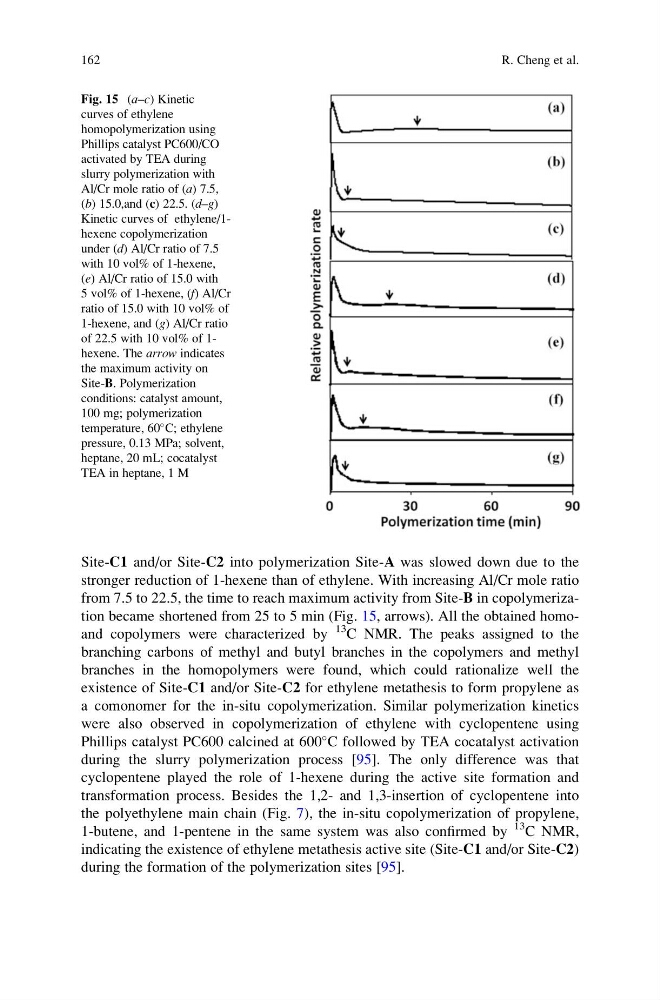
from 7.5 to 22.5, the time to reach maximum activity from Site-B in copolymerization became shortened from 25 to 5 min (Fig. 15, arrows). All the obtained homoand copolymers were characterized by
13 C NMR. The peaks assigned to the
branching carbons of methyl and butyl branches in the copolymers and methyl
branches in the homopolymers were found, which could rationalize well the
existence of Site-C1 and/or Site-C2 for ethylene metathesis to form propylene as
a comonomer for the in-situ copolymerization. Similar polymerization kinetics
were also observed in copolymerization of ethylene with cyclopentene using
Phillips catalyst PC600 calcined at 600
C followed by TEA cocatalyst activation
during the slurry polymerization process [95]. The only difference was that
cyclopentene played the role of 1-hexene during the active site formation and
transformation process. Besides the 1,2- and 1,3-insertion of cyclopentene into
the polyethylene main chain (Fig. 7), the in-situ copolymerization of propylene,
1-butene, and 1-pentene in the same system was also confirmed by
13 C NMR,
indicating the existence of ethylene metathesis active site (Site-C1 and/or Site-C2)
during the formation of the polymerization sites [95].
Fig. 15 (a–c) Kinetic
curves of ethylene
homopolymerization using
Phillips catalyst PC600/CO
activated by TEA during
slurry polymerization with
Al/Cr mole ratio of (a) 7.5,
(b) 15.0,and (c) 22.5. (d–g)
Kinetic curves of ethylene/1hexene copolymerization
under (d) Al/Cr ratio of 7.5
with 10 vol% of 1-hexene,
(e) Al/Cr ratio of 15.0 with
5 vol% of 1-hexene, (f) Al/Cr
ratio of 15.0 with 10 vol% of
1-hexene, and (g) Al/Cr ratio
of 22.5 with 10 vol% of 1hexene. The arrow indicates
the maximum activity on
Site-B. Polymerization
conditions: catalyst amount,
100 mg; polymerization
temperature, 60
C; ethylene
pressure, 0.13 MPa; solvent,
heptane, 20 mL; cocatalyst
TEA in heptane, 1 M
162
R. Cheng et al.
stronger reduction of 1-hexene than of ethylene. With increasing Al/Cr mole ratio
from 7.5 to 22.5, the time to reach maximum activity from Site-B in copolymerization became shortened from 25 to 5 min (Fig. 15, arrows). All the obtained homoand copolymers were characterized by
13 C NMR. The peaks assigned to the
branching carbons of methyl and butyl branches in the copolymers and methyl
branches in the homopolymers were found, which could rationalize well the
existence of Site-C1 and/or Site-C2 for ethylene metathesis to form propylene as
a comonomer for the in-situ copolymerization. Similar polymerization kinetics
were also observed in copolymerization of ethylene with cyclopentene using
Phillips catalyst PC600 calcined at 600
C followed by TEA cocatalyst activation
during the slurry polymerization process [95]. The only difference was that
cyclopentene played the role of 1-hexene during the active site formation and
transformation process. Besides the 1,2- and 1,3-insertion of cyclopentene into
the polyethylene main chain (Fig. 7), the in-situ copolymerization of propylene,
1-butene, and 1-pentene in the same system was also confirmed by
13 C NMR,
indicating the existence of ethylene metathesis active site (Site-C1 and/or Site-C2)
during the formation of the polymerization sites [95].
Fig. 15 (a–c) Kinetic
curves of ethylene
homopolymerization using
Phillips catalyst PC600/CO
activated by TEA during
slurry polymerization with
Al/Cr mole ratio of (a) 7.5,
(b) 15.0,and (c) 22.5. (d–g)
Kinetic curves of ethylene/1hexene copolymerization
under (d) Al/Cr ratio of 7.5
with 10 vol% of 1-hexene,
(e) Al/Cr ratio of 15.0 with
5 vol% of 1-hexene, (f) Al/Cr
ratio of 15.0 with 10 vol% of
1-hexene, and (g) Al/Cr ratio
of 22.5 with 10 vol% of 1hexene. The arrow indicates
the maximum activity on
Site-B. Polymerization
conditions: catalyst amount,
100 mg; polymerization
temperature, 60
C; ethylene
pressure, 0.13 MPa; solvent,
heptane, 20 mL; cocatalyst
TEA in heptane, 1 M
162
R. Cheng et al.