

Cr¼C species (metathesis active sites) should be transformed into Cr–C species
(polymerization active sites) in a mysterious way, as illustrated in Scheme 7. Such
mysterious phenomenon of interconversion between catalysis of olefin metathesis
and olefin polymerization with other types of catalysts has been previously reported
[97, 98] and needs further investigation in the future.
2.4 Titanium Modification of the Phillips Catalyst
The Ti-modified Phillips catalyst is a very important industrial catalyst that is
widely used in ethylene polymerization for promotion of polymerization activity
and regulation of the microstructure of the polymer chains, but the mechanism of its
action still remains mysterious. We characterized several industrial Ti-modified
Phillips catalysts calcined at 650
C and 820
C using
1 H MAS solid state NMR and
XPS. As shown in Fig. 8, the
1 H MAS solid-state NMR spectra provided the first
direct evidence of surface residual Ti–OH groups on the Ti-modified Phillips
catalysts. In Fig. 9, the high-resolution XPS studies on these industrial catalysts
clearly demonstrated that the BE value of surface chromate species slightly
increased with increased Ti loading of the catalysts, indicating the increased
electron-deficiency of surface chromate species due to modification by Ti
[71]. The slight increase in the FWHM values also indicated the broadening of
the distribution of surface chromate species. Calcination temperatures of
650–820
C showed a similar effect to that of Ti loading in terms of the increased
electron-deficiency of surface chromate species, which could be rationalized by the
removal of more electron-donating surface hydroxyl groups and the increase in
surface tension due to dehydroxylation of surface residual hydroxyl groups at
higher calcination temperatures.
In summary, it has been demonstrated that much deeper understanding of the
thermal activation during catalyst preparation, activation by CO or Al-alkyl
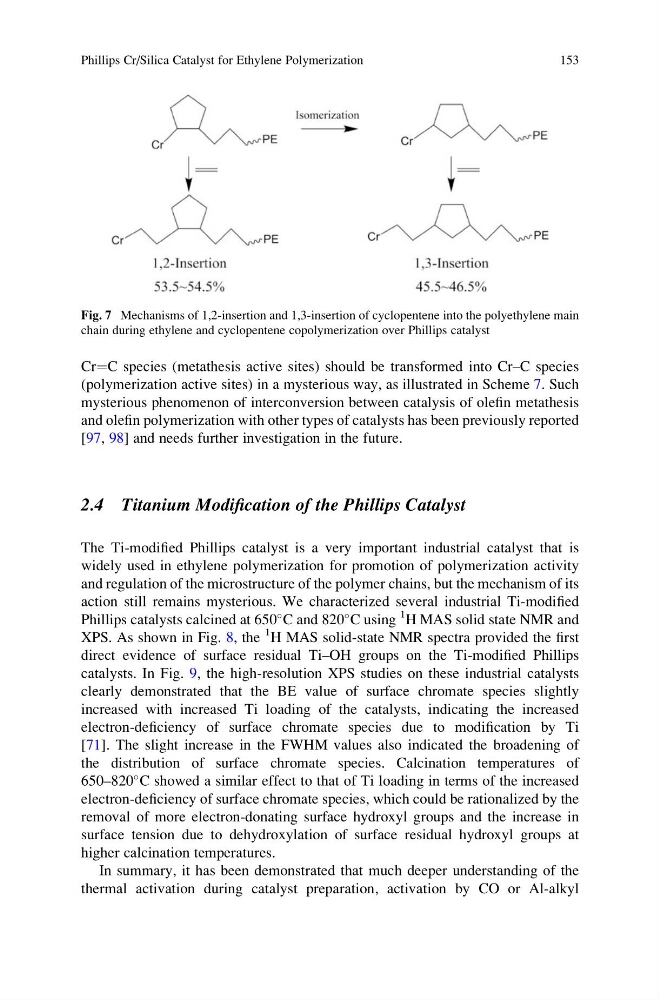
Fig. 7 Mechanisms of 1,2-insertion and 1,3-insertion of cyclopentene into the polyethylene main
chain during ethylene and cyclopentene copolymerization over Phillips catalyst
Phillips Cr/Silica Catalyst for Ethylene Polymerization
153
(polymerization active sites) in a mysterious way, as illustrated in Scheme 7. Such
mysterious phenomenon of interconversion between catalysis of olefin metathesis
and olefin polymerization with other types of catalysts has been previously reported
[97, 98] and needs further investigation in the future.
2.4 Titanium Modification of the Phillips Catalyst
The Ti-modified Phillips catalyst is a very important industrial catalyst that is
widely used in ethylene polymerization for promotion of polymerization activity
and regulation of the microstructure of the polymer chains, but the mechanism of its
action still remains mysterious. We characterized several industrial Ti-modified
Phillips catalysts calcined at 650
C and 820
C using
1 H MAS solid state NMR and
XPS. As shown in Fig. 8, the
1 H MAS solid-state NMR spectra provided the first
direct evidence of surface residual Ti–OH groups on the Ti-modified Phillips
catalysts. In Fig. 9, the high-resolution XPS studies on these industrial catalysts
clearly demonstrated that the BE value of surface chromate species slightly
increased with increased Ti loading of the catalysts, indicating the increased
electron-deficiency of surface chromate species due to modification by Ti
[71]. The slight increase in the FWHM values also indicated the broadening of
the distribution of surface chromate species. Calcination temperatures of
650–820
C showed a similar effect to that of Ti loading in terms of the increased
electron-deficiency of surface chromate species, which could be rationalized by the
removal of more electron-donating surface hydroxyl groups and the increase in
surface tension due to dehydroxylation of surface residual hydroxyl groups at
higher calcination temperatures.
In summary, it has been demonstrated that much deeper understanding of the
thermal activation during catalyst preparation, activation by CO or Al-alkyl
Fig. 7 Mechanisms of 1,2-insertion and 1,3-insertion of cyclopentene into the polyethylene main
chain during ethylene and cyclopentene copolymerization over Phillips catalyst
Phillips Cr/Silica Catalyst for Ethylene Polymerization
153