

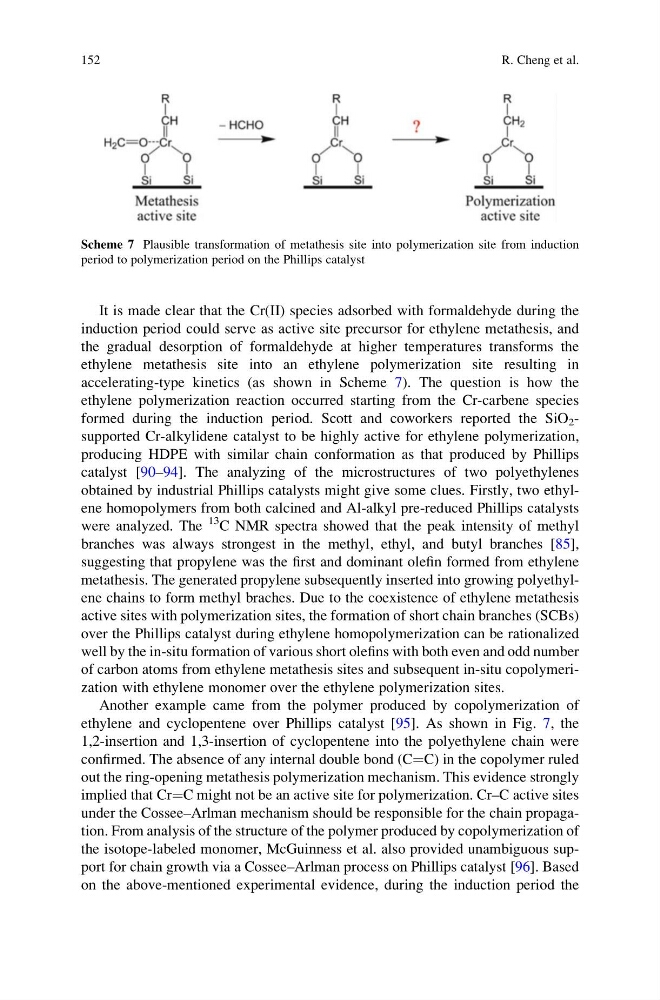
It is made clear that the Cr(II) species adsorbed with formaldehyde during the
induction period could serve as active site precursor for ethylene metathesis, and
the gradual desorption of formaldehyde at higher temperatures transforms the
ethylene metathesis site into an ethylene polymerization site resulting in
accelerating-type kinetics (as shown in Scheme 7). The question is how the
ethylene polymerization reaction occurred starting from the Cr-carbene species
formed during the induction period. Scott and coworkers reported the SiO 2 -
supported Cr-alkylidene catalyst to be highly active for ethylene polymerization,
producing HDPE with similar chain conformation as that produced by Phillips
catalyst [90–94]. The analyzing of the microstructures of two polyethylenes
obtained by industrial Phillips catalysts might give some clues. Firstly, two ethylene homopolymers from both calcined and Al-alkyl pre-reduced Phillips catalysts
were analyzed. The
13 C NMR spectra showed that the peak intensity of methyl
branches was always strongest in the methyl, ethyl, and butyl branches [85],
suggesting that propylene was the first and dominant olefin formed from ethylene
metathesis. The generated propylene subsequently inserted into growing polyethylene chains to form methyl braches. Due to the coexistence of ethylene metathesis
active sites with polymerization sites, the formation of short chain branches (SCBs)
over the Phillips catalyst during ethylene homopolymerization can be rationalized
well by the in-situ formation of various short olefins with both even and odd number
of carbon atoms from ethylene metathesis sites and subsequent in-situ copolymerization with ethylene monomer over the ethylene polymerization sites.
Another example came from the polymer produced by copolymerization of
ethylene and cyclopentene over Phillips catalyst [95]. As shown in Fig. 7, the
1,2-insertion and 1,3-insertion of cyclopentene into the polyethylene chain were
confirmed. The absence of any internal double bond (C¼C) in the copolymer ruled
out the ring-opening metathesis polymerization mechanism. This evidence strongly
implied that Cr¼C might not be an active site for polymerization. Cr–C active sites
under the Cossee–Arlman mechanism should be responsible for the chain propagation. From analysis of the structure of the polymer produced by copolymerization of
the isotope-labeled monomer, McGuinness et al. also provided unambiguous support for chain growth via a Cossee–Arlman process on Phillips catalyst [96]. Based
on the above-mentioned experimental evidence, during the induction period the
Scheme 7 Plausible transformation of metathesis site into polymerization site from induction
period to polymerization period on the Phillips catalyst
152
R. Cheng et al.
induction period could serve as active site precursor for ethylene metathesis, and
the gradual desorption of formaldehyde at higher temperatures transforms the
ethylene metathesis site into an ethylene polymerization site resulting in
accelerating-type kinetics (as shown in Scheme 7). The question is how the
ethylene polymerization reaction occurred starting from the Cr-carbene species
formed during the induction period. Scott and coworkers reported the SiO 2 -
supported Cr-alkylidene catalyst to be highly active for ethylene polymerization,
producing HDPE with similar chain conformation as that produced by Phillips
catalyst [90–94]. The analyzing of the microstructures of two polyethylenes
obtained by industrial Phillips catalysts might give some clues. Firstly, two ethylene homopolymers from both calcined and Al-alkyl pre-reduced Phillips catalysts
were analyzed. The
13 C NMR spectra showed that the peak intensity of methyl
branches was always strongest in the methyl, ethyl, and butyl branches [85],
suggesting that propylene was the first and dominant olefin formed from ethylene
metathesis. The generated propylene subsequently inserted into growing polyethylene chains to form methyl braches. Due to the coexistence of ethylene metathesis
active sites with polymerization sites, the formation of short chain branches (SCBs)
over the Phillips catalyst during ethylene homopolymerization can be rationalized
well by the in-situ formation of various short olefins with both even and odd number
of carbon atoms from ethylene metathesis sites and subsequent in-situ copolymerization with ethylene monomer over the ethylene polymerization sites.
Another example came from the polymer produced by copolymerization of
ethylene and cyclopentene over Phillips catalyst [95]. As shown in Fig. 7, the
1,2-insertion and 1,3-insertion of cyclopentene into the polyethylene chain were
confirmed. The absence of any internal double bond (C¼C) in the copolymer ruled
out the ring-opening metathesis polymerization mechanism. This evidence strongly
implied that Cr¼C might not be an active site for polymerization. Cr–C active sites
under the Cossee–Arlman mechanism should be responsible for the chain propagation. From analysis of the structure of the polymer produced by copolymerization of
the isotope-labeled monomer, McGuinness et al. also provided unambiguous support for chain growth via a Cossee–Arlman process on Phillips catalyst [96]. Based
on the above-mentioned experimental evidence, during the induction period the
Scheme 7 Plausible transformation of metathesis site into polymerization site from induction
period to polymerization period on the Phillips catalyst
152
R. Cheng et al.