

by the Cossee–Arlman mechanism [25]. It should be mentioned that the conversion
of ethylene into higher olefins with both odd and even numbers of carbon atoms is a
well-established phenomenon that was believed to proceed by metathesis over
metal alkylidene species [86]. This indicated that the coordination of formaldehyde
on surface-stabilized divalent chromium species results in the formation of active
precursor for olefin metathesis rather than polymerization. The active sites in
heterogeneous transition metal-catalyzed olefin metathesis are generally thought
to be a transition metal alkylidene species, as for their well-defined homogeneous
analogues [87]. In our work, the signal for Cr-alkylidene species for the sample
treated at 100
C for 0.5 h was firstly observed in XPS measurement [85]. At the
same time, the evolution of the Cr-metallacyclic species can be considered to be
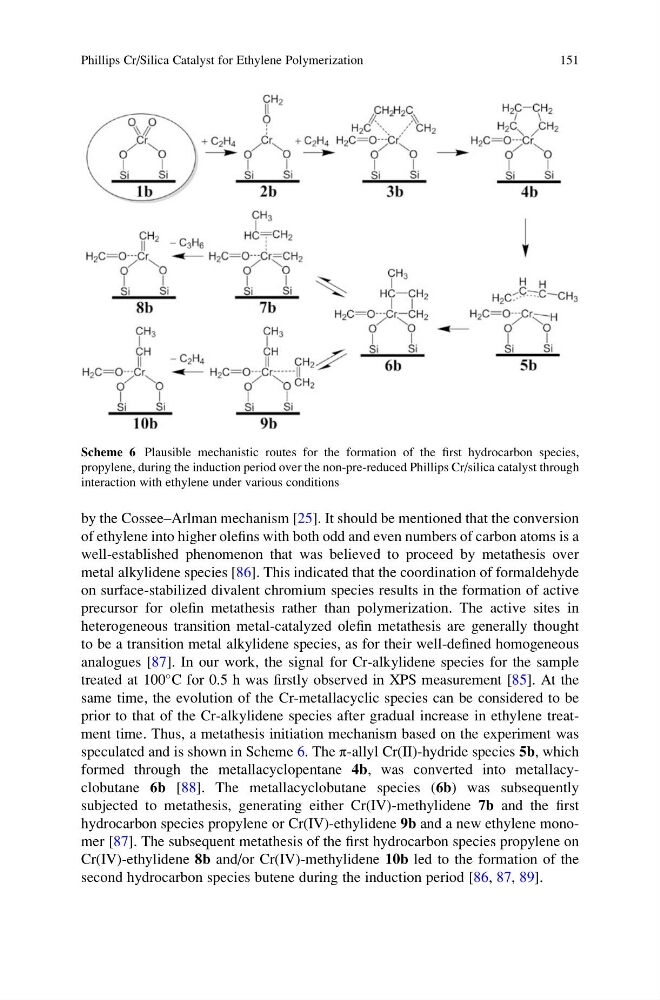
prior to that of the Cr-alkylidene species after gradual increase in ethylene treatment time. Thus, a metathesis initiation mechanism based on the experiment was
speculated and is shown in Scheme 6. The π-allyl Cr(II)-hydride species 5b, which
formed through the metallacyclopentane 4b, was converted into metallacyclobutane 6b [88]. The metallacyclobutane species (6b) was subsequently
subjected to metathesis, generating either Cr(IV)-methylidene 7b and the first
hydrocarbon species propylene or Cr(IV)-ethylidene 9b and a new ethylene monomer [87]. The subsequent metathesis of the first hydrocarbon species propylene on
Cr(IV)-ethylidene 8b and/or Cr(IV)-methylidene 10b led to the formation of the
second hydrocarbon species butene during the induction period [86, 87, 89].
Scheme 6 Plausible mechanistic routes for the formation of the first hydrocarbon species,
propylene, during the induction period over the non-pre-reduced Phillips Cr/silica catalyst through
interaction with ethylene under various conditions
Phillips Cr/Silica Catalyst for Ethylene Polymerization
151
of ethylene into higher olefins with both odd and even numbers of carbon atoms is a
well-established phenomenon that was believed to proceed by metathesis over
metal alkylidene species [86]. This indicated that the coordination of formaldehyde
on surface-stabilized divalent chromium species results in the formation of active
precursor for olefin metathesis rather than polymerization. The active sites in
heterogeneous transition metal-catalyzed olefin metathesis are generally thought
to be a transition metal alkylidene species, as for their well-defined homogeneous
analogues [87]. In our work, the signal for Cr-alkylidene species for the sample
treated at 100
C for 0.5 h was firstly observed in XPS measurement [85]. At the
same time, the evolution of the Cr-metallacyclic species can be considered to be
prior to that of the Cr-alkylidene species after gradual increase in ethylene treatment time. Thus, a metathesis initiation mechanism based on the experiment was
speculated and is shown in Scheme 6. The π-allyl Cr(II)-hydride species 5b, which
formed through the metallacyclopentane 4b, was converted into metallacyclobutane 6b [88]. The metallacyclobutane species (6b) was subsequently
subjected to metathesis, generating either Cr(IV)-methylidene 7b and the first
hydrocarbon species propylene or Cr(IV)-ethylidene 9b and a new ethylene monomer [87]. The subsequent metathesis of the first hydrocarbon species propylene on
Cr(IV)-ethylidene 8b and/or Cr(IV)-methylidene 10b led to the formation of the
second hydrocarbon species butene during the induction period [86, 87, 89].
Scheme 6 Plausible mechanistic routes for the formation of the first hydrocarbon species,
propylene, during the induction period over the non-pre-reduced Phillips Cr/silica catalyst through
interaction with ethylene under various conditions
Phillips Cr/Silica Catalyst for Ethylene Polymerization
151