

2.3 Activation of the Phillips Catalyst by Ethylene Monomer
Activation of the Phillips catalyst directly by ethylene monomer was further
investigated by XPS and TPD-MS methods in order to shed some light on the
reaction mechanisms during the induction period. Deconvolution of the XPS
spectra for industrial Phillips Cr/silica catalysts treated in ethylene atmosphere at
RT for 2 h revealed that surface chromium species presented in three oxidation
states: surface chromate Cr(VI)O x,surf species; surface-stabilized trivalent Cr(III)
species; and surface-stabilized Cr(II) species. Compared to the original catalyst
before ethylene treatment, about one-third of chromate Cr(VI)O x,surf species (i.e.,
ca. 22.6% of the whole surface Cr) was reduced to Cr species in lower oxidation
states during the ethylene treatment, even under ambient conditions [67].
TPD-MS characterization of the calcined Phillips catalyst before and after
treatment within ethylene atmosphere for 2 h under ambient conditions confirmed
the evolution of three species: formaldehyde (m/z ¼ 30); olefins with an odd
number of carbon atoms, i.e., propylene (m/z ¼ 42); and olefins with an even
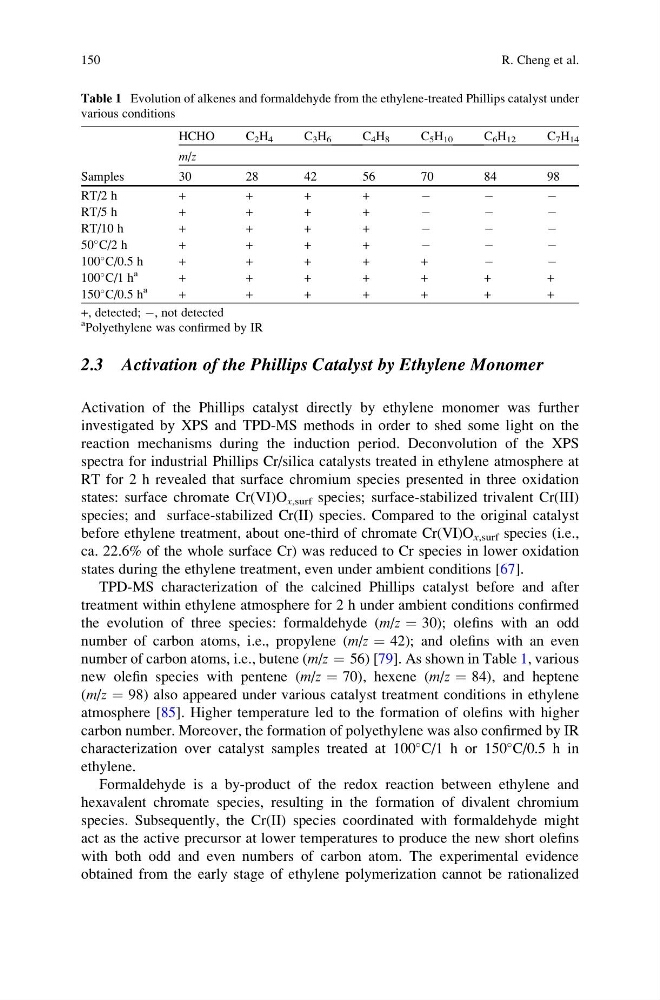
number of carbon atoms, i.e., butene (m/z ¼ 56) [79]. As shown in Table 1, various
new olefin species with pentene (m/z ¼ 70), hexene (m/z ¼ 84), and heptene
(m/z ¼ 98) also appeared under various catalyst treatment conditions in ethylene
atmosphere [85]. Higher temperature led to the formation of olefins with higher
carbon number. Moreover, the formation of polyethylene was also confirmed by IR
characterization over catalyst samples treated at 100
C/1 h or 150
C/0.5 h in
ethylene.
Formaldehyde is a by-product of the redox reaction between ethylene and
hexavalent chromate species, resulting in the formation of divalent chromium
species. Subsequently, the Cr(II) species coordinated with formaldehyde might
act as the active precursor at lower temperatures to produce the new short olefins
with both odd and even numbers of carbon atom. The experimental evidence
obtained from the early stage of ethylene polymerization cannot be rationalized
Table 1 Evolution of alkenes and formaldehyde from the ethylene-treated Phillips catalyst under
various conditions
Samples
HCHO
C 2 H 4
C 3 H 6
C 4 H 8
C 5 H 10
C 6 H 12
C 7 H 14
m/z
30
28
42
56
70
84
98
RT/2 h
+
+
+
+
À
À
À
RT/5 h
+
+
+
+
À
À
À
RT/10 h
+
+
+
+
À
À
À
50
C/2 h
+
+
+
+
À
À
À
100
C/0.5 h
+
+
+
+
+
À
À
100
C/1 h
a
+
+
+
+
+
+
+
150
C/0.5 h
a
+
+
+
+
+
+
+
+, detected; À, not detected
a
Polyethylene was confirmed by IR
150
R. Cheng et al.
Activation of the Phillips catalyst directly by ethylene monomer was further
investigated by XPS and TPD-MS methods in order to shed some light on the
reaction mechanisms during the induction period. Deconvolution of the XPS
spectra for industrial Phillips Cr/silica catalysts treated in ethylene atmosphere at
RT for 2 h revealed that surface chromium species presented in three oxidation
states: surface chromate Cr(VI)O x,surf species; surface-stabilized trivalent Cr(III)
species; and surface-stabilized Cr(II) species. Compared to the original catalyst
before ethylene treatment, about one-third of chromate Cr(VI)O x,surf species (i.e.,
ca. 22.6% of the whole surface Cr) was reduced to Cr species in lower oxidation
states during the ethylene treatment, even under ambient conditions [67].
TPD-MS characterization of the calcined Phillips catalyst before and after
treatment within ethylene atmosphere for 2 h under ambient conditions confirmed
the evolution of three species: formaldehyde (m/z ¼ 30); olefins with an odd
number of carbon atoms, i.e., propylene (m/z ¼ 42); and olefins with an even
number of carbon atoms, i.e., butene (m/z ¼ 56) [79]. As shown in Table 1, various
new olefin species with pentene (m/z ¼ 70), hexene (m/z ¼ 84), and heptene
(m/z ¼ 98) also appeared under various catalyst treatment conditions in ethylene
atmosphere [85]. Higher temperature led to the formation of olefins with higher
carbon number. Moreover, the formation of polyethylene was also confirmed by IR
characterization over catalyst samples treated at 100
C/1 h or 150
C/0.5 h in
ethylene.
Formaldehyde is a by-product of the redox reaction between ethylene and
hexavalent chromate species, resulting in the formation of divalent chromium
species. Subsequently, the Cr(II) species coordinated with formaldehyde might
act as the active precursor at lower temperatures to produce the new short olefins
with both odd and even numbers of carbon atom. The experimental evidence
obtained from the early stage of ethylene polymerization cannot be rationalized
Table 1 Evolution of alkenes and formaldehyde from the ethylene-treated Phillips catalyst under
various conditions
Samples
HCHO
C 2 H 4
C 3 H 6
C 4 H 8
C 5 H 10
C 6 H 12
C 7 H 14
m/z
30
28
42
56
70
84
98
RT/2 h
+
+
+
+
À
À
À
RT/5 h
+
+
+
+
À
À
À
RT/10 h
+
+
+
+
À
À
À
50
C/2 h
+
+
+
+
À
À
À
100
C/0.5 h
+
+
+
+
+
À
À
100
C/1 h
a
+
+
+
+
+
+
+
150
C/0.5 h
a
+
+
+
+
+
+
+
+, detected; À, not detected
a
Polyethylene was confirmed by IR
150
R. Cheng et al.