

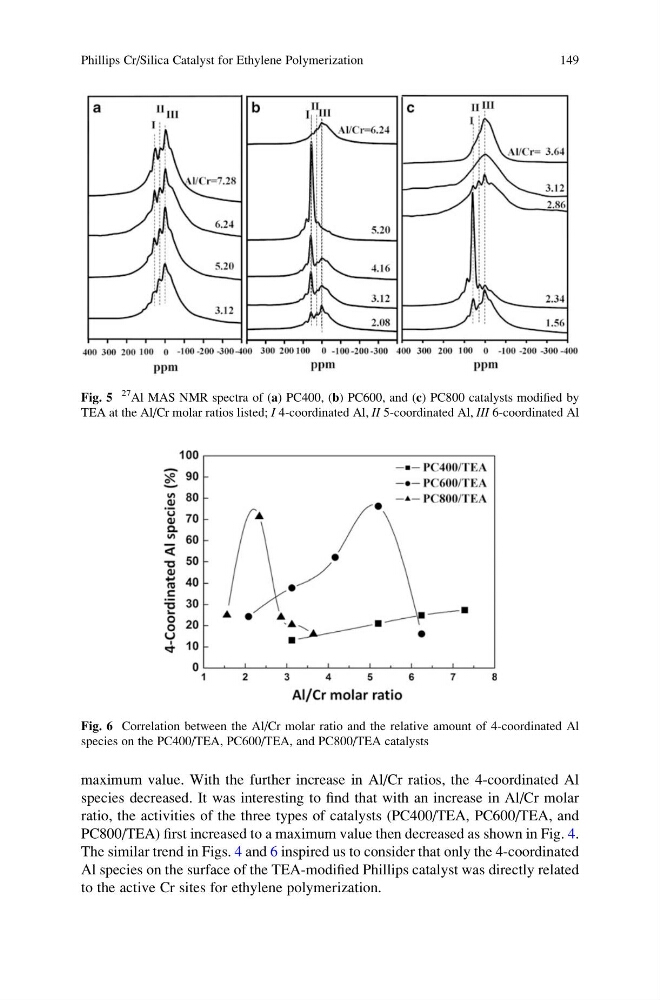
maximum value. With the further increase in Al/Cr ratios, the 4-coordinated Al
species decreased. It was interesting to find that with an increase in Al/Cr molar
ratio, the activities of the three types of catalysts (PC400/TEA, PC600/TEA, and
PC800/TEA) first increased to a maximum value then decreased as shown in Fig. 4.
The similar trend in Figs. 4 and 6 inspired us to consider that only the 4-coordinated
Al species on the surface of the TEA-modified Phillips catalyst was directly related
to the active Cr sites for ethylene polymerization.
Fig. 6 Correlation between the Al/Cr molar ratio and the relative amount of 4-coordinated Al
species on the PC400/TEA, PC600/TEA, and PC800/TEA catalysts
Fig. 5
27
Al MAS NMR spectra of (a) PC400, (b) PC600, and (c) PC800 catalysts modified by
TEA at the Al/Cr molar ratios listed; I 4-coordinated Al, II 5-coordinated Al, III 6-coordinated Al
Phillips Cr/Silica Catalyst for Ethylene Polymerization
149
species decreased. It was interesting to find that with an increase in Al/Cr molar
ratio, the activities of the three types of catalysts (PC400/TEA, PC600/TEA, and
PC800/TEA) first increased to a maximum value then decreased as shown in Fig. 4.
The similar trend in Figs. 4 and 6 inspired us to consider that only the 4-coordinated
Al species on the surface of the TEA-modified Phillips catalyst was directly related
to the active Cr sites for ethylene polymerization.
Fig. 6 Correlation between the Al/Cr molar ratio and the relative amount of 4-coordinated Al
species on the PC400/TEA, PC600/TEA, and PC800/TEA catalysts
Fig. 5
27
Al MAS NMR spectra of (a) PC400, (b) PC600, and (c) PC800 catalysts modified by
TEA at the Al/Cr molar ratios listed; I 4-coordinated Al, II 5-coordinated Al, III 6-coordinated Al
Phillips Cr/Silica Catalyst for Ethylene Polymerization
149