

depended on the concentration of TEA and the calcination temperature used during
the catalyst preparation process [84]. In Fig. 5, three kinds of Al species with 6-, 5-,
and 4-coordination states are distinguished for the PC400, PC600, and PC800
catalysts modified by TEA at various Al/Cr molar ratios. For PC400/TEA catalysts,
the profiles were only slightly changed with various Al/Cr molar ratios, and the
6-coordinated Al species was dominant. For the PC600/TEA, the peak intensity of
the 4-coordinated Al species significantly increased with increasing Al/Cr molar
ratios, resulting in a dramatic change in the relative amounts of 6-, 5-, and
4-coordinated Al species. For higher Al/Cr molar ratios, the spectra completely
changed, and the 5- and 4-coordination states of the surface Al species could not be
clearly distinguished and the 6-coordinated Al species became dominant again. For
PC800/TEA, it was observed that the 6-coordinated Al species was still predominant in a narrow range of Al/Cr molar ratio, except the sharp and strong peak of
4-coordianted Al species at the Al/Cr ratio of 2.34.
A relationship between the Al/Cr molar ratio and relative amount of
4-coordinated Al species on the PC400/TEA, PC600/TEA, and PC800/TEA
catalysts is illustrated in Fig. 6 [84]. For PC400/TEA catalysts, the relative amounts
of 4-coordinated Al species increased only slightly with the increase in Al/Cr ratios.
For PC600/TEA and PC800/TEA catalysts, the relative amounts of 4-coordinated
Al species firstly increased with an increase in Al/Cr ratios then reached a
Scheme 5 Three plausible structure models of the active Cr
2+ precursors existing as a Cr
2+ ·2Cr
6+
cluster on the TEA-modified Phillips catalyst; n ¼ 1 or 2; m ¼ 1 or 2
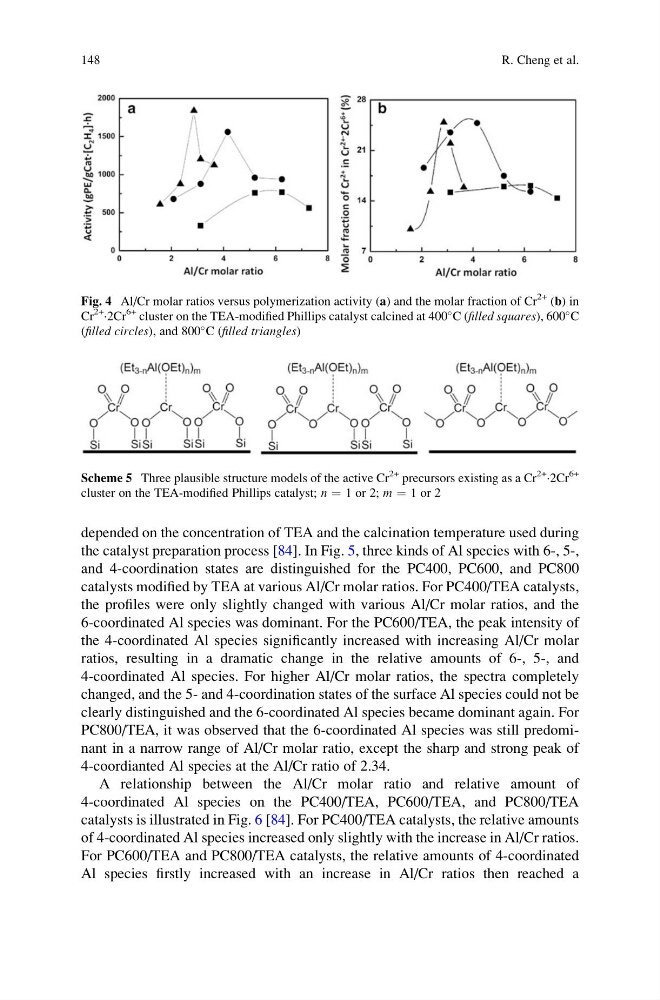
Fig. 4 Al/Cr molar ratios versus polymerization activity (a) and the molar fraction of Cr
2+ (b) in
Cr
2+ ·2Cr
6+ cluster on the TEA-modified Phillips catalyst calcined at 400
C (filled squares), 600
C
(filled circles), and 800
C (filled triangles)
148
R. Cheng et al.
the catalyst preparation process [84]. In Fig. 5, three kinds of Al species with 6-, 5-,
and 4-coordination states are distinguished for the PC400, PC600, and PC800
catalysts modified by TEA at various Al/Cr molar ratios. For PC400/TEA catalysts,
the profiles were only slightly changed with various Al/Cr molar ratios, and the
6-coordinated Al species was dominant. For the PC600/TEA, the peak intensity of
the 4-coordinated Al species significantly increased with increasing Al/Cr molar
ratios, resulting in a dramatic change in the relative amounts of 6-, 5-, and
4-coordinated Al species. For higher Al/Cr molar ratios, the spectra completely
changed, and the 5- and 4-coordination states of the surface Al species could not be
clearly distinguished and the 6-coordinated Al species became dominant again. For
PC800/TEA, it was observed that the 6-coordinated Al species was still predominant in a narrow range of Al/Cr molar ratio, except the sharp and strong peak of
4-coordianted Al species at the Al/Cr ratio of 2.34.
A relationship between the Al/Cr molar ratio and relative amount of
4-coordinated Al species on the PC400/TEA, PC600/TEA, and PC800/TEA
catalysts is illustrated in Fig. 6 [84]. For PC400/TEA catalysts, the relative amounts
of 4-coordinated Al species increased only slightly with the increase in Al/Cr ratios.
For PC600/TEA and PC800/TEA catalysts, the relative amounts of 4-coordinated
Al species firstly increased with an increase in Al/Cr ratios then reached a
Scheme 5 Three plausible structure models of the active Cr
2+ precursors existing as a Cr
2+ ·2Cr
6+
cluster on the TEA-modified Phillips catalyst; n ¼ 1 or 2; m ¼ 1 or 2
Fig. 4 Al/Cr molar ratios versus polymerization activity (a) and the molar fraction of Cr
2+ (b) in
Cr
2+ ·2Cr
6+ cluster on the TEA-modified Phillips catalyst calcined at 400
C (filled squares), 600
C
(filled circles), and 800
C (filled triangles)
148
R. Cheng et al.