

revealed local aggregates of Cr species sized 200–300 nm. These aggregates,
corresponding to the red patches in the map image (marked in circles) in Fig. 1a
and to a sharp peak in the line curves in Fig. 1b, were suggested to be microcrystal
particles of Cr 2 O 3 .
The irreversible formation of chromium oxide clusters, in the form of α-Cr 2 O 3 ,
is a well-known phenomenon occurring on the Cr/silica catalyst for Cr loadings
higher than 1 wt% and/or in the presence of water poisoning. According to previous
reports [33, 56, 64, 82], the formation of aggregated Cr 2 O 3 on catalysts with a low
level of Cr loading usually occurred in the later stage of calcination, followed by the
full stabilization of bulk CrO 3 as chromate species and a consequent calcinationinduced reduction into Cr(III)O x,surf species. Previously, the formation of
aggregated Cr 2 O 3 was usually thought to be related to the thermal decomposition
(or reduction) of bulk CrO 3 , as illustrated in (1). The XPS measurement [8] showed
that the purposely introduced moisture induced the transformation of all the Cr(III)
O x,surf species and one-seventh of the Cr(VI)O x,surf species into aggregates of Cr 2 O 3
at high temperature, regardless of the oxidizing or inert atmosphere. Considering
the traces of moisture from the simultaneous dehydroxylation of residual hydroxyl
groups on the silica surface, the formation of aggregated Cr 2 O 3 microcrystals might
be induced by traces of moisture through cleavage of the Cr(III)O x,surf species
during the calcination. The mechanism is illustrated in (2):
CrðVIÞO x;surf þ H 2 O Ð
800
C
dry air
CrO 3 *
800
C
dry air
Cr 2 O 3 þ O 2
(1)
CrðIIIÞO x;surf þ H 2 O *
800
C
dry air
Cr 2 O 3
(2)
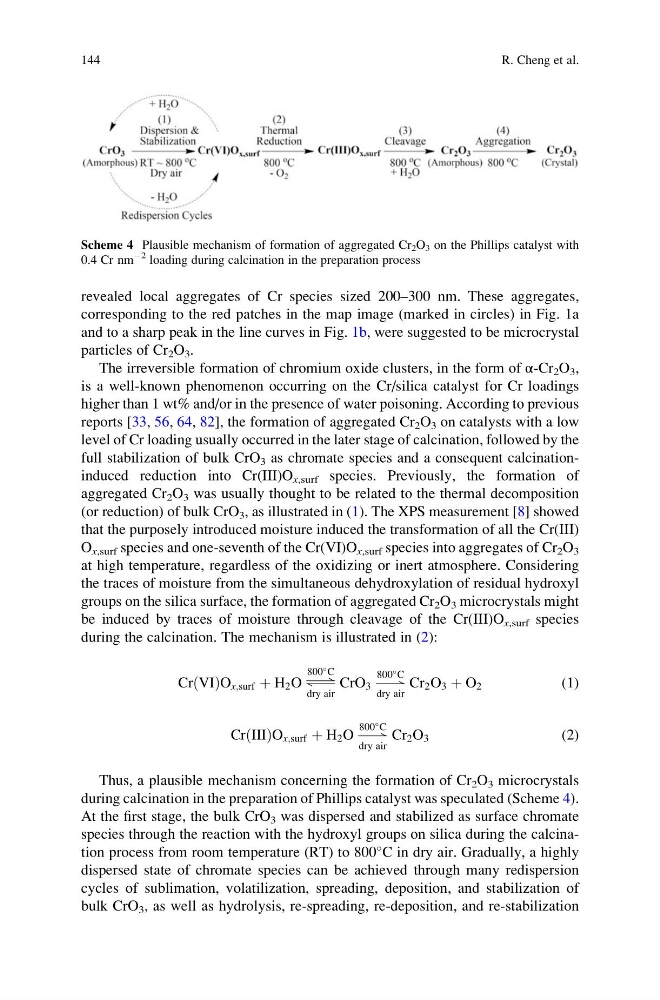
Thus, a plausible mechanism concerning the formation of Cr 2 O 3 microcrystals
during calcination in the preparation of Phillips catalyst was speculated (Scheme 4).
At the first stage, the bulk CrO 3 was dispersed and stabilized as surface chromate
species through the reaction with the hydroxyl groups on silica during the calcination process from room temperature (RT) to 800
C in dry air. Gradually, a highly
dispersed state of chromate species can be achieved through many redispersion
cycles of sublimation, volatilization, spreading, deposition, and stabilization of
bulk CrO 3 , as well as hydrolysis, re-spreading, re-deposition, and re-stabilization
Scheme 4 Plausible mechanism of formation of aggregated Cr 2 O 3 on the Phillips catalyst with
0.4 Cr nm
À2 loading during calcination in the preparation process
144
R. Cheng et al.
corresponding to the red patches in the map image (marked in circles) in Fig. 1a
and to a sharp peak in the line curves in Fig. 1b, were suggested to be microcrystal
particles of Cr 2 O 3 .
The irreversible formation of chromium oxide clusters, in the form of α-Cr 2 O 3 ,
is a well-known phenomenon occurring on the Cr/silica catalyst for Cr loadings
higher than 1 wt% and/or in the presence of water poisoning. According to previous
reports [33, 56, 64, 82], the formation of aggregated Cr 2 O 3 on catalysts with a low
level of Cr loading usually occurred in the later stage of calcination, followed by the
full stabilization of bulk CrO 3 as chromate species and a consequent calcinationinduced reduction into Cr(III)O x,surf species. Previously, the formation of
aggregated Cr 2 O 3 was usually thought to be related to the thermal decomposition
(or reduction) of bulk CrO 3 , as illustrated in (1). The XPS measurement [8] showed
that the purposely introduced moisture induced the transformation of all the Cr(III)
O x,surf species and one-seventh of the Cr(VI)O x,surf species into aggregates of Cr 2 O 3
at high temperature, regardless of the oxidizing or inert atmosphere. Considering
the traces of moisture from the simultaneous dehydroxylation of residual hydroxyl
groups on the silica surface, the formation of aggregated Cr 2 O 3 microcrystals might
be induced by traces of moisture through cleavage of the Cr(III)O x,surf species
during the calcination. The mechanism is illustrated in (2):
CrðVIÞO x;surf þ H 2 O Ð
800
C
dry air
CrO 3 *
800
C
dry air
Cr 2 O 3 þ O 2
(1)
CrðIIIÞO x;surf þ H 2 O *
800
C
dry air
Cr 2 O 3
(2)
Thus, a plausible mechanism concerning the formation of Cr 2 O 3 microcrystals
during calcination in the preparation of Phillips catalyst was speculated (Scheme 4).
At the first stage, the bulk CrO 3 was dispersed and stabilized as surface chromate
species through the reaction with the hydroxyl groups on silica during the calcination process from room temperature (RT) to 800
C in dry air. Gradually, a highly
dispersed state of chromate species can be achieved through many redispersion
cycles of sublimation, volatilization, spreading, deposition, and stabilization of
bulk CrO 3 , as well as hydrolysis, re-spreading, re-deposition, and re-stabilization
Scheme 4 Plausible mechanism of formation of aggregated Cr 2 O 3 on the Phillips catalyst with
0.4 Cr nm
À2 loading during calcination in the preparation process
144
R. Cheng et al.