

of chromate species on the support surface. These cycles may be facilitated in the
presence of traces of moisture generating from the successive dehydroxylation of
silica in the early stage of dispersion and support of bulk CrO 3 during calcination.
During this period, the thermal decomposition of bulk CrO 3 can also be sufficiently
inhibited by the presence of oxidizing gas (dry air or O 2 ). At the same time, the
dehydroxylation also results in increasing strain in surface siloxane groups and in
increasing reduction potential of the surface chromate species. At a certain critical
point, the calcination-induced reduction of chromate species into Cr(III)O x,surf
species would be expected (Scheme 4, reaction 2). Thereafter, traces of low
moisture from dehydroxylation might split some Cr(III)O x,surf species, leading to
the formation of Cr 2 O 3 microcrystals (Scheme 4, reactions 3 and 4). Higher
temperature, longer duration, and higher content of moisture in the last stage of
the calcination process can lead to more serious aggregation of surface Cr species.
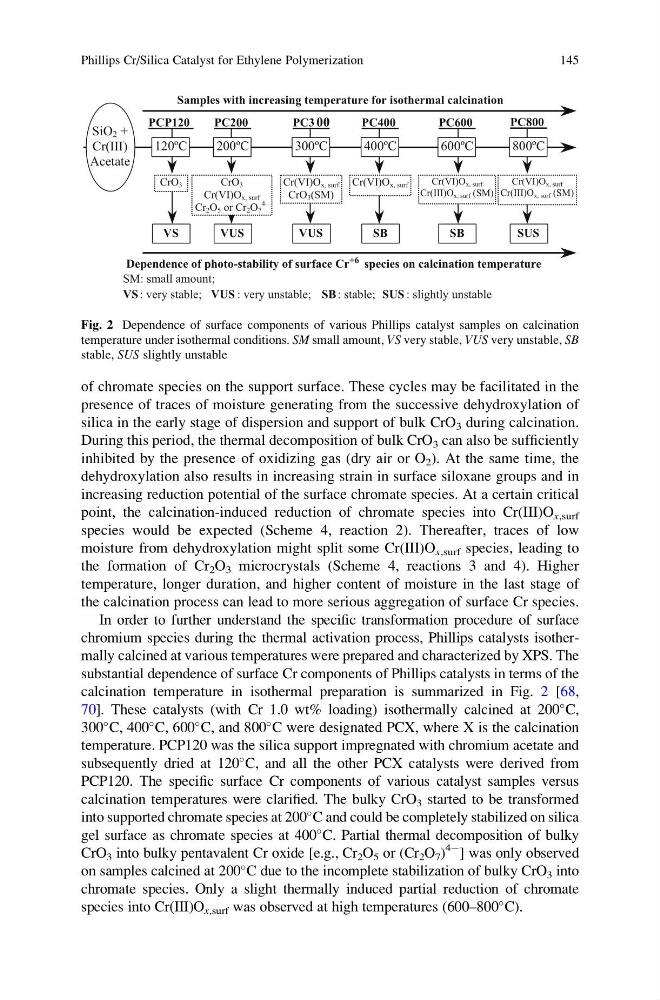
In order to further understand the specific transformation procedure of surface
chromium species during the thermal activation process, Phillips catalysts isothermally calcined at various temperatures were prepared and characterized by XPS. The
substantial dependence of surface Cr components of Phillips catalysts in terms of the
calcination temperature in isothermal preparation is summarized in Fig. 2 [68,
70]. These catalysts (with Cr 1.0 wt% loading) isothermally calcined at 200
C,
300
C, 400
C, 600
C, and 800
C were designated PCX, where X is the calcination
temperature. PCP120 was the silica support impregnated with chromium acetate and
subsequently dried at 120
C, and all the other PCX catalysts were derived from
PCP120. The specific surface Cr components of various catalyst samples versus
calcination temperatures were clarified. The bulky CrO 3 started to be transformed
into supported chromate species at 200
C and could be completely stabilized on silica
gel surface as chromate species at 400
C. Partial thermal decomposition of bulky
CrO 3 into bulky pentavalent Cr oxide [e.g., Cr 2 O 5 or (Cr 2 O 7 )
4À ] was only observed
on samples calcined at 200
C due to the incomplete stabilization of bulky CrO 3 into
chromate species. Only a slight thermally induced partial reduction of chromate
species into Cr(III)O x,surf was observed at high temperatures (600–800
C).
120ºC
SiO 2 +
Cr(III)
Acetate
200ºC
300ºC
400ºC
600ºC
800ºC
Samples with increasing temperature for isothermal calcination
CrO 3
CrO 3
Cr(VI)O x, surf
Cr 2 O 5 or Cr 2 O 7
4–
Cr(VI)O x, surf
CrO 3 (SM)
Cr(VI)O x, surf
Cr(VI)O x, surf
Cr(III)O x, surf (SM)
Cr(VI)O x, surf
Cr(III)O x, surf (SM)
PCP120
PC200
PC3 00
PC400
PC600
PC800
Dependence of photo-stability of surface Cr
+6 species on calcination temperature
SM: small amount;
VS : very stable; VUS : very unstable; SB : stable; SUS : slightly unstable
VS
VUS
VUS
SB
SB
SUS
Fig. 2 Dependence of surface components of various Phillips catalyst samples on calcination
temperature under isothermal conditions. SM small amount, VS very stable, VUS very unstable, SB
stable, SUS slightly unstable
Phillips Cr/Silica Catalyst for Ethylene Polymerization
145
presence of traces of moisture generating from the successive dehydroxylation of
silica in the early stage of dispersion and support of bulk CrO 3 during calcination.
During this period, the thermal decomposition of bulk CrO 3 can also be sufficiently
inhibited by the presence of oxidizing gas (dry air or O 2 ). At the same time, the
dehydroxylation also results in increasing strain in surface siloxane groups and in
increasing reduction potential of the surface chromate species. At a certain critical
point, the calcination-induced reduction of chromate species into Cr(III)O x,surf
species would be expected (Scheme 4, reaction 2). Thereafter, traces of low
moisture from dehydroxylation might split some Cr(III)O x,surf species, leading to
the formation of Cr 2 O 3 microcrystals (Scheme 4, reactions 3 and 4). Higher
temperature, longer duration, and higher content of moisture in the last stage of
the calcination process can lead to more serious aggregation of surface Cr species.
In order to further understand the specific transformation procedure of surface
chromium species during the thermal activation process, Phillips catalysts isothermally calcined at various temperatures were prepared and characterized by XPS. The
substantial dependence of surface Cr components of Phillips catalysts in terms of the
calcination temperature in isothermal preparation is summarized in Fig. 2 [68,
70]. These catalysts (with Cr 1.0 wt% loading) isothermally calcined at 200
C,
300
C, 400
C, 600
C, and 800
C were designated PCX, where X is the calcination
temperature. PCP120 was the silica support impregnated with chromium acetate and
subsequently dried at 120
C, and all the other PCX catalysts were derived from
PCP120. The specific surface Cr components of various catalyst samples versus
calcination temperatures were clarified. The bulky CrO 3 started to be transformed
into supported chromate species at 200
C and could be completely stabilized on silica
gel surface as chromate species at 400
C. Partial thermal decomposition of bulky
CrO 3 into bulky pentavalent Cr oxide [e.g., Cr 2 O 5 or (Cr 2 O 7 )
4À ] was only observed
on samples calcined at 200
C due to the incomplete stabilization of bulky CrO 3 into
chromate species. Only a slight thermally induced partial reduction of chromate
species into Cr(III)O x,surf was observed at high temperatures (600–800
C).
120ºC
SiO 2 +
Cr(III)
Acetate
200ºC
300ºC
400ºC
600ºC
800ºC
Samples with increasing temperature for isothermal calcination
CrO 3
CrO 3
Cr(VI)O x, surf
Cr 2 O 5 or Cr 2 O 7
4–
Cr(VI)O x, surf
CrO 3 (SM)
Cr(VI)O x, surf
Cr(VI)O x, surf
Cr(III)O x, surf (SM)
Cr(VI)O x, surf
Cr(III)O x, surf (SM)
PCP120
PC200
PC3 00
PC400
PC600
PC800
Dependence of photo-stability of surface Cr
+6 species on calcination temperature
SM: small amount;
VS : very stable; VUS : very unstable; SB : stable; SUS : slightly unstable
VS
VUS
VUS
SB
SB
SUS
Fig. 2 Dependence of surface components of various Phillips catalyst samples on calcination
temperature under isothermal conditions. SM small amount, VS very stable, VUS very unstable, SB
stable, SUS slightly unstable
Phillips Cr/Silica Catalyst for Ethylene Polymerization
145