

To make these calculations, some conditions are necessary:
1. Active centers should be formed instantly at interaction of the catalyst with
соcatalyst and the time necessary for formation of the active centers should
be less than the time of quasi-living polymerization
2. The number of active centers and polymerization rate should be constant
at the stage of quasi-living polymerization
2.2 Radiochemical Methods
In these methods, the number of active centers is defined by introduction of a
radioactive label in a growing polymeric chain. The label can be entered at an
initiation stage by use of an organoaluminum cocatalyst, containing alkyl group
with a radioactive label. This method has been used Natta [15, 146] and Chien [154]
in a study of propylene polymerization on the TiCl 3 catalyst in a combination with
cocatalysts Al(Et) 3 or Al(Et) 2 Cl labeled by radioactive isotope
14
С.
Another method is based on introduction into polymerization of compounds
(quenching agents) labeled by a radioactive isotope and by termination of polymerization in such a manner that this compound or its part joins a growing polymer
chain (QR method). In the case of olefin polymerization on ZN catalysts,
alcohol labeled with
3 H in the hydroxyl group was used as a quenching agent
(QR RO
3 H method):
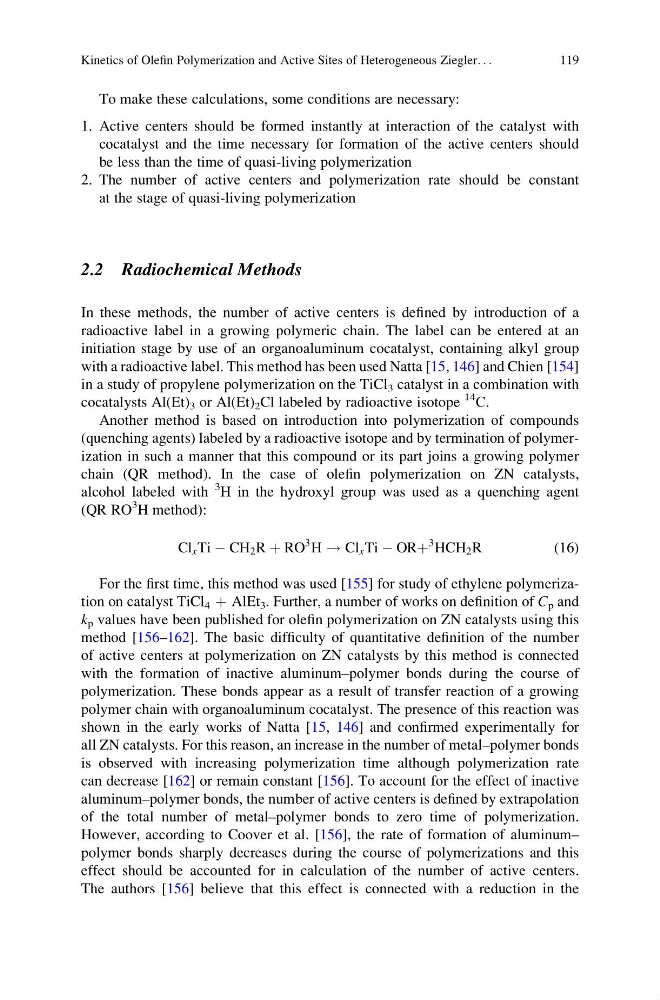
Cl x Ti À CH 2 R þ RO
3 H ! Cl x Ti À ORþ
3 HCH 2 R
(16)
For the first time, this method was used [155] for study of ethylene polymerization on catalyst TiCl 4 þ AlEt 3 . Further, a number of works on definition of C p and
k p values have been published for olefin polymerization on ZN catalysts using this
method [156–162]. The basic difficulty of quantitative definition of the number
of active centers at polymerization on ZN catalysts by this method is connected
with the formation of inactive aluminum–polymer bonds during the course of
polymerization. These bonds appear as a result of transfer reaction of a growing
polymer chain with organoaluminum cocatalyst. The presence of this reaction was
shown in the early works of Natta [15, 146] and confirmed experimentally for
all ZN catalysts. For this reason, an increase in the number of metal–polymer bonds
is observed with increasing polymerization time although polymerization rate
can decrease [162] or remain constant [156]. To account for the effect of inactive
aluminum–polymer bonds, the number of active centers is defined by extrapolation
of the total number of metal–polymer bonds to zero time of polymerization.
However, according to Coover et al. [156], the rate of formation of aluminum–
polymer bonds sharply decreases during the course of polymerizations and this
effect should be accounted for in calculation of the number of active centers.
The authors [156] believe that this effect is connected with a reduction in the
Kinetics of Olefin Polymerization and Active Sites of Heterogeneous Ziegler. . .
119
1. Active centers should be formed instantly at interaction of the catalyst with
соcatalyst and the time necessary for formation of the active centers should
be less than the time of quasi-living polymerization
2. The number of active centers and polymerization rate should be constant
at the stage of quasi-living polymerization
2.2 Radiochemical Methods
In these methods, the number of active centers is defined by introduction of a
radioactive label in a growing polymeric chain. The label can be entered at an
initiation stage by use of an organoaluminum cocatalyst, containing alkyl group
with a radioactive label. This method has been used Natta [15, 146] and Chien [154]
in a study of propylene polymerization on the TiCl 3 catalyst in a combination with
cocatalysts Al(Et) 3 or Al(Et) 2 Cl labeled by radioactive isotope
14
С.
Another method is based on introduction into polymerization of compounds
(quenching agents) labeled by a radioactive isotope and by termination of polymerization in such a manner that this compound or its part joins a growing polymer
chain (QR method). In the case of olefin polymerization on ZN catalysts,
alcohol labeled with
3 H in the hydroxyl group was used as a quenching agent
(QR RO
3 H method):
Cl x Ti À CH 2 R þ RO
3 H ! Cl x Ti À ORþ
3 HCH 2 R
(16)
For the first time, this method was used [155] for study of ethylene polymerization on catalyst TiCl 4 þ AlEt 3 . Further, a number of works on definition of C p and
k p values have been published for olefin polymerization on ZN catalysts using this
method [156–162]. The basic difficulty of quantitative definition of the number
of active centers at polymerization on ZN catalysts by this method is connected
with the formation of inactive aluminum–polymer bonds during the course of
polymerization. These bonds appear as a result of transfer reaction of a growing
polymer chain with organoaluminum cocatalyst. The presence of this reaction was
shown in the early works of Natta [15, 146] and confirmed experimentally for
all ZN catalysts. For this reason, an increase in the number of metal–polymer bonds
is observed with increasing polymerization time although polymerization rate
can decrease [162] or remain constant [156]. To account for the effect of inactive
aluminum–polymer bonds, the number of active centers is defined by extrapolation
of the total number of metal–polymer bonds to zero time of polymerization.
However, according to Coover et al. [156], the rate of formation of aluminum–
polymer bonds sharply decreases during the course of polymerizations and this
effect should be accounted for in calculation of the number of active centers.
The authors [156] believe that this effect is connected with a reduction in the
Kinetics of Olefin Polymerization and Active Sites of Heterogeneous Ziegler. . .
119