

concentration of organoaluminum compound on a surface of the catalyst owing
to its slow diffusion through a layer of formed polymer.
More reliable data on the number of active centers can be obtained by this
method for cases where the contribution of the transfer reaction with organoaluminum cocatalyst is very small. Such a case is the polymerization of
4-methylpentene-1 on catalyst VCl 3 /Al(i-Bu) 3 [163].
Later, for definition of the number of active centers at polymerization on ZN
catalysts, it was suggested that the “selective” quenching agent (
14
СО), interacting
only with titanium–polymer bonds [164–166], (QR
14 CO method) be used. The use
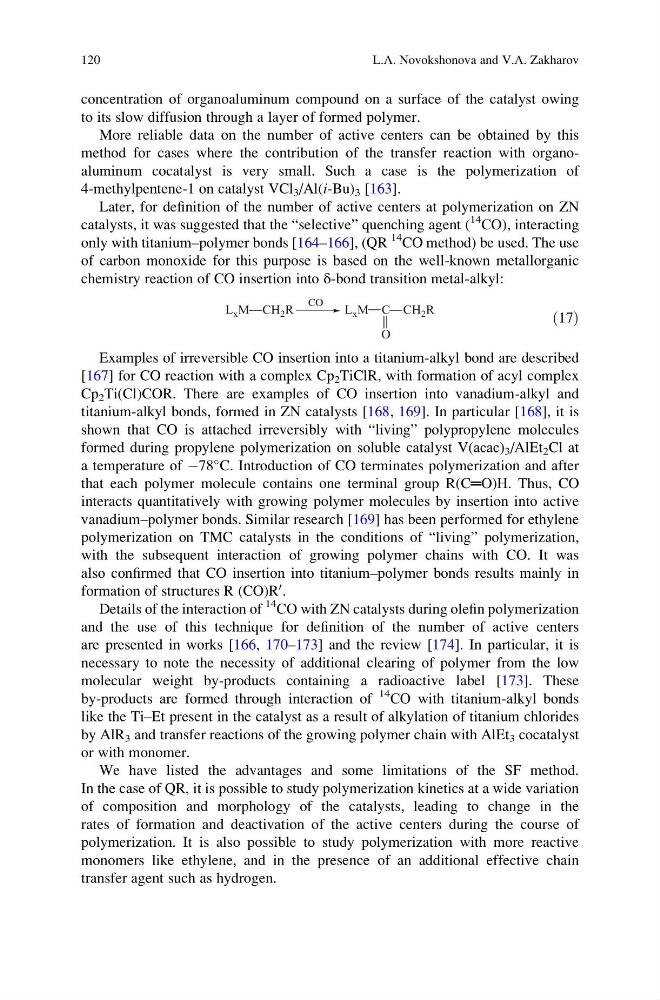
of carbon monoxide for this purpose is based on the well-known metallorganic
chemistry reaction of CO insertion into δ-bond transition metal-alkyl:
ð17Þ
Examples of irreversible CO insertion into a titanium-alkyl bond are described
[167] for CO reaction with a complex Cp 2 TiClR, with formation of acyl complex
Cp 2 Ti(Cl)COR. There are examples of CO insertion into vanadium-alkyl and
titanium-alkyl bonds, formed in ZN catalysts [168, 169]. In particular [168], it is
shown that CO is attached irreversibly with “living” polypropylene molecules
formed during propylene polymerization on soluble catalyst V(асас) 3 /AlEt 2 Cl at
a temperature of À78
C. Introduction of CO terminates polymerization and after
that each polymer molecule contains one terminal group R(C═O)H. Thus, CO
interacts quantitatively with growing polymer molecules by insertion into active
vanadium–polymer bonds. Similar research [169] has been performed for ethylene
polymerization on TMC catalysts in the conditions of “living” polymerization,
with the subsequent interaction of growing polymer chains with CO. It was
also confirmed that CO insertion into titanium–polymer bonds results mainly in
formation of structures R (CO)R
0 .
Details of the interaction of
14 СО with ZN catalysts during olefin polymerization
and the use of this technique for definition of the number of active centers
are presented in works [166, 170–173] and the review [174]. In particular, it is
necessary to note the necessity of additional clearing of polymer from the low
molecular weight by-products containing a radioactive label [173]. These
by-products are formed through interaction of
14
СО with titanium-alkyl bonds
like the Ti–Et present in the catalyst as a result of alkylation of titanium chlorides
by AlR 3 and transfer reactions of the growing polymer chain with AlEt 3 cocatalyst
or with monomer.
We have listed the advantages and some limitations of the SF method.
In the case of QR, it is possible to study polymerization kinetics at a wide variation
of composition and morphology of the catalysts, leading to change in the
rates of formation and deactivation of the active centers during the course of
polymerization. It is also possible to study polymerization with more reactive
monomers like ethylene, and in the presence of an additional effective chain
transfer agent such as hydrogen.
120
L.A. Novokshonova and V.A. Zakharov
to its slow diffusion through a layer of formed polymer.
More reliable data on the number of active centers can be obtained by this
method for cases where the contribution of the transfer reaction with organoaluminum cocatalyst is very small. Such a case is the polymerization of
4-methylpentene-1 on catalyst VCl 3 /Al(i-Bu) 3 [163].
Later, for definition of the number of active centers at polymerization on ZN
catalysts, it was suggested that the “selective” quenching agent (
14
СО), interacting
only with titanium–polymer bonds [164–166], (QR
14 CO method) be used. The use
of carbon monoxide for this purpose is based on the well-known metallorganic
chemistry reaction of CO insertion into δ-bond transition metal-alkyl:
ð17Þ
Examples of irreversible CO insertion into a titanium-alkyl bond are described
[167] for CO reaction with a complex Cp 2 TiClR, with formation of acyl complex
Cp 2 Ti(Cl)COR. There are examples of CO insertion into vanadium-alkyl and
titanium-alkyl bonds, formed in ZN catalysts [168, 169]. In particular [168], it is
shown that CO is attached irreversibly with “living” polypropylene molecules
formed during propylene polymerization on soluble catalyst V(асас) 3 /AlEt 2 Cl at
a temperature of À78
C. Introduction of CO terminates polymerization and after
that each polymer molecule contains one terminal group R(C═O)H. Thus, CO
interacts quantitatively with growing polymer molecules by insertion into active
vanadium–polymer bonds. Similar research [169] has been performed for ethylene
polymerization on TMC catalysts in the conditions of “living” polymerization,
with the subsequent interaction of growing polymer chains with CO. It was
also confirmed that CO insertion into titanium–polymer bonds results mainly in
formation of structures R (CO)R
0 .
Details of the interaction of
14 СО with ZN catalysts during olefin polymerization
and the use of this technique for definition of the number of active centers
are presented in works [166, 170–173] and the review [174]. In particular, it is
necessary to note the necessity of additional clearing of polymer from the low
molecular weight by-products containing a radioactive label [173]. These
by-products are formed through interaction of
14
СО with titanium-alkyl bonds
like the Ti–Et present in the catalyst as a result of alkylation of titanium chlorides
by AlR 3 and transfer reactions of the growing polymer chain with AlEt 3 cocatalyst
or with monomer.
We have listed the advantages and some limitations of the SF method.
In the case of QR, it is possible to study polymerization kinetics at a wide variation
of composition and morphology of the catalysts, leading to change in the
rates of formation and deactivation of the active centers during the course of
polymerization. It is also possible to study polymerization with more reactive
monomers like ethylene, and in the presence of an additional effective chain
transfer agent such as hydrogen.
120
L.A. Novokshonova and V.A. Zakharov