

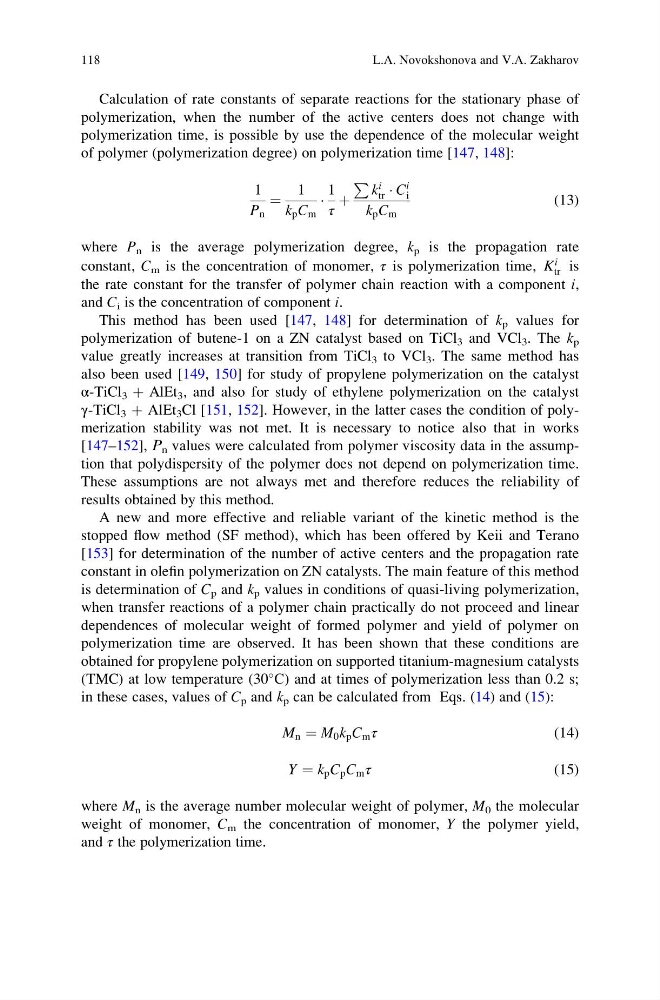
Calculation of rate constants of separate reactions for the stationary phase of
polymerization, when the number of the active centers does not change with
polymerization time, is possible by use the dependence of the molecular weight
of polymer (polymerization degree) on polymerization time [147, 148]:
1
P n
¼
1
k p C m
Á
1
τ
þ
P
k
i
tr Á C
i
i
k p C m
(13)
where P n is the average polymerization degree, k p is the propagation rate
constant, C m is the concentration of monomer, τ is polymerization time, K
i
tr is
the rate constant for the transfer of polymer chain reaction with a component i,
and C i is the concentration of component i.
This method has been used [147, 148] for determination of k p values for
polymerization of butene-1 on a ZN catalyst based on TiCl 3 and VCl 3 . The k p
value greatly increases at transition from TiCl 3 to VCl 3 . The same method has
also been used [149, 150] for study of propylene polymerization on the catalyst
α-TiCl 3 þ AlEt 3 , and also for study of ethylene polymerization on the catalyst
γ-TiCl 3 þ AlEt 3 Cl [151, 152]. However, in the latter cases the condition of polymerization stability was not met. It is necessary to notice also that in works
[147–152], Р n values were calculated from polymer viscosity data in the assumption that polydispersity of the polymer does not depend on polymerization time.
These assumptions are not always met and therefore reduces the reliability of
results obtained by this method.
A new and more effective and reliable variant of the kinetic method is the
stopped flow method (SF method), which has been offered by Keii and Terano
[153] for determination of the number of active centers and the propagation rate
constant in olefin polymerization on ZN catalysts. The main feature of this method
is determination of C p and k p values in conditions of quasi-living polymerization,
when transfer reactions of a polymer chain practically do not proceed and linear
dependences of molecular weight of formed polymer and yield of polymer on
polymerization time are observed. It has been shown that these conditions are
obtained for propylene polymerization on supported titanium-magnesium catalysts
(TMC) at low temperature (30
С) and at times of polymerization less than 0.2 s;
in these cases, values of C p and k p can be calculated from Eqs. (14) and (15):
M n ¼ M 0 k p C m τ
(14)
Y ¼ k p C p C m τ
(15)
where M n is the average number molecular weight of polymer, M 0 the molecular
weight of monomer, C m the concentration of monomer, Y the polymer yield,
and τ the polymerization time.
118
L.A. Novokshonova and V.A. Zakharov
polymerization, when the number of the active centers does not change with
polymerization time, is possible by use the dependence of the molecular weight
of polymer (polymerization degree) on polymerization time [147, 148]:
1
P n
¼
1
k p C m
Á
1
τ
þ
P
k
i
tr Á C
i
i
k p C m
(13)
where P n is the average polymerization degree, k p is the propagation rate
constant, C m is the concentration of monomer, τ is polymerization time, K
i
tr is
the rate constant for the transfer of polymer chain reaction with a component i,
and C i is the concentration of component i.
This method has been used [147, 148] for determination of k p values for
polymerization of butene-1 on a ZN catalyst based on TiCl 3 and VCl 3 . The k p
value greatly increases at transition from TiCl 3 to VCl 3 . The same method has
also been used [149, 150] for study of propylene polymerization on the catalyst
α-TiCl 3 þ AlEt 3 , and also for study of ethylene polymerization on the catalyst
γ-TiCl 3 þ AlEt 3 Cl [151, 152]. However, in the latter cases the condition of polymerization stability was not met. It is necessary to notice also that in works
[147–152], Р n values were calculated from polymer viscosity data in the assumption that polydispersity of the polymer does not depend on polymerization time.
These assumptions are not always met and therefore reduces the reliability of
results obtained by this method.
A new and more effective and reliable variant of the kinetic method is the
stopped flow method (SF method), which has been offered by Keii and Terano
[153] for determination of the number of active centers and the propagation rate
constant in olefin polymerization on ZN catalysts. The main feature of this method
is determination of C p and k p values in conditions of quasi-living polymerization,
when transfer reactions of a polymer chain practically do not proceed and linear
dependences of molecular weight of formed polymer and yield of polymer on
polymerization time are observed. It has been shown that these conditions are
obtained for propylene polymerization on supported titanium-magnesium catalysts
(TMC) at low temperature (30
С) and at times of polymerization less than 0.2 s;
in these cases, values of C p and k p can be calculated from Eqs. (14) and (15):
M n ¼ M 0 k p C m τ
(14)
Y ¼ k p C p C m τ
(15)
where M n is the average number molecular weight of polymer, M 0 the molecular
weight of monomer, C m the concentration of monomer, Y the polymer yield,
and τ the polymerization time.
118
L.A. Novokshonova and V.A. Zakharov