

2. The increase in the number of active centers can be achieved as a result
of heterogeneous catalyst fragmentation [122, 123], deagglomeration of the
growing polymer particles during copolymerization with homogeneous catalysts
[126, 130, 131], or by activation of dormant active centers [113]
3. Modification of active centers by comonomer, with variation in the propagation
rate constant [118, 119, 124, 125, 127, 132, 141]
4. Diffusion effects and the related increase in monomer concentration near the
active site [134, 145]
Due to the diversity and complexity of the considered polymerization processes,
the different causes for manifestation of the comonomer effect or their combination
may appear, depending on conditions.
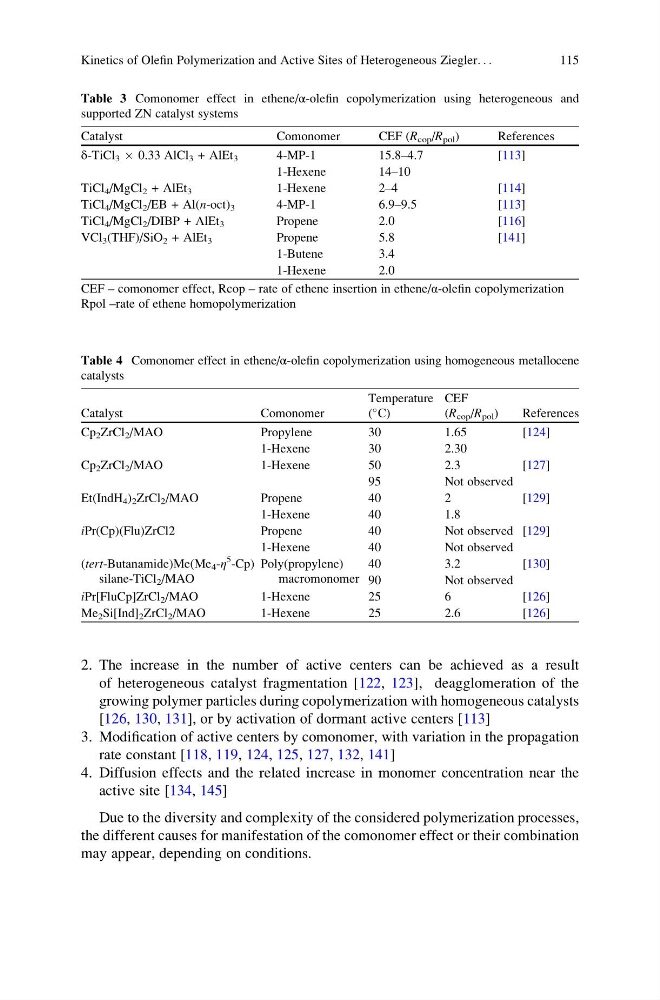
Table 4 Comonomer effect in ethene/α-olefin copolymerization using homogeneous metallocene
catalysts
Catalyst
Comonomer
Temperature
(
С)
CEF
(R cop /R pol )
References
Cp 2 ZrCl 2 /MAO
Propylene
30
1.65
[124]
1-Hexene
30
2.30
Cp 2 ZrCl 2 /MAO
1-Hexene
50
2.3
[127]
95
Not observed
Et(IndH 4 ) 2 ZrCl 2 /MAO
Propene
40
2
[129]
1-Hexene
40
1.8
iPr(Cp)(Flu)ZrCl2
Propene
40
Not observed [129]
1-Hexene
40
Not observed
(tert-Butanamide)Me(Me 4 -η
5
-Cp)
silane-TiCl 2 /MAO
Poly(propylene)
macromonomer
40
3.2
[130]
90
Not observed
iPr[FluCp]ZrCl 2 /MAO
1-Hexene
25
6
[126]
Me 2 Si[Ind] 2 ZrCl 2 /MAO
1-Hexene
25
2.6
[126]
Table 3 Comonomer effect in ethene/α-olefin copolymerization using heterogeneous and
supported ZN catalyst systems
Catalyst
Comonomer
CEF (R cop /R pol )
References
δ-TiCl 3 Â 0.33 AlCl 3 + AlEt 3
4-MP-1
15.8–4.7
[113]
1-Hexene
14–10
TiCl 4 /MgCl 2 + AlEt 3
1-Hexene
2–4
[114]
TiCl 4 /MgCl 2 /EB + Al(n-oct) 3
4-MP-1
6.9–9.5
[113]
TiCl 4 /MgCl 2 /DIBP + AlEt 3
Propene
2.0
[116]
VCl 3 (THF)/SiO 2 + AlEt 3
Propene
5.8
[141]
1-Butene
3.4
1-Hexene
2.0
CEF – comonomer effect, Rcop – rate of ethene insertion in ethene/α-olefin copolymerization
Rpol –rate of ethene homopolymerization
Kinetics of Olefin Polymerization and Active Sites of Heterogeneous Ziegler. . .
115
of heterogeneous catalyst fragmentation [122, 123], deagglomeration of the
growing polymer particles during copolymerization with homogeneous catalysts
[126, 130, 131], or by activation of dormant active centers [113]
3. Modification of active centers by comonomer, with variation in the propagation
rate constant [118, 119, 124, 125, 127, 132, 141]
4. Diffusion effects and the related increase in monomer concentration near the
active site [134, 145]
Due to the diversity and complexity of the considered polymerization processes,
the different causes for manifestation of the comonomer effect or their combination
may appear, depending on conditions.
Table 4 Comonomer effect in ethene/α-olefin copolymerization using homogeneous metallocene
catalysts
Catalyst
Comonomer
Temperature
(
С)
CEF
(R cop /R pol )
References
Cp 2 ZrCl 2 /MAO
Propylene
30
1.65
[124]
1-Hexene
30
2.30
Cp 2 ZrCl 2 /MAO
1-Hexene
50
2.3
[127]
95
Not observed
Et(IndH 4 ) 2 ZrCl 2 /MAO
Propene
40
2
[129]
1-Hexene
40
1.8
iPr(Cp)(Flu)ZrCl2
Propene
40
Not observed [129]
1-Hexene
40
Not observed
(tert-Butanamide)Me(Me 4 -η
5
-Cp)
silane-TiCl 2 /MAO
Poly(propylene)
macromonomer
40
3.2
[130]
90
Not observed
iPr[FluCp]ZrCl 2 /MAO
1-Hexene
25
6
[126]
Me 2 Si[Ind] 2 ZrCl 2 /MAO
1-Hexene
25
2.6
[126]
Table 3 Comonomer effect in ethene/α-olefin copolymerization using heterogeneous and
supported ZN catalyst systems
Catalyst
Comonomer
CEF (R cop /R pol )
References
δ-TiCl 3 Â 0.33 AlCl 3 + AlEt 3
4-MP-1
15.8–4.7
[113]
1-Hexene
14–10
TiCl 4 /MgCl 2 + AlEt 3
1-Hexene
2–4
[114]
TiCl 4 /MgCl 2 /EB + Al(n-oct) 3
4-MP-1
6.9–9.5
[113]
TiCl 4 /MgCl 2 /DIBP + AlEt 3
Propene
2.0
[116]
VCl 3 (THF)/SiO 2 + AlEt 3
Propene
5.8
[141]
1-Butene
3.4
1-Hexene
2.0
CEF – comonomer effect, Rcop – rate of ethene insertion in ethene/α-olefin copolymerization
Rpol –rate of ethene homopolymerization
Kinetics of Olefin Polymerization and Active Sites of Heterogeneous Ziegler. . .
115