

2 Number of Active Centers and Propagation Rate
Constants for Olefin Polymerization on ZN Catalysts
For catalytic olefin polymerization on heterogeneous ZN catalysts, it is accepted
that surface alkyl compounds of transition metals should be considered as the
active centers. These species contain a growing polymer chain as an alkyl group.
For analysis of the kinetics and mechanism of polymerization on ZN catalysts, it is
all-important to have data on the number of active centers (С р ). The number of
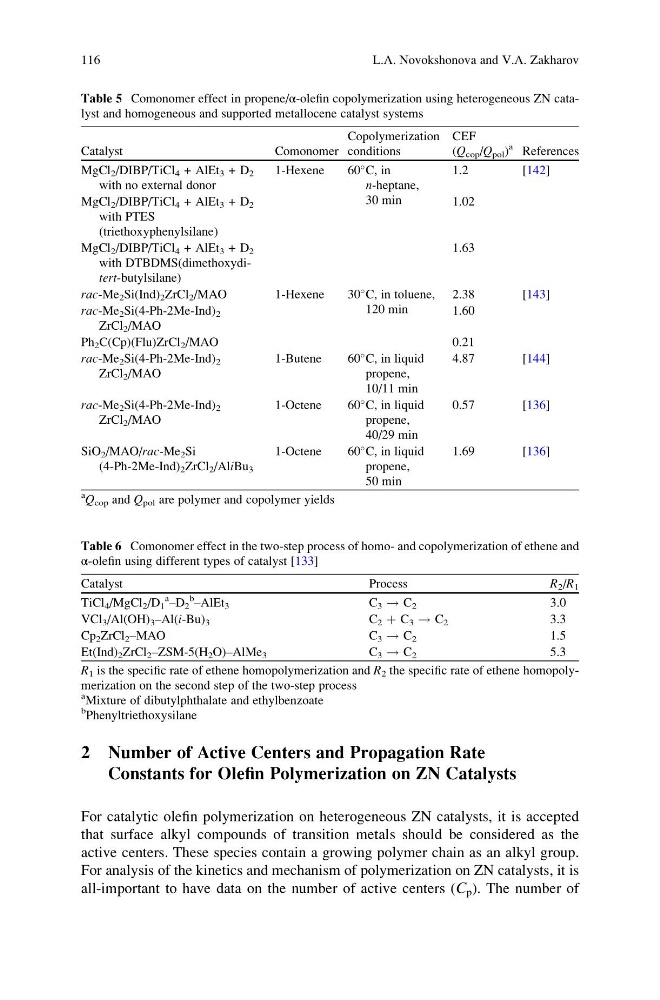
Table 5 Comonomer effect in propene/α-olefin copolymerization using heterogeneous ZN catalyst and homogeneous and supported metallocene catalyst systems
Catalyst
Comonomer
Copolymerization
conditions
CEF
(Q cop /Q pol )
a References
MgCl 2 /DIBP/TiCl 4 + AlEt 3 + D 2
with no external donor
1-Hexene
60
C, in
n-heptane,
30 min
1.2
[142]
MgCl 2 /DIBP/TiCl 4 + AlEt 3 + D 2
with PTES
(triethoxyphenylsilane)
1.02
MgCl 2 /DIBP/TiCl 4 + AlEt 3 + D 2
with DTBDMS(dimethoxyditert-butylsilane)
1.63
rac-Me 2 Si(Ind) 2 ZrCl 2 /MAO
1-Hexene
30
C, in toluene,
120 min
2.38
[143]
rac-Me 2 Si(4-Ph-2Me-Ind) 2
ZrCl 2 /MAO
1.60
Ph 2 C(Cp)(Flu)ZrCl 2 /MAO
0.21
rac-Me 2 Si(4-Ph-2Me-Ind) 2
ZrCl 2 /MAO
1-Butene
60
C, in liquid
propene,
10/11 min
4.87
[144]
rac-Me 2 Si(4-Ph-2Me-Ind) 2
ZrCl 2 /MAO
1-Octene
60
C, in liquid
propene,
40/29 min
0.57
[136]
SiO 2 /MAO/rac-Me 2 Si
(4-Ph-2Me-Ind) 2 ZrCl 2 /AliBu 3
1-Octene
60
C, in liquid
propene,
50 min
1.69
[136]
a
Q cop and Q pol are polymer and copolymer yields
Table 6 Comonomer effect in the two-step process of homo- and copolymerization of ethene and
α-olefin using different types of catalyst [133]
Catalyst
Process
R 2 /R 1
TiCl 4 /MgCl 2 /D 1
a –D 2
b
–AlEt 3
C 3 ! C 2
3.0
VCl 3 /Al(OH) 3 –Al(i-Bu) 3
C 2 þ C 3 ! C 2
3.3
Cp 2 ZrCl 2 –MAO
C 3 ! C 2
1.5
Et(Ind) 2 ZrCl 2 –ZSM-5(H 2 O)–AlMe 3
C 3 ! C 2
5.3
R 1 is the specific rate of ethene homopolymerization and R 2 the specific rate of ethene homopolymerization on the second step of the two-step process
a
Mixture of dibutylphthalate and ethylbenzoate
b
Phenyltriethoxysilane
116
L.A. Novokshonova and V.A. Zakharov
Constants for Olefin Polymerization on ZN Catalysts
For catalytic olefin polymerization on heterogeneous ZN catalysts, it is accepted
that surface alkyl compounds of transition metals should be considered as the
active centers. These species contain a growing polymer chain as an alkyl group.
For analysis of the kinetics and mechanism of polymerization on ZN catalysts, it is
all-important to have data on the number of active centers (С р ). The number of
Table 5 Comonomer effect in propene/α-olefin copolymerization using heterogeneous ZN catalyst and homogeneous and supported metallocene catalyst systems
Catalyst
Comonomer
Copolymerization
conditions
CEF
(Q cop /Q pol )
a References
MgCl 2 /DIBP/TiCl 4 + AlEt 3 + D 2
with no external donor
1-Hexene
60
C, in
n-heptane,
30 min
1.2
[142]
MgCl 2 /DIBP/TiCl 4 + AlEt 3 + D 2
with PTES
(triethoxyphenylsilane)
1.02
MgCl 2 /DIBP/TiCl 4 + AlEt 3 + D 2
with DTBDMS(dimethoxyditert-butylsilane)
1.63
rac-Me 2 Si(Ind) 2 ZrCl 2 /MAO
1-Hexene
30
C, in toluene,
120 min
2.38
[143]
rac-Me 2 Si(4-Ph-2Me-Ind) 2
ZrCl 2 /MAO
1.60
Ph 2 C(Cp)(Flu)ZrCl 2 /MAO
0.21
rac-Me 2 Si(4-Ph-2Me-Ind) 2
ZrCl 2 /MAO
1-Butene
60
C, in liquid
propene,
10/11 min
4.87
[144]
rac-Me 2 Si(4-Ph-2Me-Ind) 2
ZrCl 2 /MAO
1-Octene
60
C, in liquid
propene,
40/29 min
0.57
[136]
SiO 2 /MAO/rac-Me 2 Si
(4-Ph-2Me-Ind) 2 ZrCl 2 /AliBu 3
1-Octene
60
C, in liquid
propene,
50 min
1.69
[136]
a
Q cop and Q pol are polymer and copolymer yields
Table 6 Comonomer effect in the two-step process of homo- and copolymerization of ethene and
α-olefin using different types of catalyst [133]
Catalyst
Process
R 2 /R 1
TiCl 4 /MgCl 2 /D 1
a –D 2
b
–AlEt 3
C 3 ! C 2
3.0
VCl 3 /Al(OH) 3 –Al(i-Bu) 3
C 2 þ C 3 ! C 2
3.3
Cp 2 ZrCl 2 –MAO
C 3 ! C 2
1.5
Et(Ind) 2 ZrCl 2 –ZSM-5(H 2 O)–AlMe 3
C 3 ! C 2
5.3
R 1 is the specific rate of ethene homopolymerization and R 2 the specific rate of ethene homopolymerization on the second step of the two-step process
a
Mixture of dibutylphthalate and ethylbenzoate
b
Phenyltriethoxysilane
116
L.A. Novokshonova and V.A. Zakharov