

1.9 Comonomer Effect in Olefin Copolymerization Reactions
One of the features of olefin copolymerization kinetics is the effect of comonomer
on the rate of ethene or propene polymerization during ethene/α-olefin or propene/
α-olefin copolymerization, i.e., the so-called comonomer effect (CEF). The rate
enhancement of ethene or propene polymerization in the presence of a comonomer
is observed for conventional ZN catalysts [80, 113–123] and for homogeneous
[124–133] and supported metallocenes [134–136] and post-metallocenes catalysts
[137–140]. The increase in activity was remarked in the presence of such comonomers
as propene, 2-methylpropene, 1-butene, 3-methylbutene, 4-methylpentene-1, 1-hexene,
1-octene,1-decene, cyclopentene, styrene, and dienes.
Numerous studies have shown that the magnitude of effect depends on the
catalyst nature, the comonomer type, and the experimental conditions. Examples
of the comonomer effect for various catalysts and comonomers are shown in
Tables 3, 4, and 5 as the ratio of copolymerization rate to the ethylene (or propylene)
homopolymerization rate.
The effect is generally higher for heterogeneous catalysts, and for supported
metallocenes it is higher than for homogeneous catalysts. The length of the
α-olefin chain is also important. The higher the comonomer chain length, the
smaller the effect. The negative effect of comonomer on the rate was found
for ethylene/norbornene copolymerization [126] and for copolymerization of
propene with 1-octene for metallocene catalysts [136].
For understanding the nature of the comonomer effect, it is also very important
that the rate enhancement takes place in the sequential processes of homo- and
copolymerization, i.e., when the ethene homopolymerization is carried out after
the α-olefin homopolymerization or ethene/α-olefin copolymerization [122, 123]
(Table 6).
The nature of this phenomenon is widely discussed in the literature. Several
reasons (physical and chemical) have been proposed:
1. Monomer access to active centers through the polymer film becomes easier
with higher amorphous phase content in the copolymer [116, 119, 121–123] or
with dissolving of the polymer in the reaction medium [126, 130, 131]
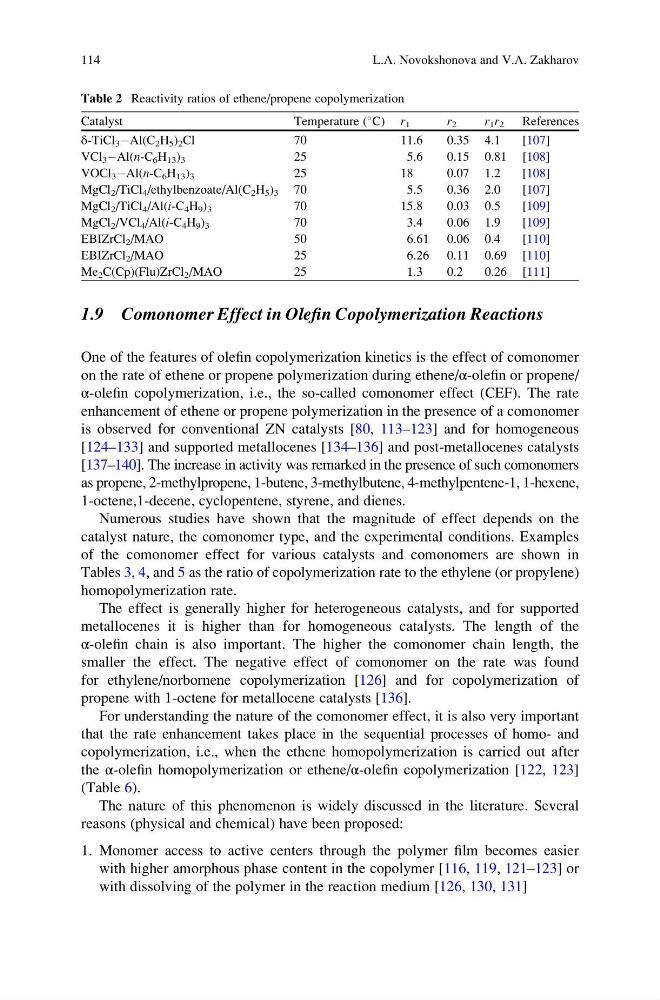
Table 2 Reactivity ratios of ethene/propene copolymerization
Catalyst
Temperature (
C) r 1
r 2
r 1 r 2 References
δ-TiCl 3 ÀAl(C 2 H 5 ) 2 Cl
70
11.6
0.35 4.1
[107]
VCl 3 ÀAl(n-C 6 H 13 ) 3
25
5.6
0.15 0.81 [108]
VOCl 3 ÀAl(n-C 6 H 13 ) 3
25
18
0.07 1.2
[108]
MgCl 2 /TiCl 4 /ethylbenzoate/Al(C 2 H 5 ) 3 70
5.5
0.36 2.0
[107]
MgCl 2 /TiCl 4 /Al(i-C 4 H 9 ) 3
70
15.8
0.03 0.5
[109]
MgCl 2 /VCl 4 /Al(i-C 4 H 9 ) 3
70
3.4
0.06 1.9
[109]
EBIZrCl 2 /MAO
50
6.61 0.06 0.4
[110]
EBIZrCl 2 /MAO
25
6.26 0.11 0.69 [110]
Me 2 C(Cp)(Flu)ZrCl 2 /MAO
25
1.3
0.2
0.26 [111]
114
L.A. Novokshonova and V.A. Zakharov
One of the features of olefin copolymerization kinetics is the effect of comonomer
on the rate of ethene or propene polymerization during ethene/α-olefin or propene/
α-olefin copolymerization, i.e., the so-called comonomer effect (CEF). The rate
enhancement of ethene or propene polymerization in the presence of a comonomer
is observed for conventional ZN catalysts [80, 113–123] and for homogeneous
[124–133] and supported metallocenes [134–136] and post-metallocenes catalysts
[137–140]. The increase in activity was remarked in the presence of such comonomers
as propene, 2-methylpropene, 1-butene, 3-methylbutene, 4-methylpentene-1, 1-hexene,
1-octene,1-decene, cyclopentene, styrene, and dienes.
Numerous studies have shown that the magnitude of effect depends on the
catalyst nature, the comonomer type, and the experimental conditions. Examples
of the comonomer effect for various catalysts and comonomers are shown in
Tables 3, 4, and 5 as the ratio of copolymerization rate to the ethylene (or propylene)
homopolymerization rate.
The effect is generally higher for heterogeneous catalysts, and for supported
metallocenes it is higher than for homogeneous catalysts. The length of the
α-olefin chain is also important. The higher the comonomer chain length, the
smaller the effect. The negative effect of comonomer on the rate was found
for ethylene/norbornene copolymerization [126] and for copolymerization of
propene with 1-octene for metallocene catalysts [136].
For understanding the nature of the comonomer effect, it is also very important
that the rate enhancement takes place in the sequential processes of homo- and
copolymerization, i.e., when the ethene homopolymerization is carried out after
the α-olefin homopolymerization or ethene/α-olefin copolymerization [122, 123]
(Table 6).
The nature of this phenomenon is widely discussed in the literature. Several
reasons (physical and chemical) have been proposed:
1. Monomer access to active centers through the polymer film becomes easier
with higher amorphous phase content in the copolymer [116, 119, 121–123] or
with dissolving of the polymer in the reaction medium [126, 130, 131]
Table 2 Reactivity ratios of ethene/propene copolymerization
Catalyst
Temperature (
C) r 1
r 2
r 1 r 2 References
δ-TiCl 3 ÀAl(C 2 H 5 ) 2 Cl
70
11.6
0.35 4.1
[107]
VCl 3 ÀAl(n-C 6 H 13 ) 3
25
5.6
0.15 0.81 [108]
VOCl 3 ÀAl(n-C 6 H 13 ) 3
25
18
0.07 1.2
[108]
MgCl 2 /TiCl 4 /ethylbenzoate/Al(C 2 H 5 ) 3 70
5.5
0.36 2.0
[107]
MgCl 2 /TiCl 4 /Al(i-C 4 H 9 ) 3
70
15.8
0.03 0.5
[109]
MgCl 2 /VCl 4 /Al(i-C 4 H 9 ) 3
70
3.4
0.06 1.9
[109]
EBIZrCl 2 /MAO
50
6.61 0.06 0.4
[110]
EBIZrCl 2 /MAO
25
6.26 0.11 0.69 [110]
Me 2 C(Cp)(Flu)ZrCl 2 /MAO
25
1.3
0.2
0.26 [111]
114
L.A. Novokshonova and V.A. Zakharov