

1.8 Copolymerization
Processes of ethene/α-olefin copolymerization are of great practical importance.
Copolymerization of ethene with small amounts of highest α-olefins (1-butene,
1-hexene, 1-octene) allows one to produce linear low density polyethylene (LLDPE),
which is one of the most widely used large-scale polyolefin products. Polypropylene,
modified with small amounts of ethene, exhibits higher impact strength compared
to isotactic homopolypropylene. Copolymerization of propene with large amounts
of ethene and terpolymerization of ethene/propene/diene result in amorphous
elastomer materials (rubbers) [103].
The properties of olefin copolymers depend on the nature and content
of comonomer and on the comonomer distribution in the polymer chain.
If monomers are distributed as long sequences, crystalline copolymers are formed.
The random distribution of comonomers gives amorphous polymer materials.
The conventional ZN systems, such as heterogeneous Ti- or V-based catalysts
and homogeneous V-based catalysts, are used for industrial production of olefin
copolymers. The application of metallocene catalysts [104] has allowed an increase
in the comonomer content in copolymers, more uniform comonomer distribution in
the polymer chains, and broadening of the range of comonomers used [104–106].
Several examples of reactivity ratios r 1 and r 2 and their product r 1 r 2 for
ethene/propene copolymerization are given in Table 2. For most heterogeneous
titanium catalysts, the product r 1 r 2 is usually close to 1 or greater, which corresponds
to the tendency for this catalysts to form copolymers with long crystallizable
ethene sequences. In the case of V-based systems, the r 1 r 2 value is lower and
they give a more random comonomer distribution in the chain [107–109, 112].
For metallocene catalysts, the product r 1 r 2 is smaller than 1, which is reflected in
the alternation of ethene and propene units in copolymer chains [110, 111].
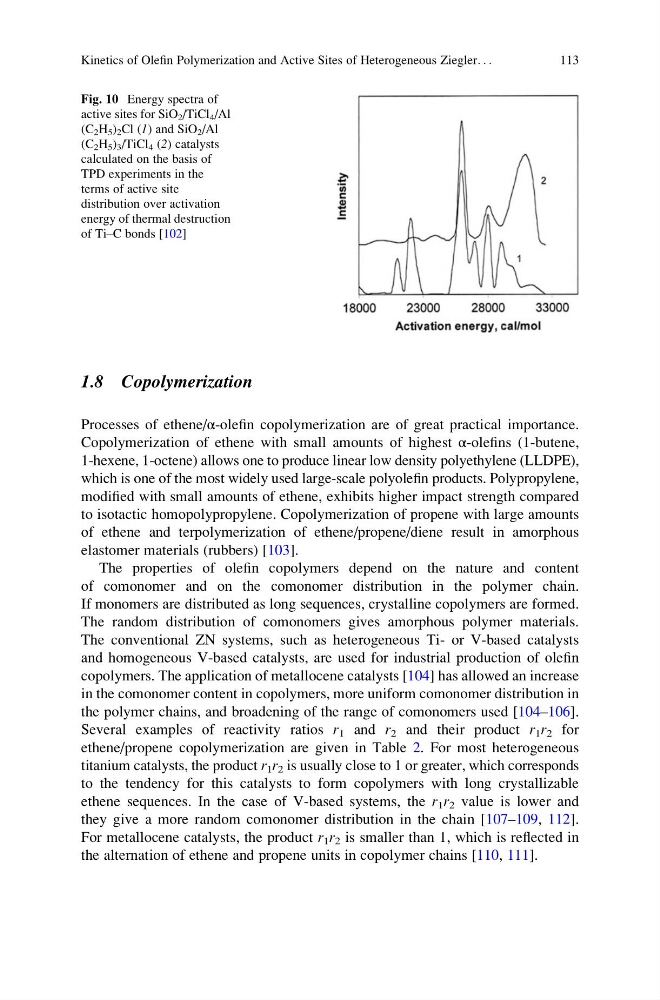
Fig. 10 Energy spectra of
active sites for SiO 2 /TiCl 4 /Al
(C 2 H 5 ) 2 Cl (1) and SiO 2 /Al
(C 2 H 5 ) 3 /TiCl 4 (2) catalysts
calculated on the basis of
TPD experiments in the
terms of active site
distribution over activation
energy of thermal destruction
of Ti–C bonds [102]
Kinetics of Olefin Polymerization and Active Sites of Heterogeneous Ziegler. . .
113
Processes of ethene/α-olefin copolymerization are of great practical importance.
Copolymerization of ethene with small amounts of highest α-olefins (1-butene,
1-hexene, 1-octene) allows one to produce linear low density polyethylene (LLDPE),
which is one of the most widely used large-scale polyolefin products. Polypropylene,
modified with small amounts of ethene, exhibits higher impact strength compared
to isotactic homopolypropylene. Copolymerization of propene with large amounts
of ethene and terpolymerization of ethene/propene/diene result in amorphous
elastomer materials (rubbers) [103].
The properties of olefin copolymers depend on the nature and content
of comonomer and on the comonomer distribution in the polymer chain.
If monomers are distributed as long sequences, crystalline copolymers are formed.
The random distribution of comonomers gives amorphous polymer materials.
The conventional ZN systems, such as heterogeneous Ti- or V-based catalysts
and homogeneous V-based catalysts, are used for industrial production of olefin
copolymers. The application of metallocene catalysts [104] has allowed an increase
in the comonomer content in copolymers, more uniform comonomer distribution in
the polymer chains, and broadening of the range of comonomers used [104–106].
Several examples of reactivity ratios r 1 and r 2 and their product r 1 r 2 for
ethene/propene copolymerization are given in Table 2. For most heterogeneous
titanium catalysts, the product r 1 r 2 is usually close to 1 or greater, which corresponds
to the tendency for this catalysts to form copolymers with long crystallizable
ethene sequences. In the case of V-based systems, the r 1 r 2 value is lower and
they give a more random comonomer distribution in the chain [107–109, 112].
For metallocene catalysts, the product r 1 r 2 is smaller than 1, which is reflected in
the alternation of ethene and propene units in copolymer chains [110, 111].
Fig. 10 Energy spectra of
active sites for SiO 2 /TiCl 4 /Al
(C 2 H 5 ) 2 Cl (1) and SiO 2 /Al
(C 2 H 5 ) 3 /TiCl 4 (2) catalysts
calculated on the basis of
TPD experiments in the
terms of active site
distribution over activation
energy of thermal destruction
of Ti–C bonds [102]
Kinetics of Olefin Polymerization and Active Sites of Heterogeneous Ziegler. . .
113