

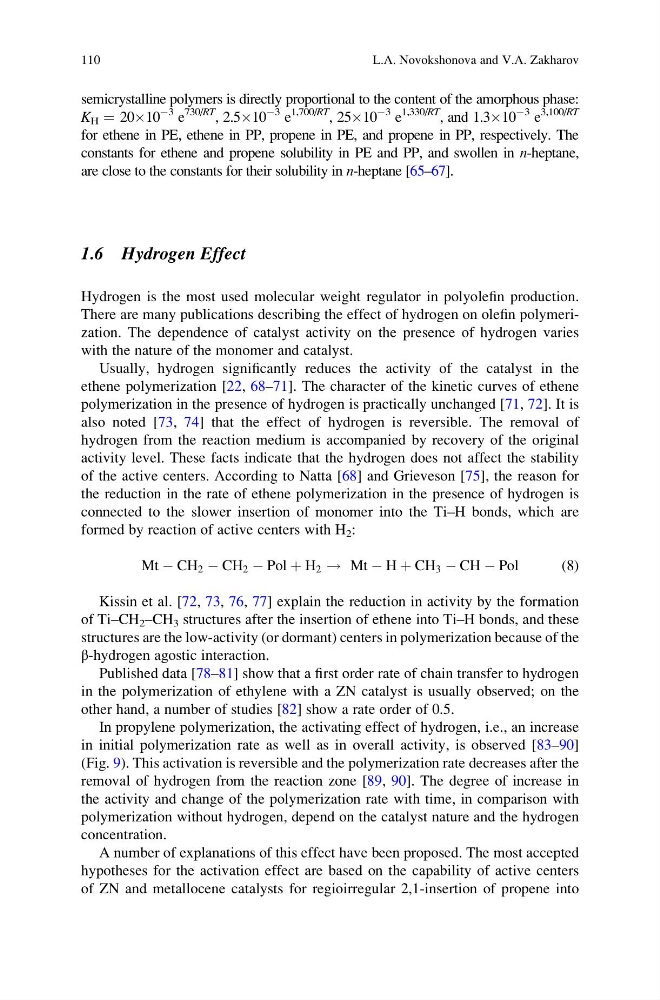
semicrystalline polymers is directly proportional to the content of the amorphous phase:
K H ¼ 20Â10
À3 e
730/RT
, 2.5Â10
À3 e
1,700/RT
, 25Â10
À3 e
1,330/RT
, and 1.3Â10
À3 e
3,100/RT
for ethene in PE, ethene in PP, propene in PE, and propene in PP, respectively. The
constants for ethene and propene solubility in PE and PP, and swollen in n-heptane,
are close to the constants for their solubility in n-heptane [65–67].
1.6 Hydrogen Effect
Hydrogen is the most used molecular weight regulator in polyolefin production.
There are many publications describing the effect of hydrogen on olefin polymerization. The dependence of catalyst activity on the presence of hydrogen varies
with the nature of the monomer and catalyst.
Usually, hydrogen significantly reduces the activity of the catalyst in the
ethene polymerization [22, 68–71]. The character of the kinetic curves of ethene
polymerization in the presence of hydrogen is practically unchanged [71, 72]. It is
also noted [73, 74] that the effect of hydrogen is reversible. The removal of
hydrogen from the reaction medium is accompanied by recovery of the original
activity level. These facts indicate that the hydrogen does not affect the stability
of the active centers. According to Natta [68] and Grieveson [75], the reason for
the reduction in the rate of ethene polymerization in the presence of hydrogen is
connected to the slower insertion of monomer into the Ti–H bonds, which are
formed by reaction of active centers with H 2 :
Mt À CH 2 À CH 2 À Pol þ H 2 ! Mt À H þ CH 3 À CH À Pol
(8)
Kissin et al. [72, 73, 76, 77] explain the reduction in activity by the formation
of Ti–CH 2 –CH 3 structures after the insertion of ethene into Ti–H bonds, and these
structures are the low-activity (or dormant) centers in polymerization because of the
β-hydrogen agostic interaction.
Published data [78–81] show that a first order rate of chain transfer to hydrogen
in the polymerization of ethylene with a ZN catalyst is usually observed; on the
other hand, a number of studies [82] show a rate order of 0.5.
In propylene polymerization, the activating effect of hydrogen, i.e., an increase
in initial polymerization rate as well as in overall activity, is observed [83–90]
(Fig. 9). This activation is reversible and the polymerization rate decreases after the
removal of hydrogen from the reaction zone [89, 90]. The degree of increase in
the activity and change of the polymerization rate with time, in comparison with
polymerization without hydrogen, depend on the catalyst nature and the hydrogen
concentration.
A number of explanations of this effect have been proposed. The most accepted
hypotheses for the activation effect are based on the capability of active centers
of ZN and metallocene catalysts for regioirregular 2,1-insertion of propene into
110
L.A. Novokshonova and V.A. Zakharov
K H ¼ 20Â10
À3 e
730/RT
, 2.5Â10
À3 e
1,700/RT
, 25Â10
À3 e
1,330/RT
, and 1.3Â10
À3 e
3,100/RT
for ethene in PE, ethene in PP, propene in PE, and propene in PP, respectively. The
constants for ethene and propene solubility in PE and PP, and swollen in n-heptane,
are close to the constants for their solubility in n-heptane [65–67].
1.6 Hydrogen Effect
Hydrogen is the most used molecular weight regulator in polyolefin production.
There are many publications describing the effect of hydrogen on olefin polymerization. The dependence of catalyst activity on the presence of hydrogen varies
with the nature of the monomer and catalyst.
Usually, hydrogen significantly reduces the activity of the catalyst in the
ethene polymerization [22, 68–71]. The character of the kinetic curves of ethene
polymerization in the presence of hydrogen is practically unchanged [71, 72]. It is
also noted [73, 74] that the effect of hydrogen is reversible. The removal of
hydrogen from the reaction medium is accompanied by recovery of the original
activity level. These facts indicate that the hydrogen does not affect the stability
of the active centers. According to Natta [68] and Grieveson [75], the reason for
the reduction in the rate of ethene polymerization in the presence of hydrogen is
connected to the slower insertion of monomer into the Ti–H bonds, which are
formed by reaction of active centers with H 2 :
Mt À CH 2 À CH 2 À Pol þ H 2 ! Mt À H þ CH 3 À CH À Pol
(8)
Kissin et al. [72, 73, 76, 77] explain the reduction in activity by the formation
of Ti–CH 2 –CH 3 structures after the insertion of ethene into Ti–H bonds, and these
structures are the low-activity (or dormant) centers in polymerization because of the
β-hydrogen agostic interaction.
Published data [78–81] show that a first order rate of chain transfer to hydrogen
in the polymerization of ethylene with a ZN catalyst is usually observed; on the
other hand, a number of studies [82] show a rate order of 0.5.
In propylene polymerization, the activating effect of hydrogen, i.e., an increase
in initial polymerization rate as well as in overall activity, is observed [83–90]
(Fig. 9). This activation is reversible and the polymerization rate decreases after the
removal of hydrogen from the reaction zone [89, 90]. The degree of increase in
the activity and change of the polymerization rate with time, in comparison with
polymerization without hydrogen, depend on the catalyst nature and the hydrogen
concentration.
A number of explanations of this effect have been proposed. The most accepted
hypotheses for the activation effect are based on the capability of active centers
of ZN and metallocene catalysts for regioirregular 2,1-insertion of propene into
110
L.A. Novokshonova and V.A. Zakharov