

the amorphous regions of polymer shells for polymerization in both the slurry
and gas phase. This means that for estimation of monomer concentration near
the active centers, the solubility constants in the polymer should be used. Use
of the monomer concentration in the gas phase for the calculation of the specific
rate of polymerization and of the copolymerization constants in the gas-phase
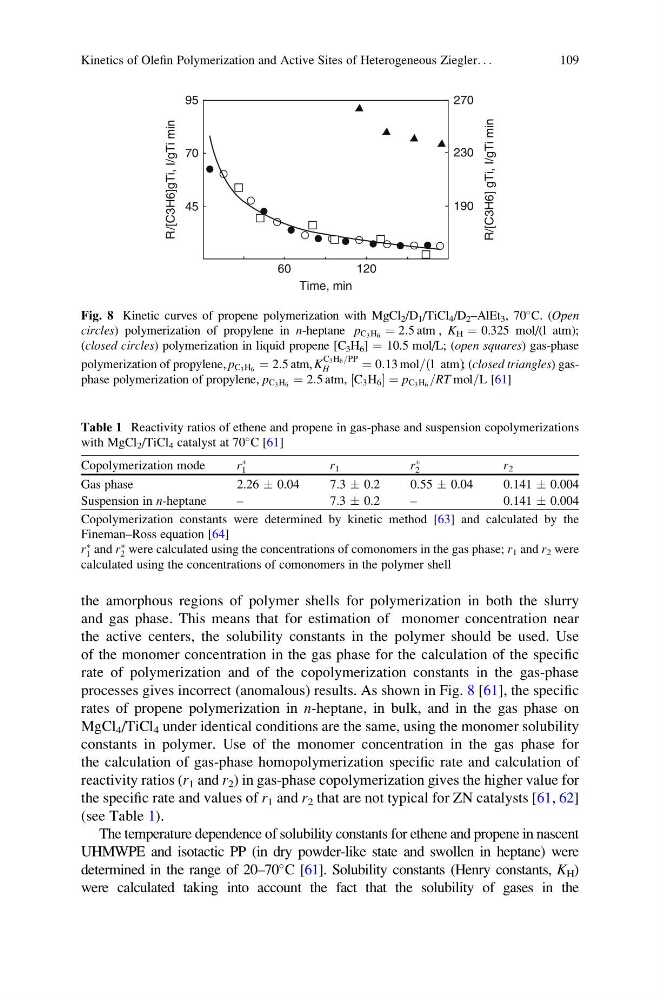
processes gives incorrect (anomalous) results. As shown in Fig. 8 [61], the specific
rates of propene polymerization in n-heptane, in bulk, and in the gas phase on
MgCl 4 /TiCl 4 under identical conditions are the same, using the monomer solubility
constants in polymer. Use of the monomer concentration in the gas phase for
the calculation of gas-phase homopolymerization specific rate and calculation of
reactivity ratios (r 1 and r 2 ) in gas-phase copolymerization gives the higher value for
the specific rate and values of r 1 and r 2 that are not typical for ZN catalysts [61, 62]
(see Table 1).
The temperature dependence of solubility constants for ethene and propene in nascent
UHMWPE and isotactic PP (in dry powder-like state and swollen in heptane) were
determined in the range of 20–70
C [61]. Solubility constants (Henry constants, K H )
were calculated taking into account the fact that the solubility of gases in the
95
70
45
60
120
Time, min
270
230
190
R/[C3H6] gTi, I/gTi min
R/[C3H6]gTi, I/gTi min
Fig. 8 Kinetic curves of propene polymerization with MgCl 2 /D 1 /TiCl 4 /D 2 –AlEt 3 , 70
C. (Open
circles) polymerization of propylene in n-heptane p C3H6 ¼ 2:5 atm , K H ¼ 0.325 mol/(l atm);
(closed circles) polymerization in liquid propene [C 3 H 6 ] ¼ 10.5 mol/L; (open squares) gas-phase
polymerization of propylene, p C3H6 ¼ 2:5 atm, K
C3H6=PP
H
¼ 0:13 mol=ðl atmÞ; (closed triangles) gasphase polymerization of propylene, p C3H6 ¼ 2:5 atm, ½C 3 H 6 ¼ p C3H6 =RT mol=L [61]
Table 1 Reactivity ratios of ethene and propene in gas-phase and suspension copolymerizations
with MgCl 2 /TiCl 4 catalyst at 70
C [61]
Copolymerization mode
r
Ã
1
r 1
r
Ã
2
r 2
Gas phase
2.26 Æ 0.04
7.3 Æ 0.2
0.55 Æ 0.04
0.141 Æ 0.004
Suspension in n-heptane
–
7.3 Æ 0.2
–
0.141 Æ 0.004
Copolymerization constants were determined by kinetic method [63] and calculated by the
Fineman–Ross equation [64]
r
Ã
1 and r
Ã
2 were calculated using the concentrations of comonomers in the gas phase; r 1 and r 2 were
calculated using the concentrations of comonomers in the polymer shell
Kinetics of Olefin Polymerization and Active Sites of Heterogeneous Ziegler. . .
109
and gas phase. This means that for estimation of monomer concentration near
the active centers, the solubility constants in the polymer should be used. Use
of the monomer concentration in the gas phase for the calculation of the specific
rate of polymerization and of the copolymerization constants in the gas-phase
processes gives incorrect (anomalous) results. As shown in Fig. 8 [61], the specific
rates of propene polymerization in n-heptane, in bulk, and in the gas phase on
MgCl 4 /TiCl 4 under identical conditions are the same, using the monomer solubility
constants in polymer. Use of the monomer concentration in the gas phase for
the calculation of gas-phase homopolymerization specific rate and calculation of
reactivity ratios (r 1 and r 2 ) in gas-phase copolymerization gives the higher value for
the specific rate and values of r 1 and r 2 that are not typical for ZN catalysts [61, 62]
(see Table 1).
The temperature dependence of solubility constants for ethene and propene in nascent
UHMWPE and isotactic PP (in dry powder-like state and swollen in heptane) were
determined in the range of 20–70
C [61]. Solubility constants (Henry constants, K H )
were calculated taking into account the fact that the solubility of gases in the
95
70
45
60
120
Time, min
270
230
190
R/[C3H6] gTi, I/gTi min
R/[C3H6]gTi, I/gTi min
Fig. 8 Kinetic curves of propene polymerization with MgCl 2 /D 1 /TiCl 4 /D 2 –AlEt 3 , 70
C. (Open
circles) polymerization of propylene in n-heptane p C3H6 ¼ 2:5 atm , K H ¼ 0.325 mol/(l atm);
(closed circles) polymerization in liquid propene [C 3 H 6 ] ¼ 10.5 mol/L; (open squares) gas-phase
polymerization of propylene, p C3H6 ¼ 2:5 atm, K
C3H6=PP
H
¼ 0:13 mol=ðl atmÞ; (closed triangles) gasphase polymerization of propylene, p C3H6 ¼ 2:5 atm, ½C 3 H 6 ¼ p C3H6 =RT mol=L [61]
Table 1 Reactivity ratios of ethene and propene in gas-phase and suspension copolymerizations
with MgCl 2 /TiCl 4 catalyst at 70
C [61]
Copolymerization mode
r
Ã
1
r 1
r
Ã
2
r 2
Gas phase
2.26 Æ 0.04
7.3 Æ 0.2
0.55 Æ 0.04
0.141 Æ 0.004
Suspension in n-heptane
–
7.3 Æ 0.2
–
0.141 Æ 0.004
Copolymerization constants were determined by kinetic method [63] and calculated by the
Fineman–Ross equation [64]
r
Ã
1 and r
Ã
2 were calculated using the concentrations of comonomers in the gas phase; r 1 and r 2 were
calculated using the concentrations of comonomers in the polymer shell
Kinetics of Olefin Polymerization and Active Sites of Heterogeneous Ziegler. . .
109