

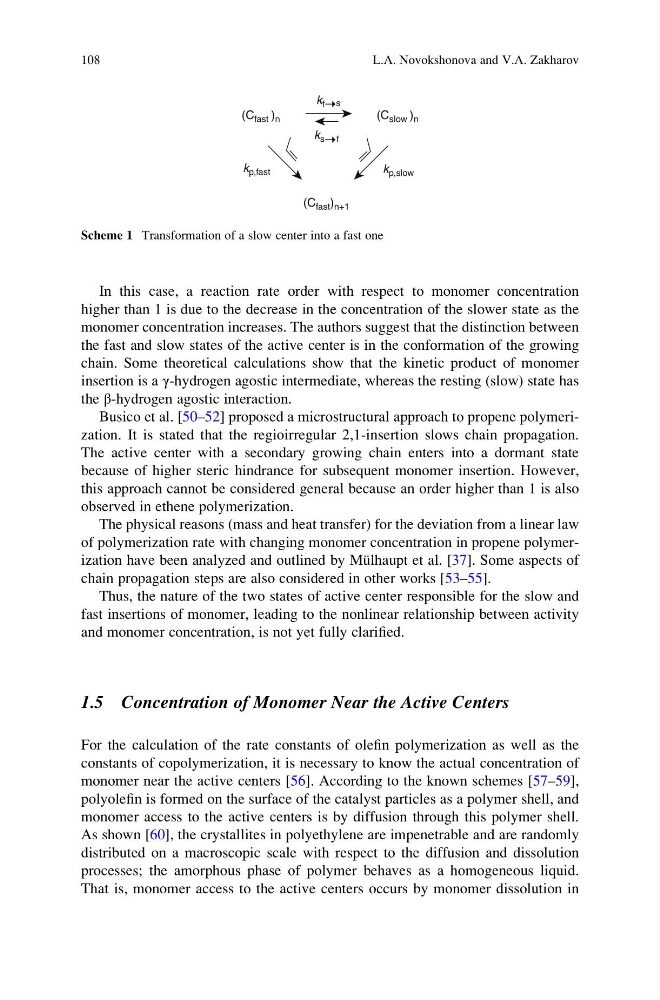
In this case, a reaction rate order with respect to monomer concentration
higher than 1 is due to the decrease in the concentration of the slower state as the
monomer concentration increases. The authors suggest that the distinction between
the fast and slow states of the active center is in the conformation of the growing
chain. Some theoretical calculations show that the kinetic product of monomer
insertion is a γ-hydrogen agostic intermediate, whereas the resting (slow) state has
the β-hydrogen agostic interaction.
Busico et al. [50–52] proposed a microstructural approach to propene polymerization. It is stated that the regioirregular 2,1-insertion slows chain propagation.
The active center with a secondary growing chain enters into a dormant state
because of higher steric hindrance for subsequent monomer insertion. However,
this approach cannot be considered general because an order higher than 1 is also
observed in ethene polymerization.
The physical reasons (mass and heat transfer) for the deviation from a linear law
of polymerization rate with changing monomer concentration in propene polymerization have been analyzed and outlined by Mu ¨lhaupt et al. [37]. Some aspects of
chain propagation steps are also considered in other works [53–55].
Thus, the nature of the two states of active center responsible for the slow and
fast insertions of monomer, leading to the nonlinear relationship between activity
and monomer concentration, is not yet fully clarified.
1.5 Concentration of Monomer Near the Active Centers
For the calculation of the rate constants of olefin polymerization as well as the
constants of copolymerization, it is necessary to know the actual concentration of
monomer near the active centers [56]. According to the known schemes [57–59],
polyolefin is formed on the surface of the catalyst particles as a polymer shell, and
monomer access to the active centers is by diffusion through this polymer shell.
As shown [60], the crystallites in polyethylene are impenetrable and are randomly
distributed on a macroscopic scale with respect to the diffusion and dissolution
processes; the amorphous phase of polymer behaves as a homogeneous liquid.
That is, monomer access to the active centers occurs by monomer dissolution in
(C fast ) n
(C slow ) n
(C fast ) n+1
k p,fast
k p,slow
k f s
k s f
Scheme 1 Transformation of a slow center into a fast one
108
L.A. Novokshonova and V.A. Zakharov
higher than 1 is due to the decrease in the concentration of the slower state as the
monomer concentration increases. The authors suggest that the distinction between
the fast and slow states of the active center is in the conformation of the growing
chain. Some theoretical calculations show that the kinetic product of monomer
insertion is a γ-hydrogen agostic intermediate, whereas the resting (slow) state has
the β-hydrogen agostic interaction.
Busico et al. [50–52] proposed a microstructural approach to propene polymerization. It is stated that the regioirregular 2,1-insertion slows chain propagation.
The active center with a secondary growing chain enters into a dormant state
because of higher steric hindrance for subsequent monomer insertion. However,
this approach cannot be considered general because an order higher than 1 is also
observed in ethene polymerization.
The physical reasons (mass and heat transfer) for the deviation from a linear law
of polymerization rate with changing monomer concentration in propene polymerization have been analyzed and outlined by Mu ¨lhaupt et al. [37]. Some aspects of
chain propagation steps are also considered in other works [53–55].
Thus, the nature of the two states of active center responsible for the slow and
fast insertions of monomer, leading to the nonlinear relationship between activity
and monomer concentration, is not yet fully clarified.
1.5 Concentration of Monomer Near the Active Centers
For the calculation of the rate constants of olefin polymerization as well as the
constants of copolymerization, it is necessary to know the actual concentration of
monomer near the active centers [56]. According to the known schemes [57–59],
polyolefin is formed on the surface of the catalyst particles as a polymer shell, and
monomer access to the active centers is by diffusion through this polymer shell.
As shown [60], the crystallites in polyethylene are impenetrable and are randomly
distributed on a macroscopic scale with respect to the diffusion and dissolution
processes; the amorphous phase of polymer behaves as a homogeneous liquid.
That is, monomer access to the active centers occurs by monomer dissolution in
(C fast ) n
(C slow ) n
(C fast ) n+1
k p,fast
k p,slow
k f s
k s f
Scheme 1 Transformation of a slow center into a fast one
108
L.A. Novokshonova and V.A. Zakharov