

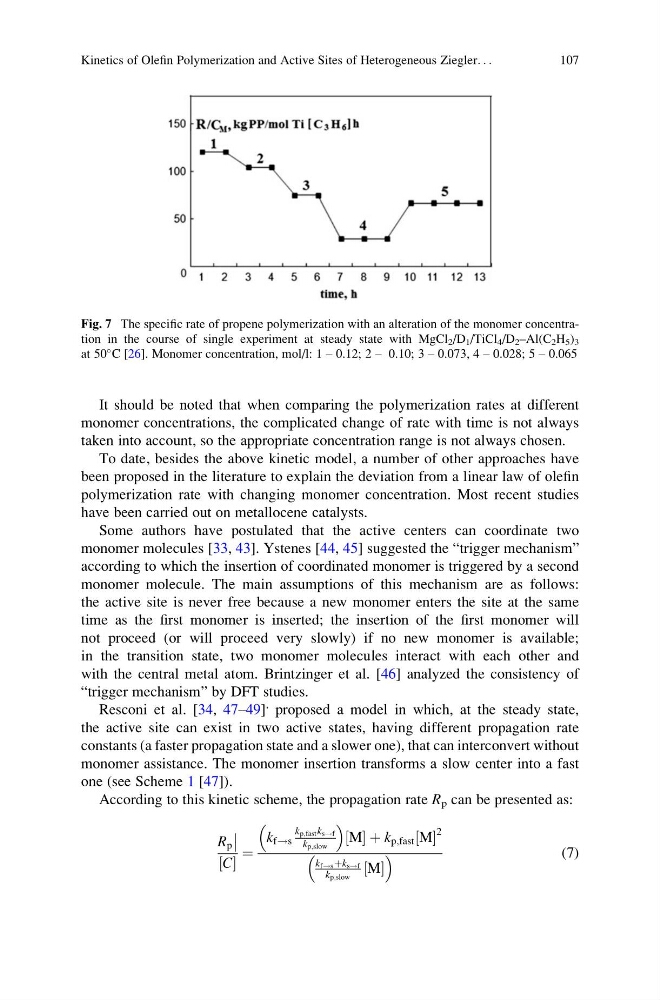
It should be noted that when comparing the polymerization rates at different
monomer concentrations, the complicated change of rate with time is not always
taken into account, so the appropriate concentration range is not always chosen.
To date, besides the above kinetic model, a number of other approaches have
been proposed in the literature to explain the deviation from a linear law of olefin
polymerization rate with changing monomer concentration. Most recent studies
have been carried out on metallocene catalysts.
Some authors have postulated that the active centers can coordinate two
monomer molecules [33, 43]. Ystenes [44, 45] suggested the “trigger mechanism”
according to which the insertion of coordinated monomer is triggered by a second
monomer molecule. The main assumptions of this mechanism are as follows:
the active site is never free because a new monomer enters the site at the same
time as the first monomer is inserted; the insertion of the first monomer will
not proceed (or will proceed very slowly) if no new monomer is available;
in the transition state, two monomer molecules interact with each other and
with the central metal atom. Brintzinger et al. [46] analyzed the consistency of
“trigger mechanism” by DFT studies.
Resconi et al. [34, 47–49]
, proposed a model in which, at the steady state,
the active site can exist in two active states, having different propagation rate
constants (a faster propagation state and a slower one), that can interconvert without
monomer assistance. The monomer insertion transforms a slow center into a fast
one (see Scheme 1 [47]).
According to this kinetic scheme, the propagation rate R p can be presented as:
R p
½C
¼
k f!s
k p;fast k s!f
k p;slow
½M þ k p;fast ½M
2
k f!s þk s!f
k p;slow
½M
(7)
Fig. 7 The specific rate of propene polymerization with an alteration of the monomer concentration in the course of single experiment at steady state with MgCl 2 /D 1 /TiCl 4 /D 2 –Al(C 2 H 5 ) 3
at 50
C [26]. Monomer concentration, mol/l: 1 – 0.12; 2 – 0.10; 3 – 0.073, 4 – 0.028; 5 – 0.065
Kinetics of Olefin Polymerization and Active Sites of Heterogeneous Ziegler. . .
107
monomer concentrations, the complicated change of rate with time is not always
taken into account, so the appropriate concentration range is not always chosen.
To date, besides the above kinetic model, a number of other approaches have
been proposed in the literature to explain the deviation from a linear law of olefin
polymerization rate with changing monomer concentration. Most recent studies
have been carried out on metallocene catalysts.
Some authors have postulated that the active centers can coordinate two
monomer molecules [33, 43]. Ystenes [44, 45] suggested the “trigger mechanism”
according to which the insertion of coordinated monomer is triggered by a second
monomer molecule. The main assumptions of this mechanism are as follows:
the active site is never free because a new monomer enters the site at the same
time as the first monomer is inserted; the insertion of the first monomer will
not proceed (or will proceed very slowly) if no new monomer is available;
in the transition state, two monomer molecules interact with each other and
with the central metal atom. Brintzinger et al. [46] analyzed the consistency of
“trigger mechanism” by DFT studies.
Resconi et al. [34, 47–49]
, proposed a model in which, at the steady state,
the active site can exist in two active states, having different propagation rate
constants (a faster propagation state and a slower one), that can interconvert without
monomer assistance. The monomer insertion transforms a slow center into a fast
one (see Scheme 1 [47]).
According to this kinetic scheme, the propagation rate R p can be presented as:
R p
½C
¼
k f!s
k p;fast k s!f
k p;slow
½M þ k p;fast ½M
2
k f!s þk s!f
k p;slow
½M
(7)
Fig. 7 The specific rate of propene polymerization with an alteration of the monomer concentration in the course of single experiment at steady state with MgCl 2 /D 1 /TiCl 4 /D 2 –Al(C 2 H 5 ) 3
at 50
C [26]. Monomer concentration, mol/l: 1 – 0.12; 2 – 0.10; 3 – 0.073, 4 – 0.028; 5 – 0.065
Kinetics of Olefin Polymerization and Active Sites of Heterogeneous Ziegler. . .
107