

of magnitude lower than the propagation rate constant, and that the activation
energy of initiation (slow monomer insertion stage) is much higher than the
activation energy of chain propagation (fast monomer insertion stage).
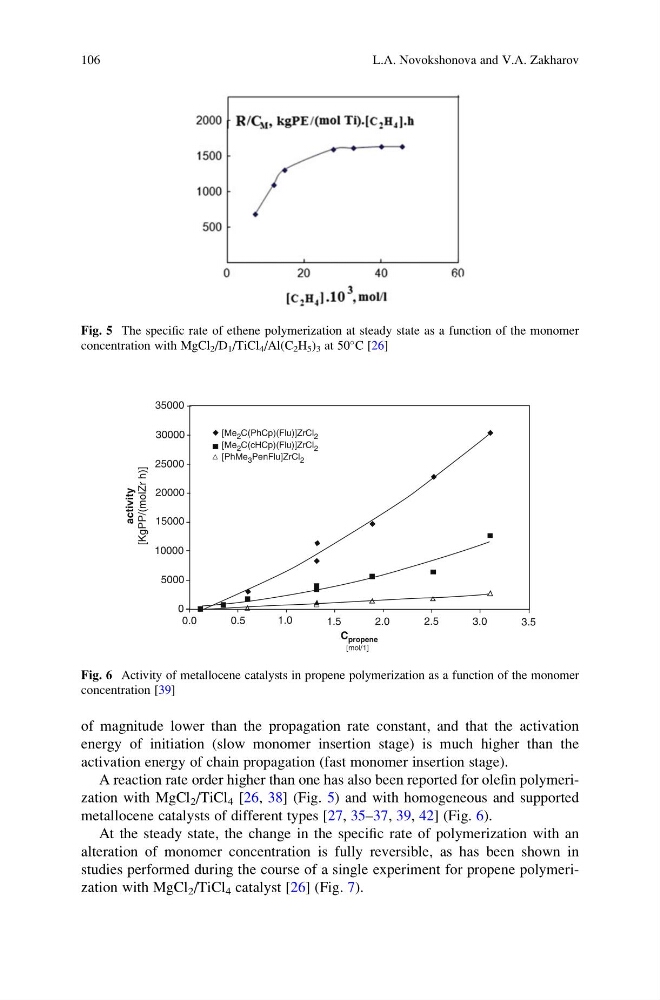
A reaction rate order higher than one has also been reported for olefin polymerization with MgCl 2 /TiCl 4 [26, 38] (Fig. 5) and with homogeneous and supported
metallocene catalysts of different types [27, 35–37, 39, 42] (Fig. 6).
At the steady state, the change in the specific rate of polymerization with an
alteration of monomer concentration is fully reversible, as has been shown in
studies performed during the course of a single experiment for propene polymerization with MgCl 2 /TiCl 4 catalyst [26] (Fig. 7).
Fig. 5 The specific rate of ethene polymerization at steady state as a function of the monomer
concentration with MgCl 2 /D 1 /TiCl 4 /Al(C 2 H 5 ) 3 at 50
C [26]
35000
30000
25000
20000
15000
10000
5000
0
0.0
0.5
1.0
1.5
2.0
2.5
3.0
3.5
C propene
[mol/1]
activity
[KgPP/(molZr h)]
[Me 2 C(PhCp)(Flu)]ZrCl 2
[Me 2 C(cHCp)(Flu)]ZrCl 2
[PhMe 3 PenFlu]ZrCl 2
Fig. 6 Activity of metallocene catalysts in propene polymerization as a function of the monomer
concentration [39]
106
L.A. Novokshonova and V.A. Zakharov
energy of initiation (slow monomer insertion stage) is much higher than the
activation energy of chain propagation (fast monomer insertion stage).
A reaction rate order higher than one has also been reported for olefin polymerization with MgCl 2 /TiCl 4 [26, 38] (Fig. 5) and with homogeneous and supported
metallocene catalysts of different types [27, 35–37, 39, 42] (Fig. 6).
At the steady state, the change in the specific rate of polymerization with an
alteration of monomer concentration is fully reversible, as has been shown in
studies performed during the course of a single experiment for propene polymerization with MgCl 2 /TiCl 4 catalyst [26] (Fig. 7).
Fig. 5 The specific rate of ethene polymerization at steady state as a function of the monomer
concentration with MgCl 2 /D 1 /TiCl 4 /Al(C 2 H 5 ) 3 at 50
C [26]
35000
30000
25000
20000
15000
10000
5000
0
0.0
0.5
1.0
1.5
2.0
2.5
3.0
3.5
C propene
[mol/1]
activity
[KgPP/(molZr h)]
[Me 2 C(PhCp)(Flu)]ZrCl 2
[Me 2 C(cHCp)(Flu)]ZrCl 2
[PhMe 3 PenFlu]ZrCl 2
Fig. 6 Activity of metallocene catalysts in propene polymerization as a function of the monomer
concentration [39]
106
L.A. Novokshonova and V.A. Zakharov