

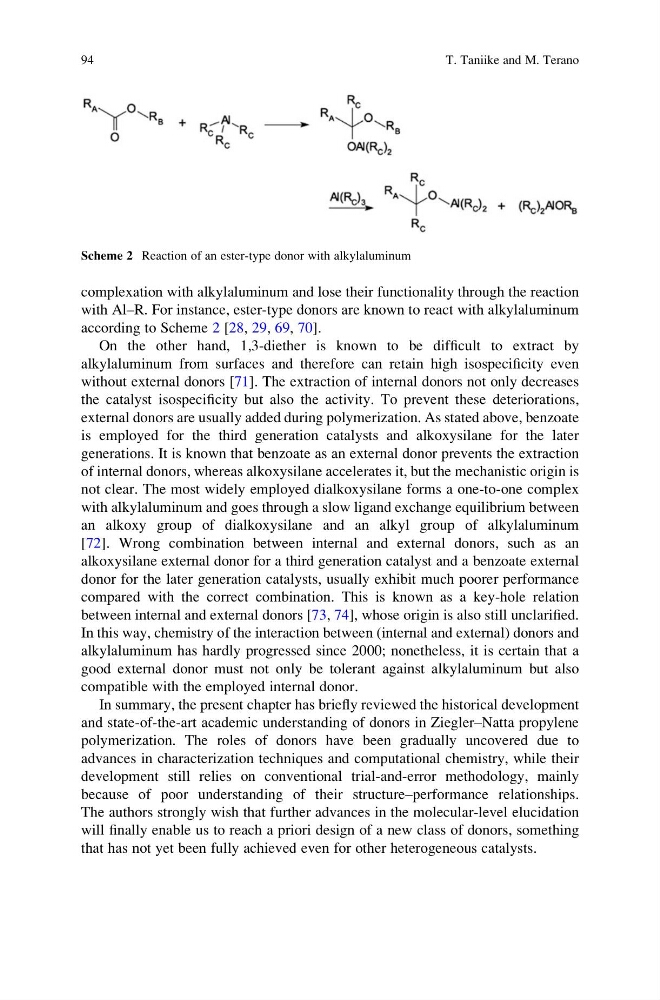
complexation with alkylaluminum and lose their functionality through the reaction
with Al–R. For instance, ester-type donors are known to react with alkylaluminum
according to Scheme 2 [28, 29, 69, 70].
On the other hand, 1,3-diether is known to be difficult to extract by
alkylaluminum from surfaces and therefore can retain high isospecificity even
without external donors [71]. The extraction of internal donors not only decreases
the catalyst isospecificity but also the activity. To prevent these deteriorations,
external donors are usually added during polymerization. As stated above, benzoate
is employed for the third generation catalysts and alkoxysilane for the later
generations. It is known that benzoate as an external donor prevents the extraction
of internal donors, whereas alkoxysilane accelerates it, but the mechanistic origin is
not clear. The most widely employed dialkoxysilane forms a one-to-one complex
with alkylaluminum and goes through a slow ligand exchange equilibrium between
an alkoxy group of dialkoxysilane and an alkyl group of alkylaluminum
[72]. Wrong combination between internal and external donors, such as an
alkoxysilane external donor for a third generation catalyst and a benzoate external
donor for the later generation catalysts, usually exhibit much poorer performance
compared with the correct combination. This is known as a key-hole relation
between internal and external donors [73, 74], whose origin is also still unclarified.
In this way, chemistry of the interaction between (internal and external) donors and
alkylaluminum has hardly progressed since 2000; nonetheless, it is certain that a
good external donor must not only be tolerant against alkylaluminum but also
compatible with the employed internal donor.
In summary, the present chapter has briefly reviewed the historical development
and state-of-the-art academic understanding of donors in Ziegler–Natta propylene
polymerization. The roles of donors have been gradually uncovered due to
advances in characterization techniques and computational chemistry, while their
development still relies on conventional trial-and-error methodology, mainly
because of poor understanding of their structure–performance relationships.
The authors strongly wish that further advances in the molecular-level elucidation
will finally enable us to reach a priori design of a new class of donors, something
that has not yet been fully achieved even for other heterogeneous catalysts.
Scheme 2 Reaction of an ester-type donor with alkylaluminum
94
T. Taniike and M. Terano
with Al–R. For instance, ester-type donors are known to react with alkylaluminum
according to Scheme 2 [28, 29, 69, 70].
On the other hand, 1,3-diether is known to be difficult to extract by
alkylaluminum from surfaces and therefore can retain high isospecificity even
without external donors [71]. The extraction of internal donors not only decreases
the catalyst isospecificity but also the activity. To prevent these deteriorations,
external donors are usually added during polymerization. As stated above, benzoate
is employed for the third generation catalysts and alkoxysilane for the later
generations. It is known that benzoate as an external donor prevents the extraction
of internal donors, whereas alkoxysilane accelerates it, but the mechanistic origin is
not clear. The most widely employed dialkoxysilane forms a one-to-one complex
with alkylaluminum and goes through a slow ligand exchange equilibrium between
an alkoxy group of dialkoxysilane and an alkyl group of alkylaluminum
[72]. Wrong combination between internal and external donors, such as an
alkoxysilane external donor for a third generation catalyst and a benzoate external
donor for the later generation catalysts, usually exhibit much poorer performance
compared with the correct combination. This is known as a key-hole relation
between internal and external donors [73, 74], whose origin is also still unclarified.
In this way, chemistry of the interaction between (internal and external) donors and
alkylaluminum has hardly progressed since 2000; nonetheless, it is certain that a
good external donor must not only be tolerant against alkylaluminum but also
compatible with the employed internal donor.
In summary, the present chapter has briefly reviewed the historical development
and state-of-the-art academic understanding of donors in Ziegler–Natta propylene
polymerization. The roles of donors have been gradually uncovered due to
advances in characterization techniques and computational chemistry, while their
development still relies on conventional trial-and-error methodology, mainly
because of poor understanding of their structure–performance relationships.
The authors strongly wish that further advances in the molecular-level elucidation
will finally enable us to reach a priori design of a new class of donors, something
that has not yet been fully achieved even for other heterogeneous catalysts.
Scheme 2 Reaction of an ester-type donor with alkylaluminum
94
T. Taniike and M. Terano