

3 Speckle Noise Reduction and Enhancement for OCT Images
59
p w 2 (k) (w 2 (k))
∞
−∞
p ¯
w(k) ( ¯
w(k))dw 1 (k)
a(k)
exp
−
w
2
2 (k)
2σ
2
21 (k)
σ 21 (k)
√
2π
+ (1 − a(k))
exp
−
w
2
2 (k)
2σ
2
22 (k)
σ 22 (k)
√
2π
(3.19)
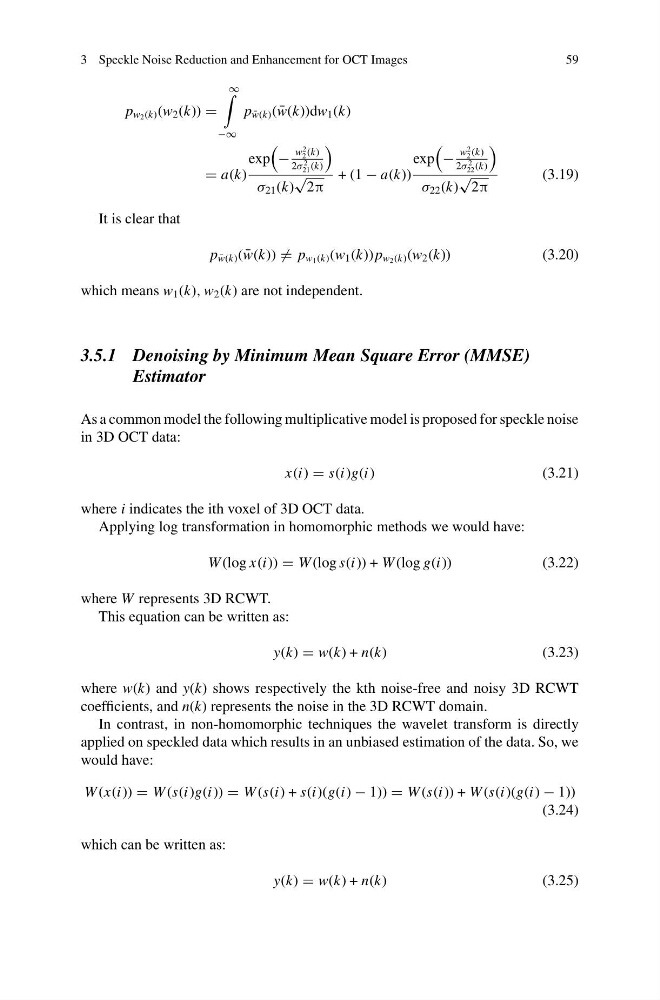
It is clear that
p ¯
w(k) ( ¯
w(k)) p w 1 (k) (w 1 (k)) p w 2 (k) (w 2 (k))
(3.20)
which means w 1 (k), w 2 (k) are not independent.
3.5.1 Denoising by Minimum Mean Square Error (MMSE)
Estimator
As a common model the following multiplicative model is proposed for speckle noise
in 3D OCT data:
x(i) s(i)g(i)
(3.21)
where i indicates the ith voxel of 3D OCT data.
Applying log transformation in homomorphic methods we would have:
W (log x(i)) W (log s(i)) + W (log g(i))
(3.22)
where W represents 3D RCWT.
This equation can be written as:
y(k) w(k) + n(k)
(3.23)
where w(k) and y(k) shows respectively the kth noise-free and noisy 3D RCWT
coefficients, and n(k) represents the noise in the 3D RCWT domain.
In contrast, in non-homomorphic techniques the wavelet transform is directly
applied on speckled data which results in an unbiased estimation of the data. So, we
would have:
W (x(i)) W (s(i)g(i)) W (s(i) + s(i)(g(i) − 1)) W (s(i)) + W (s(i)(g(i) − 1))
(3.24)
which can be written as:
y(k) w(k) + n(k)
(3.25)
59
p w 2 (k) (w 2 (k))
∞
−∞
p ¯
w(k) ( ¯
w(k))dw 1 (k)
a(k)
exp
−
w
2
2 (k)
2σ
2
21 (k)
σ 21 (k)
√
2π
+ (1 − a(k))
exp
−
w
2
2 (k)
2σ
2
22 (k)
σ 22 (k)
√
2π
(3.19)
It is clear that
p ¯
w(k) ( ¯
w(k)) p w 1 (k) (w 1 (k)) p w 2 (k) (w 2 (k))
(3.20)
which means w 1 (k), w 2 (k) are not independent.
3.5.1 Denoising by Minimum Mean Square Error (MMSE)
Estimator
As a common model the following multiplicative model is proposed for speckle noise
in 3D OCT data:
x(i) s(i)g(i)
(3.21)
where i indicates the ith voxel of 3D OCT data.
Applying log transformation in homomorphic methods we would have:
W (log x(i)) W (log s(i)) + W (log g(i))
(3.22)
where W represents 3D RCWT.
This equation can be written as:
y(k) w(k) + n(k)
(3.23)
where w(k) and y(k) shows respectively the kth noise-free and noisy 3D RCWT
coefficients, and n(k) represents the noise in the 3D RCWT domain.
In contrast, in non-homomorphic techniques the wavelet transform is directly
applied on speckled data which results in an unbiased estimation of the data. So, we
would have:
W (x(i)) W (s(i)g(i)) W (s(i) + s(i)(g(i) − 1)) W (s(i)) + W (s(i)(g(i) − 1))
(3.24)
which can be written as:
y(k) w(k) + n(k)
(3.25)