

58
Z. Amini et al.
when we use hommomorphic method in 3D dual-tree complex wavelet domain, the
forward transform in Fig. 3.6 would be log transform+forward 3D dual-tree complex
wavelet transform.
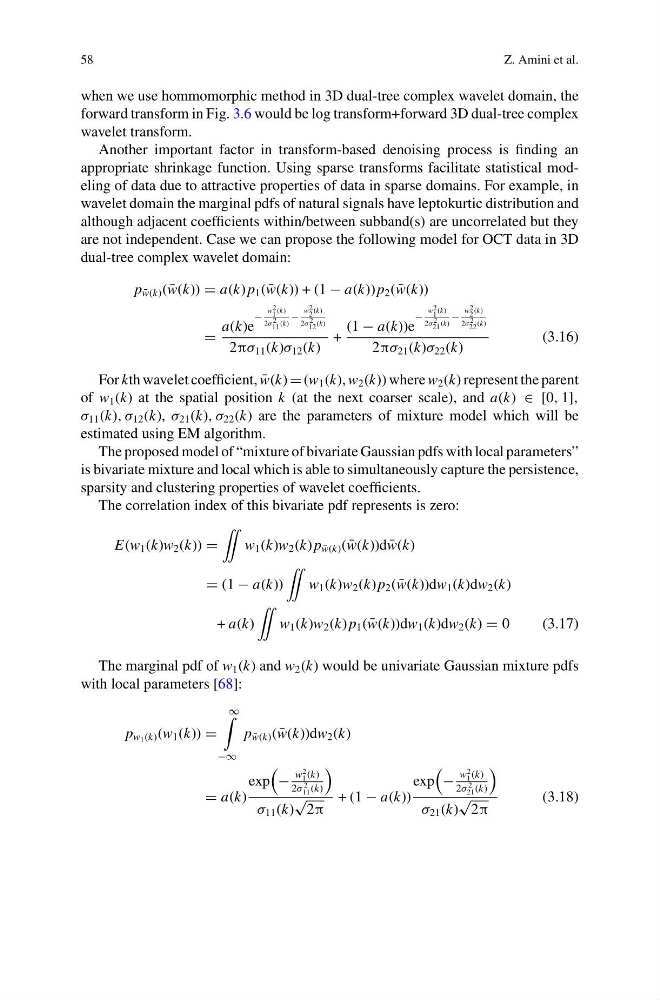
Another important factor in transform-based denoising process is finding an
appropriate shrinkage function. Using sparse transforms facilitate statistical modeling of data due to attractive properties of data in sparse domains. For example, in
wavelet domain the marginal pdfs of natural signals have leptokurtic distribution and
although adjacent coefficients within/between subband(s) are uncorrelated but they
are not independent. Case we can propose the following model for OCT data in 3D
dual-tree complex wavelet domain:
p ¯
w(k) ( ¯
w(k)) a(k) p 1 ( ¯
w(k)) + (1 − a(k)) p 2 ( ¯
w(k))
a(k)e
−
w 2
1 (k)
2σ 2
11 (k)
−
w 2
2 (k)
2σ 2
12 (k)
2πσ 11 (k)σ 12 (k)
+
(1 − a(k))e
−
w 2
1 (k)
2σ 2
21 (k)
−
w 2
2 (k)
2σ 2
22 (k)
2πσ 21 (k)σ 22 (k)
(3.16)
For kth wavelet coefficient, ¯
w(k) (w 1 (k), w 2 (k)) where w 2 (k) represent the parent
of w 1 (k) at the spatial position k (at the next coarser scale), and a(k) ∈ [0, 1],
σ 11 (k), σ 12 (k), σ 21 (k), σ 22 (k) are the parameters of mixture model which will be
estimated using EM algorithm.
The proposed model of “mixture of bivariate Gaussian pdfs with local parameters”
is bivariate mixture and local which is able to simultaneously capture the persistence,
sparsity and clustering properties of wavelet coefficients.
The correlation index of this bivariate pdf represents is zero:
E(w 1 (k)w 2 (k))
¨
w 1 (k)w 2 (k) p ¯
w(k) ( ¯
w(k))d ¯
w(k)
(1 − a(k))
¨
w 1 (k)w 2 (k) p 2 ( ¯
w(k))dw 1 (k)dw 2 (k)
+ a(k)
¨
w 1 (k)w 2 (k) p 1 ( ¯
w(k))dw 1 (k)dw 2 (k) 0
(3.17)
The marginal pdf of w 1 (k) and w 2 (k) would be univariate Gaussian mixture pdfs
with local parameters [68]:
p w 1 (k) (w 1 (k))
∞
−∞
p ¯
w(k) ( ¯
w(k))dw 2 (k)
a(k)
exp
−
w
2
1 (k)
2σ
2
11 (k)
σ 11 (k)
√
2π
+ (1 − a(k))
exp
−
w
2
1 (k)
2σ
2
21 (k)
σ 21 (k)
√
2π
(3.18)
Z. Amini et al.
when we use hommomorphic method in 3D dual-tree complex wavelet domain, the
forward transform in Fig. 3.6 would be log transform+forward 3D dual-tree complex
wavelet transform.
Another important factor in transform-based denoising process is finding an
appropriate shrinkage function. Using sparse transforms facilitate statistical modeling of data due to attractive properties of data in sparse domains. For example, in
wavelet domain the marginal pdfs of natural signals have leptokurtic distribution and
although adjacent coefficients within/between subband(s) are uncorrelated but they
are not independent. Case we can propose the following model for OCT data in 3D
dual-tree complex wavelet domain:
p ¯
w(k) ( ¯
w(k)) a(k) p 1 ( ¯
w(k)) + (1 − a(k)) p 2 ( ¯
w(k))
a(k)e
−
w 2
1 (k)
2σ 2
11 (k)
−
w 2
2 (k)
2σ 2
12 (k)
2πσ 11 (k)σ 12 (k)
+
(1 − a(k))e
−
w 2
1 (k)
2σ 2
21 (k)
−
w 2
2 (k)
2σ 2
22 (k)
2πσ 21 (k)σ 22 (k)
(3.16)
For kth wavelet coefficient, ¯
w(k) (w 1 (k), w 2 (k)) where w 2 (k) represent the parent
of w 1 (k) at the spatial position k (at the next coarser scale), and a(k) ∈ [0, 1],
σ 11 (k), σ 12 (k), σ 21 (k), σ 22 (k) are the parameters of mixture model which will be
estimated using EM algorithm.
The proposed model of “mixture of bivariate Gaussian pdfs with local parameters”
is bivariate mixture and local which is able to simultaneously capture the persistence,
sparsity and clustering properties of wavelet coefficients.
The correlation index of this bivariate pdf represents is zero:
E(w 1 (k)w 2 (k))
¨
w 1 (k)w 2 (k) p ¯
w(k) ( ¯
w(k))d ¯
w(k)
(1 − a(k))
¨
w 1 (k)w 2 (k) p 2 ( ¯
w(k))dw 1 (k)dw 2 (k)
+ a(k)
¨
w 1 (k)w 2 (k) p 1 ( ¯
w(k))dw 1 (k)dw 2 (k) 0
(3.17)
The marginal pdf of w 1 (k) and w 2 (k) would be univariate Gaussian mixture pdfs
with local parameters [68]:
p w 1 (k) (w 1 (k))
∞
−∞
p ¯
w(k) ( ¯
w(k))dw 2 (k)
a(k)
exp
−
w
2
1 (k)
2σ
2
11 (k)
σ 11 (k)
√
2π
+ (1 − a(k))
exp
−
w
2
1 (k)
2σ
2
21 (k)
σ 21 (k)
√
2π
(3.18)