

352
L. Pan and X. Chen
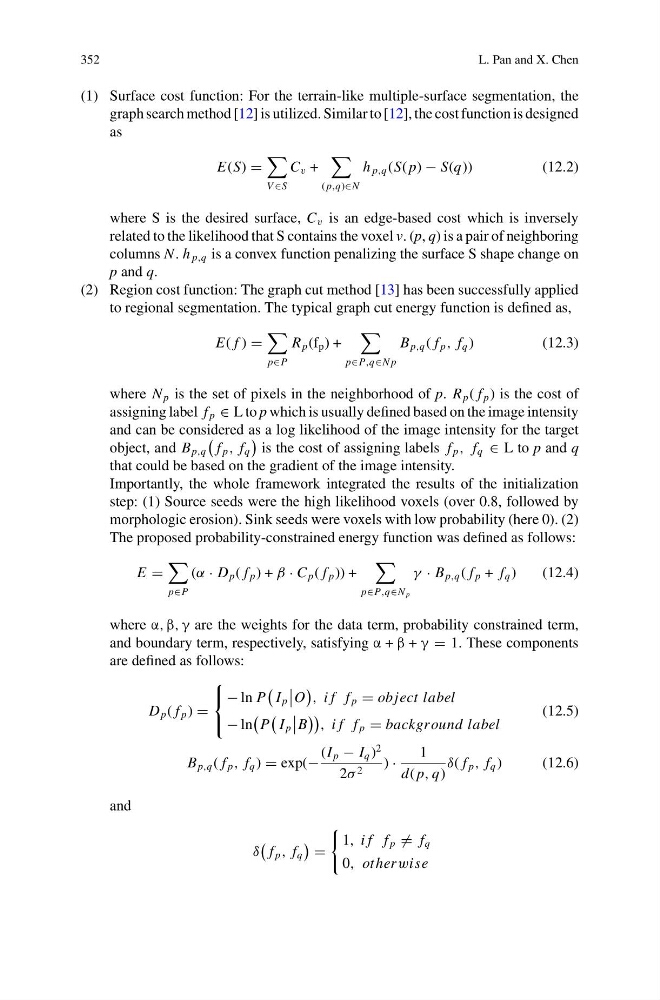
(1) Surface cost function: For the terrain-like multiple-surface segmentation, the
graph search method [12] is utilized. Similar to [12], the cost function is designed
as
E(S)
V ∈S
C v +
( p,q)∈N
h p,q (S( p) − S(q))
(12.2)
where S is the desired surface, C v is an edge-based cost which is inversely
related to the likelihood that S contains the voxel v. (p, q) is a pair of neighboring
columns N. h p,q is a convex function penalizing the surface S shape change on
p and q.
(2) Region cost function: The graph cut method [13] has been successfully applied
to regional segmentation. The typical graph cut energy function is defined as,
E( f )
p∈P
R p (f p ) +
p∈P,q∈N p
B p,q ( f p , f q )
(12.3)
where N p is the set of pixels in the neighborhood of p. R p ( f p ) is the cost of
assigning label f p ∈ L to p which is usually defined based on the image intensity
and can be considered as a log likelihood of the image intensity for the target
object, and B p,q
f p , f q
is the cost of assigning labels f p , f q ∈ L to p and q
that could be based on the gradient of the image intensity.
Importantly, the whole framework integrated the results of the initialization
step: (1) Source seeds were the high likelihood voxels (over 0.8, followed by
morphologic erosion). Sink seeds were voxels with low probability (here 0). (2)
The proposed probability-constrained energy function was defined as follows:
E
p∈P
(α · D p ( f p ) + β · C p ( f p )) +
p∈P,q∈N p
γ · B p,q ( f p + f q )
(12.4)
where α, β, γ are the weights for the data term, probability constrained term,
and boundary term, respectively, satisfying α + β + γ 1. These components
are defined as follows:
D p ( f p )
⎧
⎨
⎩
− ln P
I p
O
, i f f p object label
− ln
P
I p
B
, i f f p background label
(12.5)
B p,q ( f p , f q ) exp(−
(I p − I q )
2
2σ 2 ) ·
1
d( p, q)
δ( f p , f q )
(12.6)
and
δ
f p , f q
1, i f f p f q
0, other wise
L. Pan and X. Chen
(1) Surface cost function: For the terrain-like multiple-surface segmentation, the
graph search method [12] is utilized. Similar to [12], the cost function is designed
as
E(S)
V ∈S
C v +
( p,q)∈N
h p,q (S( p) − S(q))
(12.2)
where S is the desired surface, C v is an edge-based cost which is inversely
related to the likelihood that S contains the voxel v. (p, q) is a pair of neighboring
columns N. h p,q is a convex function penalizing the surface S shape change on
p and q.
(2) Region cost function: The graph cut method [13] has been successfully applied
to regional segmentation. The typical graph cut energy function is defined as,
E( f )
p∈P
R p (f p ) +
p∈P,q∈N p
B p,q ( f p , f q )
(12.3)
where N p is the set of pixels in the neighborhood of p. R p ( f p ) is the cost of
assigning label f p ∈ L to p which is usually defined based on the image intensity
and can be considered as a log likelihood of the image intensity for the target
object, and B p,q
f p , f q
is the cost of assigning labels f p , f q ∈ L to p and q
that could be based on the gradient of the image intensity.
Importantly, the whole framework integrated the results of the initialization
step: (1) Source seeds were the high likelihood voxels (over 0.8, followed by
morphologic erosion). Sink seeds were voxels with low probability (here 0). (2)
The proposed probability-constrained energy function was defined as follows:
E
p∈P
(α · D p ( f p ) + β · C p ( f p )) +
p∈P,q∈N p
γ · B p,q ( f p + f q )
(12.4)
where α, β, γ are the weights for the data term, probability constrained term,
and boundary term, respectively, satisfying α + β + γ 1. These components
are defined as follows:
D p ( f p )
⎧
⎨
⎩
− ln P
I p
O
, i f f p object label
− ln
P
I p
B
, i f f p background label
(12.5)
B p,q ( f p , f q ) exp(−
(I p − I q )
2
2σ 2 ) ·
1
d( p, q)
δ( f p , f q )
(12.6)
and
δ
f p , f q
1, i f f p f q
0, other wise