

12 Segmentation of Symptomatic Exudate-Associated …
353
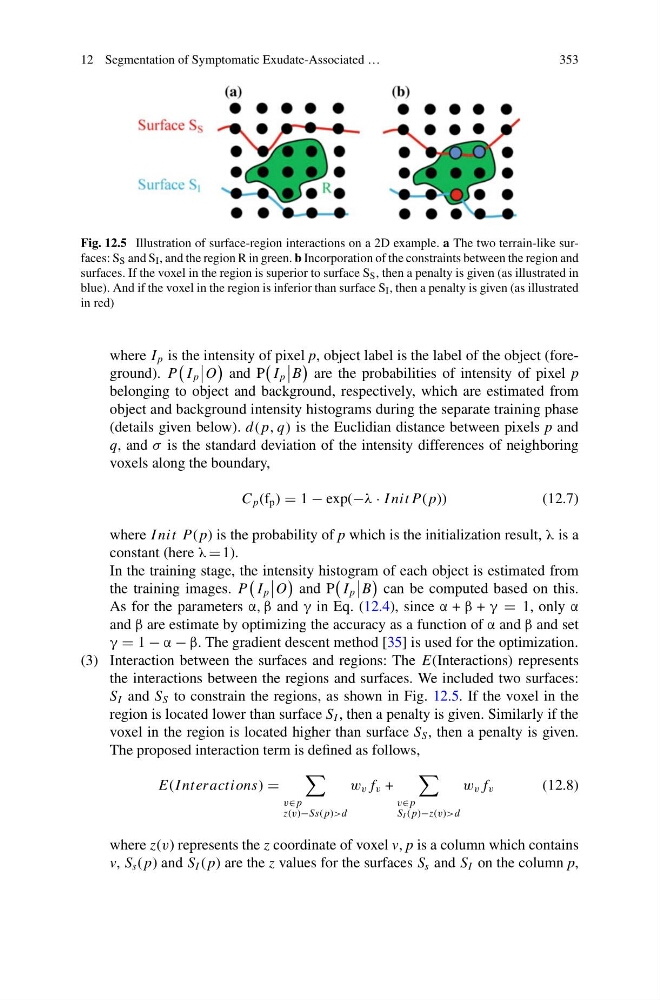
Fig. 12.5 Illustration of surface-region interactions on a 2D example. a The two terrain-like surfaces: S S and S I , and the region R in green. b Incorporation of the constraints between the region and
surfaces. If the voxel in the region is superior to surface S S , then a penalty is given (as illustrated in
blue). And if the voxel in the region is inferior than surface S I , then a penalty is given (as illustrated
in red)
where I p is the intensity of pixel p, object label is the label of the object (foreground). P
I p
O
and P
I p
B
are the probabilities of intensity of pixel p
belonging to object and background, respectively, which are estimated from
object and background intensity histograms during the separate training phase
(details given below). d( p, q) is the Euclidian distance between pixels p and
q, and σ is the standard deviation of the intensity differences of neighboring
voxels along the boundary,
C p (f p ) 1 − exp(−λ · I nit P( p))
(12.7)
where I nit P( p) is the probability of p which is the initialization result, λ is a
constant (here λ 1).
In the training stage, the intensity histogram of each object is estimated from
the training images. P
I p
O
and P
I p
B
can be computed based on this.
As for the parameters α, β and γ in Eq. (12.4), since α + β + γ 1, only α
and β are estimate by optimizing the accuracy as a function of α and β and set
γ 1 − α − β. The gradient descent method [35] is used for the optimization.
(3) Interaction between the surfaces and regions: The E(Interactions) represents
the interactions between the regions and surfaces. We included two surfaces:
S I and S S to constrain the regions, as shown in Fig. 12.5. If the voxel in the
region is located lower than surface S I , then a penalty is given. Similarly if the
voxel in the region is located higher than surface S S , then a penalty is given.
The proposed interaction term is defined as follows,
E(I nteractions)
v∈ p
z(v)−Ss( p)>d
w v f v +
v∈ p
S I ( p)−z(v)>d
w v f v
(12.8)
where z(v) represents the z coordinate of voxel v, p is a column which contains
v, S s ( p) and S I ( p) are the z values for the surfaces S s and S I on the column p,
353
Fig. 12.5 Illustration of surface-region interactions on a 2D example. a The two terrain-like surfaces: S S and S I , and the region R in green. b Incorporation of the constraints between the region and
surfaces. If the voxel in the region is superior to surface S S , then a penalty is given (as illustrated in
blue). And if the voxel in the region is inferior than surface S I , then a penalty is given (as illustrated
in red)
where I p is the intensity of pixel p, object label is the label of the object (foreground). P
I p
O
and P
I p
B
are the probabilities of intensity of pixel p
belonging to object and background, respectively, which are estimated from
object and background intensity histograms during the separate training phase
(details given below). d( p, q) is the Euclidian distance between pixels p and
q, and σ is the standard deviation of the intensity differences of neighboring
voxels along the boundary,
C p (f p ) 1 − exp(−λ · I nit P( p))
(12.7)
where I nit P( p) is the probability of p which is the initialization result, λ is a
constant (here λ 1).
In the training stage, the intensity histogram of each object is estimated from
the training images. P
I p
O
and P
I p
B
can be computed based on this.
As for the parameters α, β and γ in Eq. (12.4), since α + β + γ 1, only α
and β are estimate by optimizing the accuracy as a function of α and β and set
γ 1 − α − β. The gradient descent method [35] is used for the optimization.
(3) Interaction between the surfaces and regions: The E(Interactions) represents
the interactions between the regions and surfaces. We included two surfaces:
S I and S S to constrain the regions, as shown in Fig. 12.5. If the voxel in the
region is located lower than surface S I , then a penalty is given. Similarly if the
voxel in the region is located higher than surface S S , then a penalty is given.
The proposed interaction term is defined as follows,
E(I nteractions)
v∈ p
z(v)−Ss( p)>d
w v f v +
v∈ p
S I ( p)−z(v)>d
w v f v
(12.8)
where z(v) represents the z coordinate of voxel v, p is a column which contains
v, S s ( p) and S I ( p) are the z values for the surfaces S s and S I on the column p,