

350
L. Pan and X. Chen
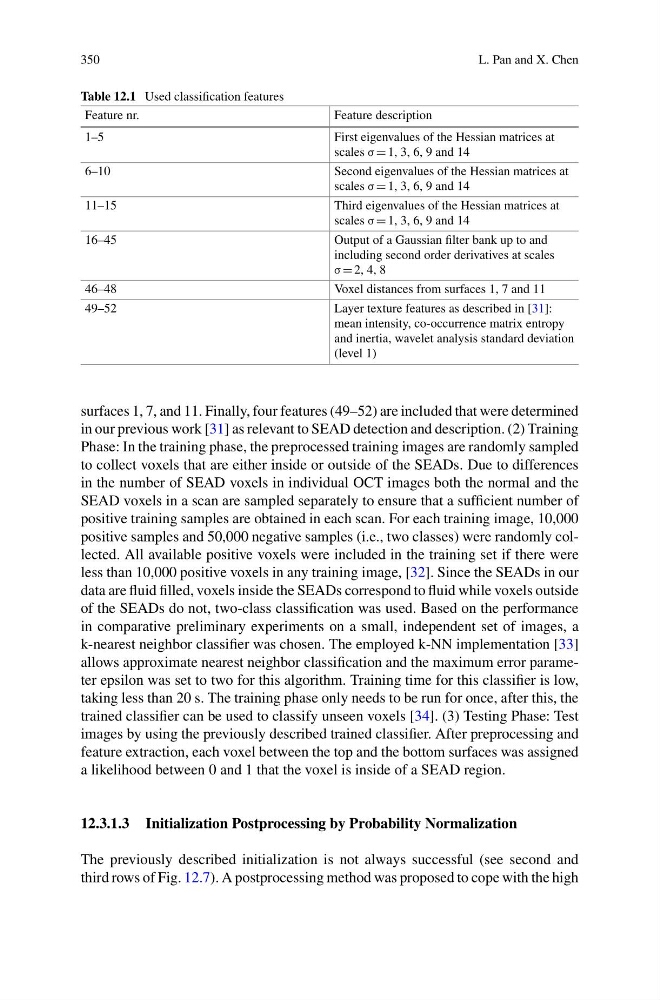
Table 12.1 Used classification features
Feature nr.
Feature description
1–5
First eigenvalues of the Hessian matrices at
scales σ 1, 3, 6, 9 and 14
6–10
Second eigenvalues of the Hessian matrices at
scales σ 1, 3, 6, 9 and 14
11–15
Third eigenvalues of the Hessian matrices at
scales σ 1, 3, 6, 9 and 14
16–45
Output of a Gaussian filter bank up to and
including second order derivatives at scales
σ 2, 4, 8
46–48
Voxel distances from surfaces 1, 7 and 11
49–52
Layer texture features as described in [31]:
mean intensity, co-occurrence matrix entropy
and inertia, wavelet analysis standard deviation
(level 1)
surfaces 1, 7, and 11. Finally, four features (49–52) are included that were determined
in our previous work [31] as relevant to SEAD detection and description. (2) Training
Phase: In the training phase, the preprocessed training images are randomly sampled
to collect voxels that are either inside or outside of the SEADs. Due to differences
in the number of SEAD voxels in individual OCT images both the normal and the
SEAD voxels in a scan are sampled separately to ensure that a sufficient number of
positive training samples are obtained in each scan. For each training image, 10,000
positive samples and 50,000 negative samples (i.e., two classes) were randomly collected. All available positive voxels were included in the training set if there were
less than 10,000 positive voxels in any training image, [32]. Since the SEADs in our
data are fluid filled, voxels inside the SEADs correspond to fluid while voxels outside
of the SEADs do not, two-class classification was used. Based on the performance
in comparative preliminary experiments on a small, independent set of images, a
k-nearest neighbor classifier was chosen. The employed k-NN implementation [33]
allows approximate nearest neighbor classification and the maximum error parameter epsilon was set to two for this algorithm. Training time for this classifier is low,
taking less than 20 s. The training phase only needs to be run for once, after this, the
trained classifier can be used to classify unseen voxels [34]. (3) Testing Phase: Test
images by using the previously described trained classifier. After preprocessing and
feature extraction, each voxel between the top and the bottom surfaces was assigned
a likelihood between 0 and 1 that the voxel is inside of a SEAD region.
12.3.1.3 Initialization Postprocessing by Probability Normalization
The previously described initialization is not always successful (see second and
third rows of Fig. 12.7). A postprocessing method was proposed to cope with the high
L. Pan and X. Chen
Table 12.1 Used classification features
Feature nr.
Feature description
1–5
First eigenvalues of the Hessian matrices at
scales σ 1, 3, 6, 9 and 14
6–10
Second eigenvalues of the Hessian matrices at
scales σ 1, 3, 6, 9 and 14
11–15
Third eigenvalues of the Hessian matrices at
scales σ 1, 3, 6, 9 and 14
16–45
Output of a Gaussian filter bank up to and
including second order derivatives at scales
σ 2, 4, 8
46–48
Voxel distances from surfaces 1, 7 and 11
49–52
Layer texture features as described in [31]:
mean intensity, co-occurrence matrix entropy
and inertia, wavelet analysis standard deviation
(level 1)
surfaces 1, 7, and 11. Finally, four features (49–52) are included that were determined
in our previous work [31] as relevant to SEAD detection and description. (2) Training
Phase: In the training phase, the preprocessed training images are randomly sampled
to collect voxels that are either inside or outside of the SEADs. Due to differences
in the number of SEAD voxels in individual OCT images both the normal and the
SEAD voxels in a scan are sampled separately to ensure that a sufficient number of
positive training samples are obtained in each scan. For each training image, 10,000
positive samples and 50,000 negative samples (i.e., two classes) were randomly collected. All available positive voxels were included in the training set if there were
less than 10,000 positive voxels in any training image, [32]. Since the SEADs in our
data are fluid filled, voxels inside the SEADs correspond to fluid while voxels outside
of the SEADs do not, two-class classification was used. Based on the performance
in comparative preliminary experiments on a small, independent set of images, a
k-nearest neighbor classifier was chosen. The employed k-NN implementation [33]
allows approximate nearest neighbor classification and the maximum error parameter epsilon was set to two for this algorithm. Training time for this classifier is low,
taking less than 20 s. The training phase only needs to be run for once, after this, the
trained classifier can be used to classify unseen voxels [34]. (3) Testing Phase: Test
images by using the previously described trained classifier. After preprocessing and
feature extraction, each voxel between the top and the bottom surfaces was assigned
a likelihood between 0 and 1 that the voxel is inside of a SEAD region.
12.3.1.3 Initialization Postprocessing by Probability Normalization
The previously described initialization is not always successful (see second and
third rows of Fig. 12.7). A postprocessing method was proposed to cope with the high