

Solutions
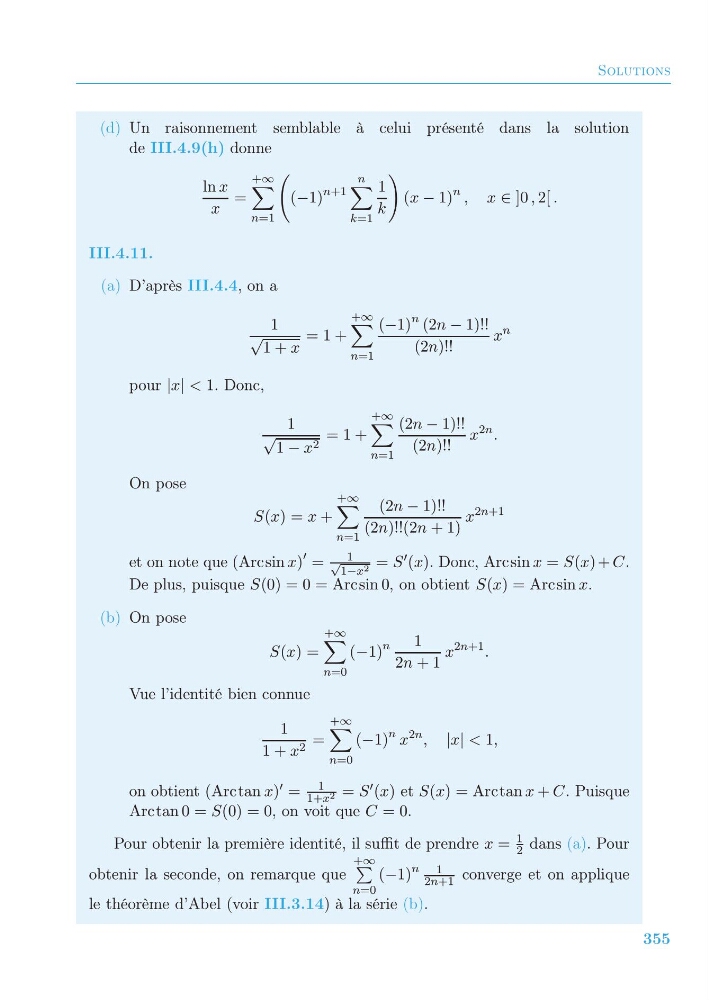
(d) Un raisonnement semblable à celui présenté dans la solution
de III.4.9(h) donne
ln x
x
=
+∞
n=1
(−1)
n+1
n
k=1
1
k
(x − 1)
n , x ∈ ]0 , 2[ .
III.4.11.
(a) D’après III.4.4, on a
1
√
1 + x
= 1 +
+∞
n=1
(−1)
n (2n − 1)!!
(2n)!!
x
n
pour |x| < 1. Donc,
1
√
1 − x 2
= 1 +
+∞
n=1
(2n − 1)!!
(2n)!!
x
2n .
On pose
S(x) = x +
+∞
n=1
(2n − 1)!!
(2n)!!(2n + 1)
x
2n+1
et on note que (Arcsin x)
=
1
√
1−x 2 = S (x). Donc, Arcsin x = S(x) + C.
De plus, puisque S(0) = 0 = Arcsin 0, on obtient S(x) = Arcsin x.
(b) On pose
S(x) =
+∞
n=0
(−1)
n
1
2n + 1
x
2n+1 .
Vue l’identité bien connue
1
1 + x 2 =
+∞
n=0
(−1)
n x
2n , |x| < 1,
on obtient (Arctan x) =
1
1+x 2 = S (x) et S(x) = Arctan x + C. Puisque
Arctan 0 = S(0) = 0, on voit que C = 0.
Pour obtenir la première identité, il suffit de prendre x =
1
2 dans (a). Pour
obtenir la seconde, on remarque que
+∞
n=0
(−1)
n 1
2n+1 converge et on applique
le théorème d’Abel (voir III.3.14) à la série (b).
355
(d) Un raisonnement semblable à celui présenté dans la solution
de III.4.9(h) donne
ln x
x
=
+∞
n=1
(−1)
n+1
n
k=1
1
k
(x − 1)
n , x ∈ ]0 , 2[ .
III.4.11.
(a) D’après III.4.4, on a
1
√
1 + x
= 1 +
+∞
n=1
(−1)
n (2n − 1)!!
(2n)!!
x
n
pour |x| < 1. Donc,
1
√
1 − x 2
= 1 +
+∞
n=1
(2n − 1)!!
(2n)!!
x
2n .
On pose
S(x) = x +
+∞
n=1
(2n − 1)!!
(2n)!!(2n + 1)
x
2n+1
et on note que (Arcsin x)
=
1
√
1−x 2 = S (x). Donc, Arcsin x = S(x) + C.
De plus, puisque S(0) = 0 = Arcsin 0, on obtient S(x) = Arcsin x.
(b) On pose
S(x) =
+∞
n=0
(−1)
n
1
2n + 1
x
2n+1 .
Vue l’identité bien connue
1
1 + x 2 =
+∞
n=0
(−1)
n x
2n , |x| < 1,
on obtient (Arctan x) =
1
1+x 2 = S (x) et S(x) = Arctan x + C. Puisque
Arctan 0 = S(0) = 0, on voit que C = 0.
Pour obtenir la première identité, il suffit de prendre x =
1
2 dans (a). Pour
obtenir la seconde, on remarque que
+∞
n=0
(−1)
n 1
2n+1 converge et on applique
le théorème d’Abel (voir III.3.14) à la série (b).
355