

Solutions
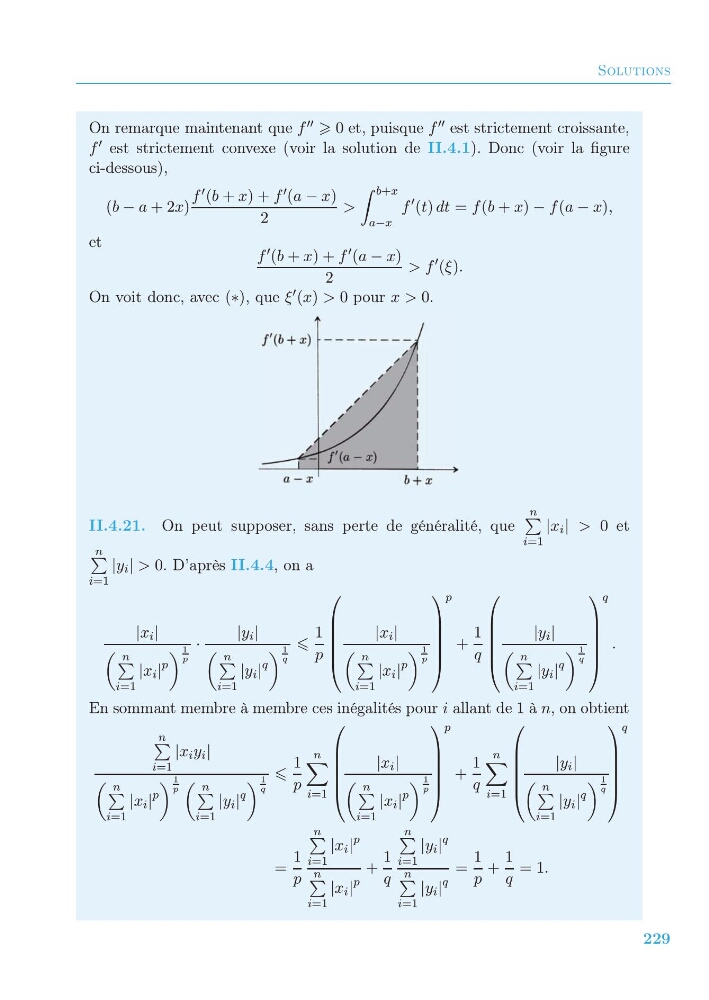
On remarque maintenant que f 0 et, puisque f est strictement croissante,
f est strictement convexe (voir la solution de II.4.1). Donc (voir la figure
ci-dessous),
(b − a + 2x)
f (b + x) + f (a − x)
2
>
b+x
a−x
f
(t) dt = f (b + x) − f (a − x),
et
f (b + x) + f (a − x)
2
> f
(ξ).
On voit donc, avec (∗), que ξ (x) > 0 pour x > 0.
II.4.21. On peut supposer, sans perte de généralité, que
n
i=1
|x i | > 0 et
n
i=1
|y i | > 0. D’après II.4.4, on a
|x i |
n
i=1
|x i |
p
1
p
·
|y i |
n
i=1
|y i |
q
1
q
1
p
⎛
⎜
⎜
⎜
⎜
⎝
|x i |
n
i=1
|x i |
p
1
p
⎞
⎟
⎟
⎟
⎟
⎠
p
+
1
q
⎛
⎜
⎜
⎜
⎜
⎝
|y i |
n
i=1
|y i |
q
1
q
⎞
⎟
⎟
⎟
⎟
⎠
q
.
En sommant membre à membre ces inégalités pour i allant de 1 à n, on obtient
n
i=1
|x i y i |
n
i=1
|x i |
p
1
p
n
i=1
|y i |
q
1
q
1
p
n
i=1
⎛
⎜
⎜
⎜
⎜
⎝
|x i |
n
i=1
|x i |
p
1
p
⎞
⎟
⎟
⎟
⎟
⎠
p
+
1
q
n
i=1
⎛
⎜
⎜
⎜
⎜
⎝
|y i |
n
i=1
|y i |
q
1
q
⎞
⎟
⎟
⎟
⎟
⎠
q
=
1
p
n
i=1
|x i |
p
n
i=1
|x i |
p
+
1
q
n
i=1
|y i |
q
n
i=1
|y i |
q
=
1
p
+
1
q
= 1.
229
On remarque maintenant que f 0 et, puisque f est strictement croissante,
f est strictement convexe (voir la solution de II.4.1). Donc (voir la figure
ci-dessous),
(b − a + 2x)
f (b + x) + f (a − x)
2
>
b+x
a−x
f
(t) dt = f (b + x) − f (a − x),
et
f (b + x) + f (a − x)
2
> f
(ξ).
On voit donc, avec (∗), que ξ (x) > 0 pour x > 0.
II.4.21. On peut supposer, sans perte de généralité, que
n
i=1
|x i | > 0 et
n
i=1
|y i | > 0. D’après II.4.4, on a
|x i |
n
i=1
|x i |
p
1
p
·
|y i |
n
i=1
|y i |
q
1
q
1
p
⎛
⎜
⎜
⎜
⎜
⎝
|x i |
n
i=1
|x i |
p
1
p
⎞
⎟
⎟
⎟
⎟
⎠
p
+
1
q
⎛
⎜
⎜
⎜
⎜
⎝
|y i |
n
i=1
|y i |
q
1
q
⎞
⎟
⎟
⎟
⎟
⎠
q
.
En sommant membre à membre ces inégalités pour i allant de 1 à n, on obtient
n
i=1
|x i y i |
n
i=1
|x i |
p
1
p
n
i=1
|y i |
q
1
q
1
p
n
i=1
⎛
⎜
⎜
⎜
⎜
⎝
|x i |
n
i=1
|x i |
p
1
p
⎞
⎟
⎟
⎟
⎟
⎠
p
+
1
q
n
i=1
⎛
⎜
⎜
⎜
⎜
⎝
|y i |
n
i=1
|y i |
q
1
q
⎞
⎟
⎟
⎟
⎟
⎠
q
=
1
p
n
i=1
|x i |
p
n
i=1
|x i |
p
+
1
q
n
i=1
|y i |
q
n
i=1
|y i |
q
=
1
p
+
1
q
= 1.
229