

Solutions
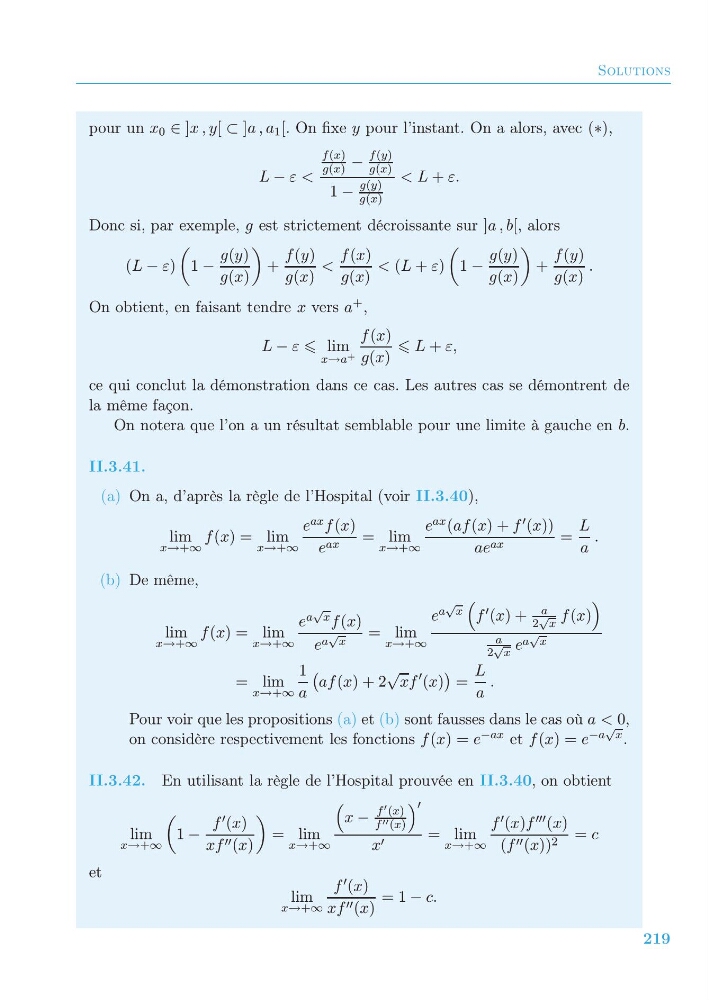
pour un x 0 ∈ ]x , y[ ⊂ ]a , a 1 [. On fixe y pour l’instant. On a alors, avec (∗),
L − ε <
f (x)
g(x) −
f (y)
g(x)
1 −
g(y)
g(x)
< L + ε.
Donc si, par exemple, g est strictement décroissante sur ]a , b[, alors
(L − ε)
1 −
g(y)
g(x)
+
f (y)
g(x)
<
f (x)
g(x)
< (L + ε)
1 −
g(y)
g(x)
+
f (y)
g(x)
.
On obtient, en faisant tendre x vers a + ,
L − ε lim
x→a +
f (x)
g(x)
L + ε,
ce qui conclut la démonstration dans ce cas. Les autres cas se démontrent de
la même façon.
On notera que l’on a un résultat semblable pour une limite à gauche en b.
II.3.41.
(a) On a, d’après la règle de l’Hospital (voir II.3.40),
lim
x→+∞
f (x) = lim
x→+∞
e ax f (x)
e ax = lim
x→+∞
e ax (af (x) + f (x))
ae ax
=
L
a
.
(b) De même,
lim
x→+∞
f (x) = lim
x→+∞
e a
√
x f (x)
e a
√ x
= lim
x→+∞
e a
√
x
f (x) +
a
2
√
x
f (x)
a
2
√
x
e a
√ x
= lim
x→+∞
1
a
af (x) + 2
√
xf
(x)
=
L
a
.
Pour voir que les propositions (a) et (b) sont fausses dans le cas où a < 0,
on considère respectivement les fonctions f (x) = e −ax et f (x) = e −a
√
x .
II.3.42. En utilisant la règle de l’Hospital prouvée en II.3.40, on obtient
lim
x→+∞
1 −
f (x)
xf (x)
= lim
x→+∞
x −
f (x)
f (x)
x
= lim
x→+∞
f (x)f (x)
(f (x)) 2 = c
et
lim
x→+∞
f (x)
xf (x)
= 1 − c.
219
pour un x 0 ∈ ]x , y[ ⊂ ]a , a 1 [. On fixe y pour l’instant. On a alors, avec (∗),
L − ε <
f (x)
g(x) −
f (y)
g(x)
1 −
g(y)
g(x)
< L + ε.
Donc si, par exemple, g est strictement décroissante sur ]a , b[, alors
(L − ε)
1 −
g(y)
g(x)
+
f (y)
g(x)
<
f (x)
g(x)
< (L + ε)
1 −
g(y)
g(x)
+
f (y)
g(x)
.
On obtient, en faisant tendre x vers a + ,
L − ε lim
x→a +
f (x)
g(x)
L + ε,
ce qui conclut la démonstration dans ce cas. Les autres cas se démontrent de
la même façon.
On notera que l’on a un résultat semblable pour une limite à gauche en b.
II.3.41.
(a) On a, d’après la règle de l’Hospital (voir II.3.40),
lim
x→+∞
f (x) = lim
x→+∞
e ax f (x)
e ax = lim
x→+∞
e ax (af (x) + f (x))
ae ax
=
L
a
.
(b) De même,
lim
x→+∞
f (x) = lim
x→+∞
e a
√
x f (x)
e a
√ x
= lim
x→+∞
e a
√
x
f (x) +
a
2
√
x
f (x)
a
2
√
x
e a
√ x
= lim
x→+∞
1
a
af (x) + 2
√
xf
(x)
=
L
a
.
Pour voir que les propositions (a) et (b) sont fausses dans le cas où a < 0,
on considère respectivement les fonctions f (x) = e −ax et f (x) = e −a
√
x .
II.3.42. En utilisant la règle de l’Hospital prouvée en II.3.40, on obtient
lim
x→+∞
1 −
f (x)
xf (x)
= lim
x→+∞
x −
f (x)
f (x)
x
= lim
x→+∞
f (x)f (x)
(f (x)) 2 = c
et
lim
x→+∞
f (x)
xf (x)
= 1 − c.
219