

Chapitre II. Dérivation
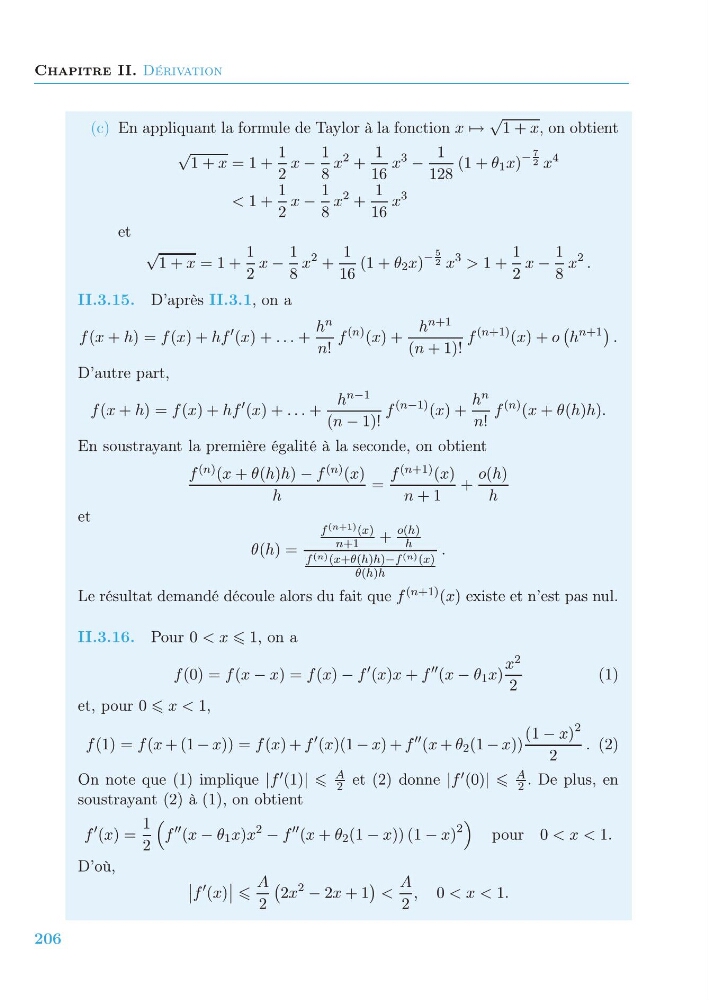
(c) En appliquant la formule de Taylor à la fonction x →
√
1 + x, on obtient
√
1 + x = 1 +
1
2
x −
1
8
x
2 +
1
16
x
3
−
1
128
(1 + θ 1 x)
−
7
2 x
4
< 1 +
1
2
x −
1
8
x
2 +
1
16
x
3
et
√
1 + x = 1 +
1
2
x −
1
8
x
2 +
1
16
(1 + θ 2 x)
−
5
2 x
3 > 1 +
1
2
x −
1
8
x
2 .
II.3.15. D’après II.3.1, on a
f (x + h) = f (x) + hf
(x) + . . . +
h n
n!
f
(n) (x) +
h n+1
(n + 1)!
f
(n+1) (x) + o
h
n+1
.
D’autre part,
f (x + h) = f (x) + hf
(x) + . . . +
h n−1
(n − 1)!
f
(n−1) (x) +
h n
n!
f
(n) (x + θ(h)h).
En soustrayant la première égalité à la seconde, on obtient
f (n) (x + θ(h)h) − f (n) (x)
h
=
f (n+1) (x)
n + 1
+
o(h)
h
et
θ(h) =
f (n+1) (x)
n+1
+
o(h)
h
f (n) (x+θ(h)h)−f (n) (x)
θ(h)h
.
Le résultat demandé découle alors du fait que f (n+1) (x) existe et n’est pas nul.
II.3.16. Pour 0 < x 1, on a
f (0) = f (x − x) = f (x) − f
(x)x + f
(x − θ 1 x)
x 2
2
(1)
et, pour 0 x < 1,
f (1) = f (x + (1 − x)) = f (x) + f
(x)(1 − x) + f
(x + θ 2 (1 − x))
(1 − x)
2
2
. (2)
On note que (1) implique |f (1)|
A
2 et (2) donne |f (0)|
A
2 . De plus, en
soustrayant (2) à (1), on obtient
f
(x) =
1
2
f
(x − θ 1 x)x
2
− f
(x + θ 2 (1 − x)) (1 − x)
2
pour 0 < x < 1.
D’où,
f
(x)
A
2
2x
2
− 2x + 1
<
A
2
, 0 < x < 1.
206
(c) En appliquant la formule de Taylor à la fonction x →
√
1 + x, on obtient
√
1 + x = 1 +
1
2
x −
1
8
x
2 +
1
16
x
3
−
1
128
(1 + θ 1 x)
−
7
2 x
4
< 1 +
1
2
x −
1
8
x
2 +
1
16
x
3
et
√
1 + x = 1 +
1
2
x −
1
8
x
2 +
1
16
(1 + θ 2 x)
−
5
2 x
3 > 1 +
1
2
x −
1
8
x
2 .
II.3.15. D’après II.3.1, on a
f (x + h) = f (x) + hf
(x) + . . . +
h n
n!
f
(n) (x) +
h n+1
(n + 1)!
f
(n+1) (x) + o
h
n+1
.
D’autre part,
f (x + h) = f (x) + hf
(x) + . . . +
h n−1
(n − 1)!
f
(n−1) (x) +
h n
n!
f
(n) (x + θ(h)h).
En soustrayant la première égalité à la seconde, on obtient
f (n) (x + θ(h)h) − f (n) (x)
h
=
f (n+1) (x)
n + 1
+
o(h)
h
et
θ(h) =
f (n+1) (x)
n+1
+
o(h)
h
f (n) (x+θ(h)h)−f (n) (x)
θ(h)h
.
Le résultat demandé découle alors du fait que f (n+1) (x) existe et n’est pas nul.
II.3.16. Pour 0 < x 1, on a
f (0) = f (x − x) = f (x) − f
(x)x + f
(x − θ 1 x)
x 2
2
(1)
et, pour 0 x < 1,
f (1) = f (x + (1 − x)) = f (x) + f
(x)(1 − x) + f
(x + θ 2 (1 − x))
(1 − x)
2
2
. (2)
On note que (1) implique |f (1)|
A
2 et (2) donne |f (0)|
A
2 . De plus, en
soustrayant (2) à (1), on obtient
f
(x) =
1
2
f
(x − θ 1 x)x
2
− f
(x + θ 2 (1 − x)) (1 − x)
2
pour 0 < x < 1.
D’où,
f
(x)
A
2
2x
2
− 2x + 1
<
A
2
, 0 < x < 1.
206