

Solutions
II.3.17.
(a) Pour x ∈ [−c , c], on a
f (c) − f (x) = f
(x)(c − x) +
f (x + θ 1 (c − x))
2
(c − x)
2
(∗)
et
f (−c) − f (x) = −f
(x)(c + x) +
f (x − θ 2 (c + x))
2
(c + x)
2 .
Donc,
f
(x) =
f (c)−f (−c)
2
−
(c−x) 2 f (x+θ 1 (c− x))−(c+x) 2 f (x−θ 2 (c+x))
4c
.
En conséquence,
f
(x)
M 0
c
+
c
2 + x
2
M 2
2c
.
(b) Pour x ∈ [−c , c[, on obtient avec (∗) dans la solution de (a)
f
(x) =
f (c) − f (x)
h
−
f (x + θ 1 h)
2
h,
où h = c − x > 0. Donc, |f (x)| 2
M 0
h +
1
2 M 2 h. En prenant h = 2
M 0
M 2
,
on a alors |f (x)| 2
√
M 0 M 2 , ce qui implique M 1 2
√
M 0 M 2 .
II.3.18. L’inégalité M 1 2
√
M 0 M 2 a été prouvée en II.3.17(b). L’égalité
est atteinte, par exemple, pour f définie par
f (x) =
2x 2 − 1 si −1 < x < 0,
x 2 −1
x 2 +1
si x ∈ R + .
On a en effet M 0 = 1 et M 1 = M 2 = 4.
II.3.19. Pour h > 0 et x ∈ R, on a
f (x + h) = f (x) + f
(x)h + f
(x + θh)
h 2
2
et
f (x − h) = f (x) − f
(x)h + f
(x − θ 1 h)
h 2
2
.
207
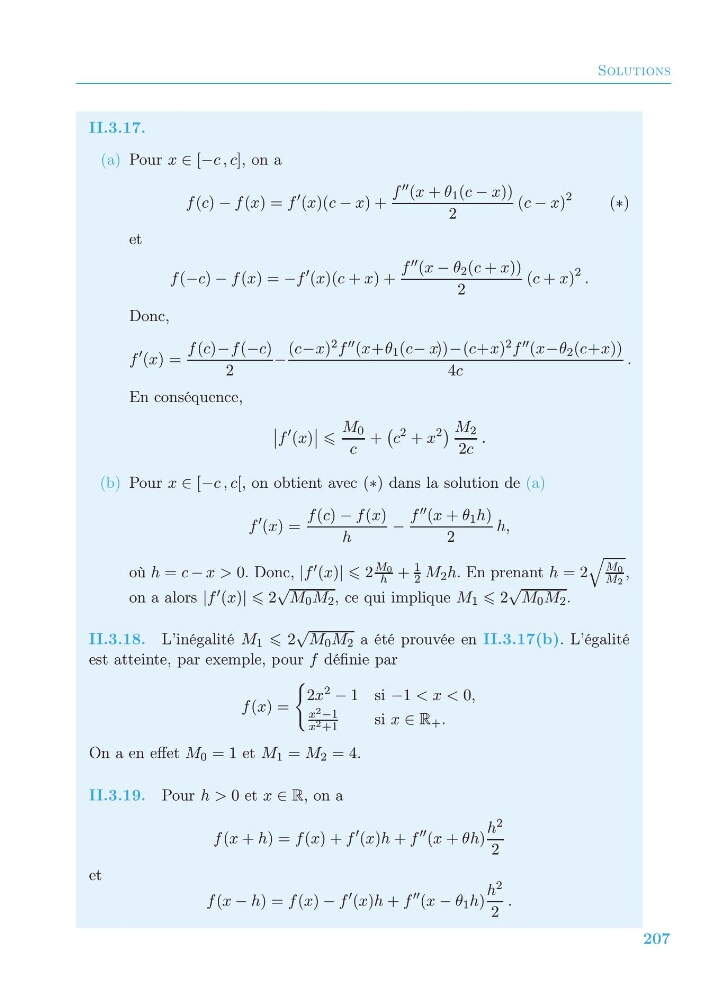
II.3.17.
(a) Pour x ∈ [−c , c], on a
f (c) − f (x) = f
(x)(c − x) +
f (x + θ 1 (c − x))
2
(c − x)
2
(∗)
et
f (−c) − f (x) = −f
(x)(c + x) +
f (x − θ 2 (c + x))
2
(c + x)
2 .
Donc,
f
(x) =
f (c)−f (−c)
2
−
(c−x) 2 f (x+θ 1 (c− x))−(c+x) 2 f (x−θ 2 (c+x))
4c
.
En conséquence,
f
(x)
M 0
c
+
c
2 + x
2
M 2
2c
.
(b) Pour x ∈ [−c , c[, on obtient avec (∗) dans la solution de (a)
f
(x) =
f (c) − f (x)
h
−
f (x + θ 1 h)
2
h,
où h = c − x > 0. Donc, |f (x)| 2
M 0
h +
1
2 M 2 h. En prenant h = 2
M 0
M 2
,
on a alors |f (x)| 2
√
M 0 M 2 , ce qui implique M 1 2
√
M 0 M 2 .
II.3.18. L’inégalité M 1 2
√
M 0 M 2 a été prouvée en II.3.17(b). L’égalité
est atteinte, par exemple, pour f définie par
f (x) =
2x 2 − 1 si −1 < x < 0,
x 2 −1
x 2 +1
si x ∈ R + .
On a en effet M 0 = 1 et M 1 = M 2 = 4.
II.3.19. Pour h > 0 et x ∈ R, on a
f (x + h) = f (x) + f
(x)h + f
(x + θh)
h 2
2
et
f (x − h) = f (x) − f
(x)h + f
(x − θ 1 h)
h 2
2
.
207