

Solutions
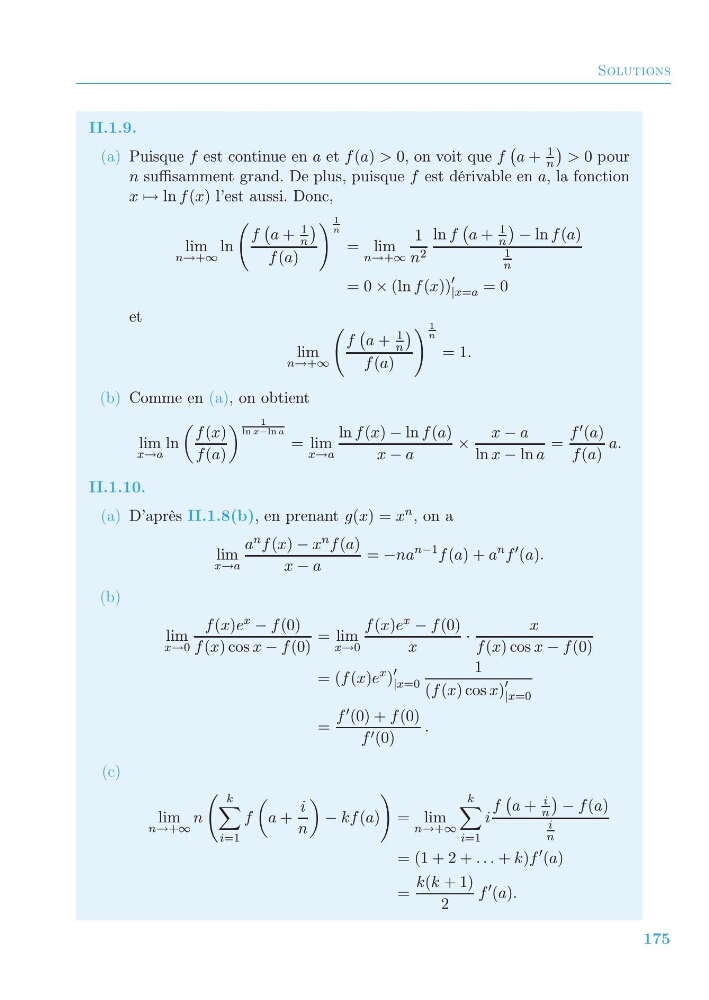
II.1.9.
(a) Puisque f est continue en a et f (a) > 0, on voit que f
a +
1
n
> 0 pour
n suffisamment grand. De plus, puisque f est dérivable en a, la fonction
x → ln f (x) l’est aussi. Donc,
lim
n→+∞
ln
f
a +
1
n
f (a)
1
n
= lim
n→+∞
1
n 2
ln f
a +
1
n
− ln f (a)
1
n
= 0 × (ln f (x))
|x=a = 0
et
lim
n→+∞
f
a +
1
n
f (a)
1
n
= 1.
(b) Comme en (a), on obtient
lim
x→a
ln
f (x)
f (a)
1
ln x−ln a
= lim
x→a
ln f (x) − ln f (a)
x − a
×
x − a
ln x − ln a
=
f (a)
f (a)
a.
II.1.10.
(a) D’après II.1.8(b), en prenant g(x) = x n , on a
lim
x→a
a n f (x) − x n f (a)
x − a
= −na
n−1 f (a) + a
n f
(a).
(b)
lim
x→0
f (x)e x − f (0)
f (x) cos x − f (0)
= lim
x→0
f (x)e x − f (0)
x
·
x
f (x) cos x − f (0)
= (f (x)e
x )
|x=0
1
(f (x) cos x)
|x=0
=
f (0) + f (0)
f (0)
.
(c)
lim
n→+∞
n
k
i=1
f
a +
i
n
− kf (a)
= lim
n→+∞
k
i=1
i
f
a +
i
n
− f (a)
i
n
= (1 + 2 + . . . + k)f
(a)
=
k(k + 1)
2
f
(a).
175
II.1.9.
(a) Puisque f est continue en a et f (a) > 0, on voit que f
a +
1
n
> 0 pour
n suffisamment grand. De plus, puisque f est dérivable en a, la fonction
x → ln f (x) l’est aussi. Donc,
lim
n→+∞
ln
f
a +
1
n
f (a)
1
n
= lim
n→+∞
1
n 2
ln f
a +
1
n
− ln f (a)
1
n
= 0 × (ln f (x))
|x=a = 0
et
lim
n→+∞
f
a +
1
n
f (a)
1
n
= 1.
(b) Comme en (a), on obtient
lim
x→a
ln
f (x)
f (a)
1
ln x−ln a
= lim
x→a
ln f (x) − ln f (a)
x − a
×
x − a
ln x − ln a
=
f (a)
f (a)
a.
II.1.10.
(a) D’après II.1.8(b), en prenant g(x) = x n , on a
lim
x→a
a n f (x) − x n f (a)
x − a
= −na
n−1 f (a) + a
n f
(a).
(b)
lim
x→0
f (x)e x − f (0)
f (x) cos x − f (0)
= lim
x→0
f (x)e x − f (0)
x
·
x
f (x) cos x − f (0)
= (f (x)e
x )
|x=0
1
(f (x) cos x)
|x=0
=
f (0) + f (0)
f (0)
.
(c)
lim
n→+∞
n
k
i=1
f
a +
i
n
− kf (a)
= lim
n→+∞
k
i=1
i
f
a +
i
n
− f (a)
i
n
= (1 + 2 + . . . + k)f
(a)
=
k(k + 1)
2
f
(a).
175