

Chapitre II. Dérivation
Solutions
II.1. Dérivée d’une fonction réelle
II.1.1.
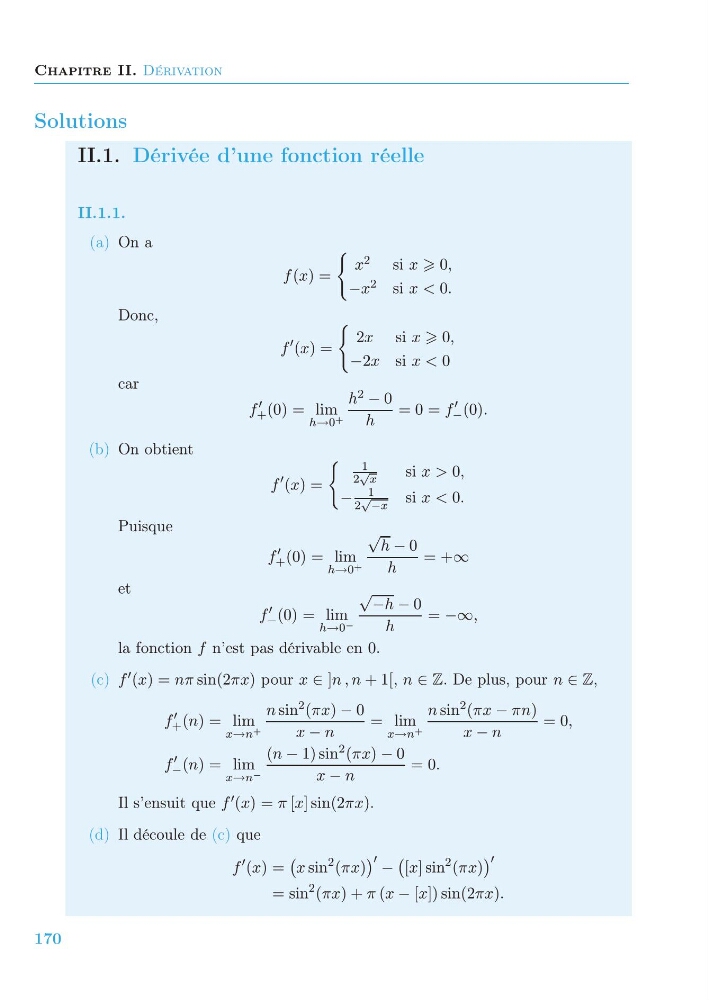
(a) On a
f (x) =
x 2 si x 0,
−x 2 si x < 0.
Donc,
f
(x) =
2x si x 0,
−2x si x < 0
car
f
+ (0) = lim
h→0 +
h 2 − 0
h
= 0 = f
− (0).
(b) On obtient
f
(x) =
1
2
√ x
si x > 0,
−
1
2
√ −x
si x < 0.
Puisque
f
+ (0) = lim
h→0 +
√
h − 0
h
= +∞
et
f
− (0) = lim
h→0 −
√ −h − 0
h
= −∞,
la fonction f n’est pas dérivable en 0.
(c) f (x) = nπ sin(2πx) pour x ∈ ]n , n + 1[, n ∈ Z. De plus, pour n ∈ Z,
f
+ (n) = lim
x→n +
n sin
2 (πx) − 0
x − n
= lim
x→n +
n sin
2 (πx − πn)
x − n
= 0,
f
− (n) = lim
x→n −
(n − 1) sin
2 (πx) − 0
x − n
= 0.
Il s’ensuit que f (x) = π [x] sin(2πx).
(d) Il découle de (c) que
f
(x) =
x sin
2 (πx)
−
[x] sin
2 (πx)
= sin
2 (πx) + π (x − [x]) sin(2πx).
170
Solutions
II.1. Dérivée d’une fonction réelle
II.1.1.
(a) On a
f (x) =
x 2 si x 0,
−x 2 si x < 0.
Donc,
f
(x) =
2x si x 0,
−2x si x < 0
car
f
+ (0) = lim
h→0 +
h 2 − 0
h
= 0 = f
− (0).
(b) On obtient
f
(x) =
1
2
√ x
si x > 0,
−
1
2
√ −x
si x < 0.
Puisque
f
+ (0) = lim
h→0 +
√
h − 0
h
= +∞
et
f
− (0) = lim
h→0 −
√ −h − 0
h
= −∞,
la fonction f n’est pas dérivable en 0.
(c) f (x) = nπ sin(2πx) pour x ∈ ]n , n + 1[, n ∈ Z. De plus, pour n ∈ Z,
f
+ (n) = lim
x→n +
n sin
2 (πx) − 0
x − n
= lim
x→n +
n sin
2 (πx − πn)
x − n
= 0,
f
− (n) = lim
x→n −
(n − 1) sin
2 (πx) − 0
x − n
= 0.
Il s’ensuit que f (x) = π [x] sin(2πx).
(d) Il découle de (c) que
f
(x) =
x sin
2 (πx)
−
[x] sin
2 (πx)
= sin
2 (πx) + π (x − [x]) sin(2πx).
170