

Énoncés
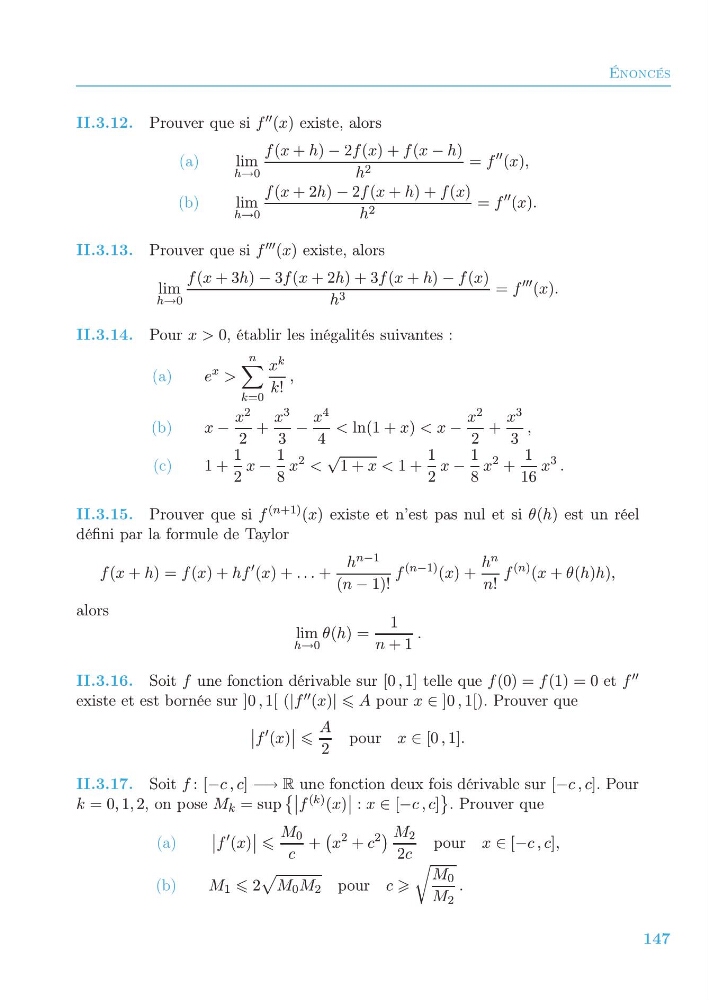
II.3.12. Prouver que si f (x) existe, alors
(a)
lim
h→0
f (x + h) − 2f (x) + f (x − h)
h 2
= f
(x),
(b)
lim
h→0
f (x + 2h) − 2f (x + h) + f (x)
h 2
= f
(x).
II.3.13. Prouver que si f (x) existe, alors
lim
h→0
f (x + 3h) − 3f (x + 2h) + 3f (x + h) − f (x)
h 3
= f
(x).
II.3.14. Pour x > 0, établir les inégalités suivantes :
(a)
e
x >
n
k=0
x k
k!
,
(b)
x −
x 2
2
+
x 3
3
−
x 4
4
< ln(1 + x) < x −
x 2
2
+
x 3
3
,
(c)
1 +
1
2
x −
1
8
x
2 <
√
1 + x < 1 +
1
2
x −
1
8
x
2 +
1
16
x
3 .
II.3.15. Prouver que si f (n+1) (x) existe et n’est pas nul et si θ(h) est un réel
défini par la formule de Taylor
f (x + h) = f (x) + hf
(x) + . . . +
h n−1
(n − 1)!
f
(n−1) (x) +
h n
n!
f
(n) (x + θ(h)h),
alors
lim
h→0
θ(h) =
1
n + 1
.
II.3.16. Soit f une fonction dérivable sur [0 , 1] telle que f (0) = f (1) = 0 et f
existe et est bornée sur ]0 , 1[ (|f (x)| A pour x ∈ ]0 , 1[). Prouver que
f
(x)
A
2
pour x ∈ [0 , 1].
II.3.17. Soit f : [−c , c] −→ R une fonction deux fois dérivable sur [−c , c]. Pour
k = 0, 1, 2, on pose M k = sup
f (k) (x)
: x ∈ [−c , c]
. Prouver que
(a)
f
(x)
M 0
c
+
x
2 + c
2
M 2
2c
pour x ∈ [−c , c],
(b)
M 1 2
M 0 M 2 pour c
M 0
M 2
.
147
II.3.12. Prouver que si f (x) existe, alors
(a)
lim
h→0
f (x + h) − 2f (x) + f (x − h)
h 2
= f
(x),
(b)
lim
h→0
f (x + 2h) − 2f (x + h) + f (x)
h 2
= f
(x).
II.3.13. Prouver que si f (x) existe, alors
lim
h→0
f (x + 3h) − 3f (x + 2h) + 3f (x + h) − f (x)
h 3
= f
(x).
II.3.14. Pour x > 0, établir les inégalités suivantes :
(a)
e
x >
n
k=0
x k
k!
,
(b)
x −
x 2
2
+
x 3
3
−
x 4
4
< ln(1 + x) < x −
x 2
2
+
x 3
3
,
(c)
1 +
1
2
x −
1
8
x
2 <
√
1 + x < 1 +
1
2
x −
1
8
x
2 +
1
16
x
3 .
II.3.15. Prouver que si f (n+1) (x) existe et n’est pas nul et si θ(h) est un réel
défini par la formule de Taylor
f (x + h) = f (x) + hf
(x) + . . . +
h n−1
(n − 1)!
f
(n−1) (x) +
h n
n!
f
(n) (x + θ(h)h),
alors
lim
h→0
θ(h) =
1
n + 1
.
II.3.16. Soit f une fonction dérivable sur [0 , 1] telle que f (0) = f (1) = 0 et f
existe et est bornée sur ]0 , 1[ (|f (x)| A pour x ∈ ]0 , 1[). Prouver que
f
(x)
A
2
pour x ∈ [0 , 1].
II.3.17. Soit f : [−c , c] −→ R une fonction deux fois dérivable sur [−c , c]. Pour
k = 0, 1, 2, on pose M k = sup
f (k) (x)
: x ∈ [−c , c]
. Prouver que
(a)
f
(x)
M 0
c
+
x
2 + c
2
M 2
2c
pour x ∈ [−c , c],
(b)
M 1 2
M 0 M 2 pour c
M 0
M 2
.
147