

Énoncés
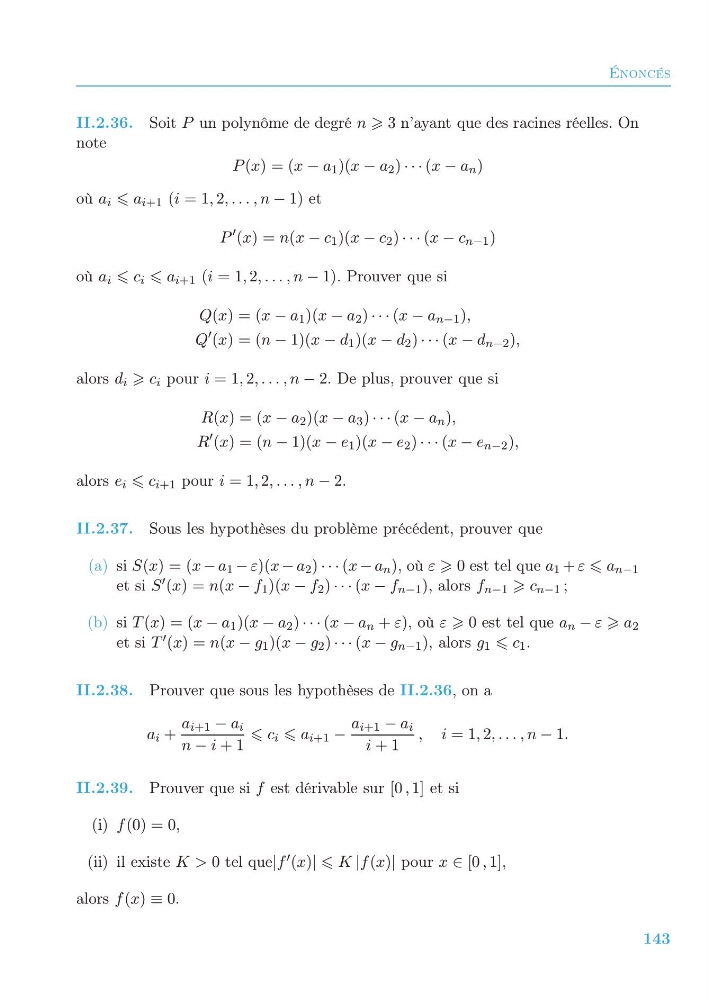
II.2.36. Soit P un polynôme de degré n 3 n’ayant que des racines réelles. On
note
P (x) = (x − a 1 )(x − a 2 ) · · · (x − a n )
où a i a i+1 (i = 1, 2, . . . , n − 1) et
P
(x) = n(x − c 1 )(x − c 2 ) · · · (x − c n−1 )
où a i c i a i+1 (i = 1, 2, . . . , n − 1). Prouver que si
Q(x) = (x − a 1 )(x − a 2 ) · · · (x − a n−1 ),
Q
(x) = (n − 1)(x − d 1 )(x − d 2 ) · · · (x − d n−2 ),
alors d i c i pour i = 1, 2, . . . , n − 2. De plus, prouver que si
R(x) = (x − a 2 )(x − a 3 ) · · · (x − a n ),
R
(x) = (n − 1)(x − e 1 )(x − e 2 ) · · · (x − e n−2 ),
alors e i c i+1 pour i = 1, 2, . . . , n − 2.
II.2.37. Sous les hypothèses du problème précédent, prouver que
(a) si S(x) = (x − a 1 − ε)(x − a 2 ) · · · (x − a n ), où ε 0 est tel que a 1 + ε a n−1
et si S (x) = n(x − f 1 )(x − f 2 ) · · · (x − f n−1 ), alors f n−1 c n−1 ;
(b) si T (x) = (x − a 1 )(x − a 2 ) · · · (x − a n + ε), où ε 0 est tel que a n − ε a 2
et si T (x) = n(x − g 1 )(x − g 2 ) · · · (x − g n−1 ), alors g 1 c 1 .
II.2.38. Prouver que sous les hypothèses de II.2.36, on a
a i +
a i+1 − a i
n − i + 1
c i a i+1 −
a i+1 − a i
i + 1
, i = 1, 2, . . . , n − 1.
II.2.39. Prouver que si f est dérivable sur [0 , 1] et si
(i) f (0) = 0,
(ii) il existe K > 0 tel que|f (x)| K |f (x)| pour x ∈ [0 , 1],
alors f (x) ≡ 0.
143
II.2.36. Soit P un polynôme de degré n 3 n’ayant que des racines réelles. On
note
P (x) = (x − a 1 )(x − a 2 ) · · · (x − a n )
où a i a i+1 (i = 1, 2, . . . , n − 1) et
P
(x) = n(x − c 1 )(x − c 2 ) · · · (x − c n−1 )
où a i c i a i+1 (i = 1, 2, . . . , n − 1). Prouver que si
Q(x) = (x − a 1 )(x − a 2 ) · · · (x − a n−1 ),
Q
(x) = (n − 1)(x − d 1 )(x − d 2 ) · · · (x − d n−2 ),
alors d i c i pour i = 1, 2, . . . , n − 2. De plus, prouver que si
R(x) = (x − a 2 )(x − a 3 ) · · · (x − a n ),
R
(x) = (n − 1)(x − e 1 )(x − e 2 ) · · · (x − e n−2 ),
alors e i c i+1 pour i = 1, 2, . . . , n − 2.
II.2.37. Sous les hypothèses du problème précédent, prouver que
(a) si S(x) = (x − a 1 − ε)(x − a 2 ) · · · (x − a n ), où ε 0 est tel que a 1 + ε a n−1
et si S (x) = n(x − f 1 )(x − f 2 ) · · · (x − f n−1 ), alors f n−1 c n−1 ;
(b) si T (x) = (x − a 1 )(x − a 2 ) · · · (x − a n + ε), où ε 0 est tel que a n − ε a 2
et si T (x) = n(x − g 1 )(x − g 2 ) · · · (x − g n−1 ), alors g 1 c 1 .
II.2.38. Prouver que sous les hypothèses de II.2.36, on a
a i +
a i+1 − a i
n − i + 1
c i a i+1 −
a i+1 − a i
i + 1
, i = 1, 2, . . . , n − 1.
II.2.39. Prouver que si f est dérivable sur [0 , 1] et si
(i) f (0) = 0,
(ii) il existe K > 0 tel que|f (x)| K |f (x)| pour x ∈ [0 , 1],
alors f (x) ≡ 0.
143