

7.3
steadystate continuity equations (6.34) and indicate the distance over which the minority
carrier densities drop by a factor of 1/e (where e is the base of the natural logarithm); this
is demonstrated for a p-n homojunction in Appendix B. Often these diffusion lengths are
interpreted as the typical distance minority carriers diffuse before being annihilated.
Example
To get an idea about the diffusion lengths, let us assume the mobility of electrons in a p-type c-Si wafer to be μ n ≈
1, 250 cm 2 V −1 s −1 , which corresponds to doping of N A = 10 14 cm −3 , and τ n = 10 −6 s. Further, assume room
temperature (300 K). For the given conditions, the electron diffusion length in the p-type c-Si can be calculated
from Eq. (7.28a):
Shockley–Read–Hall recombination
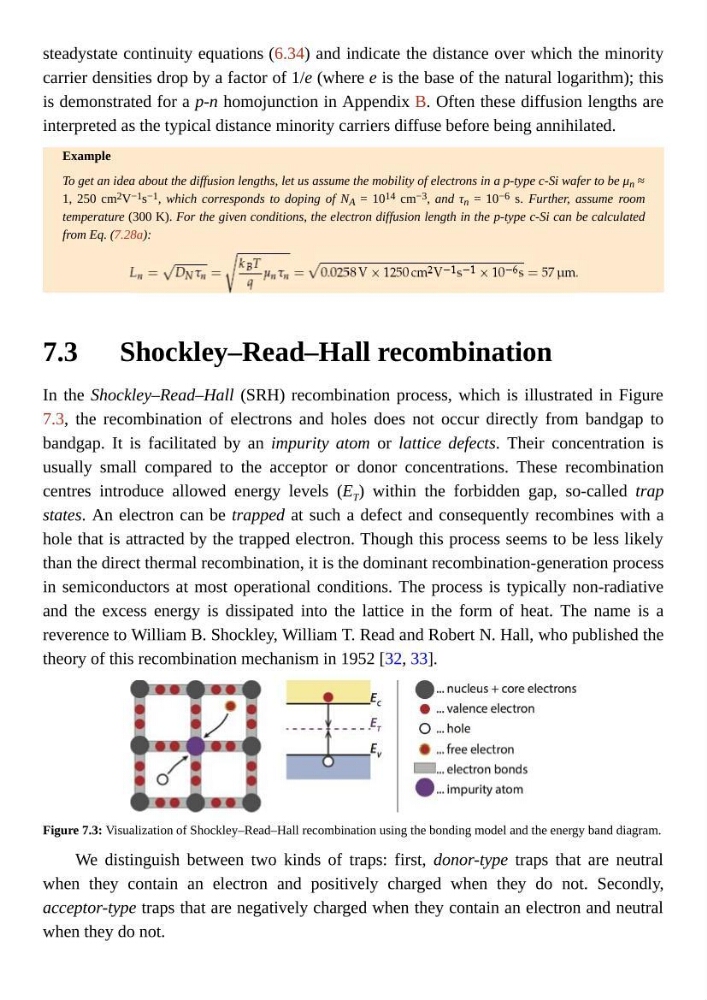
In the Shockley–Read–Hall (SRH) recombination process, which is illustrated in Figure
7.3, the recombination of electrons and holes does not occur directly from bandgap to
bandgap. It is facilitated by an impurity atom or lattice defects. Their concentration is
usually small compared to the acceptor or donor concentrations. These recombination
centres introduce allowed energy levels (E T ) within the forbidden gap, so-called trap
states. An electron can be trapped at such a defect and consequently recombines with a
hole that is attracted by the trapped electron. Though this process seems to be less likely
than the direct thermal recombination, it is the dominant recombination-generation process
in semiconductors at most operational conditions. The process is typically non-radiative
and the excess energy is dissipated into the lattice in the form of heat. The name is a
reverence to William B. Shockley, William T. Read and Robert N. Hall, who published the
theory of this recombination mechanism in 1952 [32, 33].
Figure 7.3: Visualization of Shockley–Read–Hall recombination using the bonding model and the energy band diagram.
We distinguish between two kinds of traps: first, donor-type traps that are neutral
when they contain an electron and positively charged when they do not. Secondly,
acceptor-type traps that are negatively charged when they contain an electron and neutral
when they do not.
steadystate continuity equations (6.34) and indicate the distance over which the minority
carrier densities drop by a factor of 1/e (where e is the base of the natural logarithm); this
is demonstrated for a p-n homojunction in Appendix B. Often these diffusion lengths are
interpreted as the typical distance minority carriers diffuse before being annihilated.
Example
To get an idea about the diffusion lengths, let us assume the mobility of electrons in a p-type c-Si wafer to be μ n ≈
1, 250 cm 2 V −1 s −1 , which corresponds to doping of N A = 10 14 cm −3 , and τ n = 10 −6 s. Further, assume room
temperature (300 K). For the given conditions, the electron diffusion length in the p-type c-Si can be calculated
from Eq. (7.28a):
Shockley–Read–Hall recombination
In the Shockley–Read–Hall (SRH) recombination process, which is illustrated in Figure
7.3, the recombination of electrons and holes does not occur directly from bandgap to
bandgap. It is facilitated by an impurity atom or lattice defects. Their concentration is
usually small compared to the acceptor or donor concentrations. These recombination
centres introduce allowed energy levels (E T ) within the forbidden gap, so-called trap
states. An electron can be trapped at such a defect and consequently recombines with a
hole that is attracted by the trapped electron. Though this process seems to be less likely
than the direct thermal recombination, it is the dominant recombination-generation process
in semiconductors at most operational conditions. The process is typically non-radiative
and the excess energy is dissipated into the lattice in the form of heat. The name is a
reverence to William B. Shockley, William T. Read and Robert N. Hall, who published the
theory of this recombination mechanism in 1952 [32, 33].
Figure 7.3: Visualization of Shockley–Read–Hall recombination using the bonding model and the energy band diagram.
We distinguish between two kinds of traps: first, donor-type traps that are neutral
when they contain an electron and positively charged when they do not. Secondly,
acceptor-type traps that are negatively charged when they contain an electron and neutral
when they do not.