

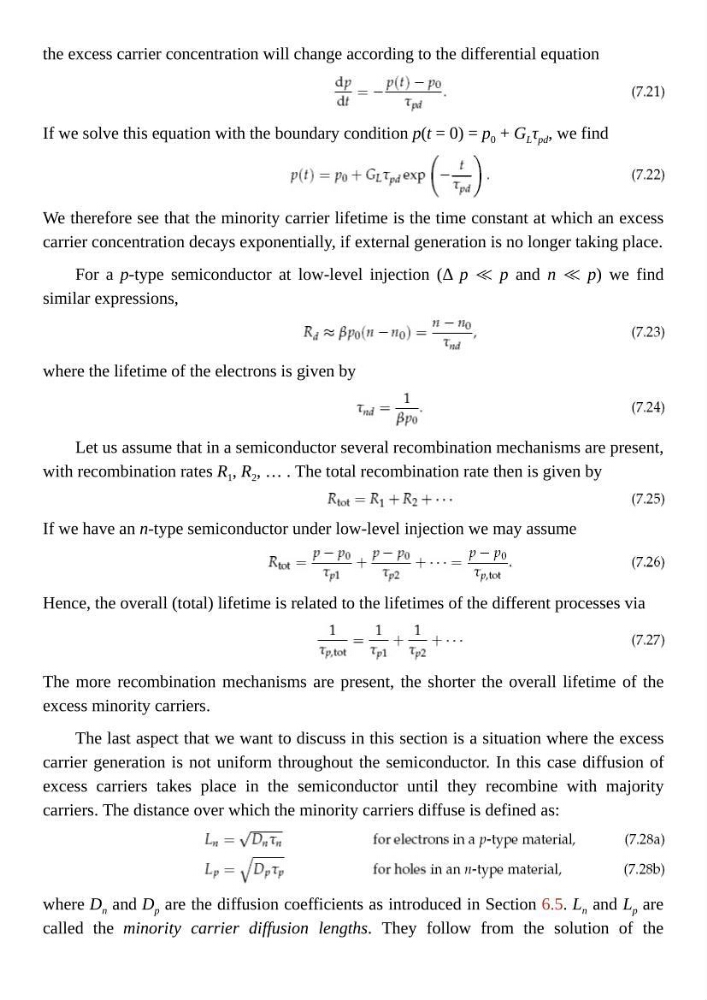
the excess carrier concentration will change according to the differential equation
If we solve this equation with the boundary condition p(t = 0) = p 0 + G L τ pd , we find
We therefore see that the minority carrier lifetime is the time constant at which an excess
carrier concentration decays exponentially, if external generation is no longer taking place.
For a p-type semiconductor at low-level injection (Δ p ≪ p and n ≪ p) we find
similar expressions,
where the lifetime of the electrons is given by
Let us assume that in a semiconductor several recombination mechanisms are present,
with recombination rates R 1 , R 2 , … . The total recombination rate then is given by
If we have an n-type semiconductor under low-level injection we may assume
Hence, the overall (total) lifetime is related to the lifetimes of the different processes via
The more recombination mechanisms are present, the shorter the overall lifetime of the
excess minority carriers.
The last aspect that we want to discuss in this section is a situation where the excess
carrier generation is not uniform throughout the semiconductor. In this case diffusion of
excess carriers takes place in the semiconductor until they recombine with majority
carriers. The distance over which the minority carriers diffuse is defined as:
where D n and D p are the diffusion coefficients as introduced in Section 6.5. L n and L p are
called the minority carrier diffusion lengths. They follow from the solution of the
If we solve this equation with the boundary condition p(t = 0) = p 0 + G L τ pd , we find
We therefore see that the minority carrier lifetime is the time constant at which an excess
carrier concentration decays exponentially, if external generation is no longer taking place.
For a p-type semiconductor at low-level injection (Δ p ≪ p and n ≪ p) we find
similar expressions,
where the lifetime of the electrons is given by
Let us assume that in a semiconductor several recombination mechanisms are present,
with recombination rates R 1 , R 2 , … . The total recombination rate then is given by
If we have an n-type semiconductor under low-level injection we may assume
Hence, the overall (total) lifetime is related to the lifetimes of the different processes via
The more recombination mechanisms are present, the shorter the overall lifetime of the
excess minority carriers.
The last aspect that we want to discuss in this section is a situation where the excess
carrier generation is not uniform throughout the semiconductor. In this case diffusion of
excess carriers takes place in the semiconductor until they recombine with majority
carriers. The distance over which the minority carriers diffuse is defined as:
where D n and D p are the diffusion coefficients as introduced in Section 6.5. L n and L p are
called the minority carrier diffusion lengths. They follow from the solution of the